If you were to look at my profile, you will see that one of my favorites books is the "Life of Reason" by George Santayana. You may not know who he is, and if you are interested, you can read about him here: http://en.wikipedia.org/wiki/George_Santayana. I'm confident you are familiar with the following aphorism: "Those who forget the lessons of history are doomed to repeat it"...bad paraphrase, but it's my "humming a few bars for you".
I stumbled up Santayana in a used book store in Lynchburg (The Little Givens Bookstore) which had a pretty extensive used book section. One of my favorite past times is going to used bookstores and wandering the stacks. I find that books jump out at you at times--a sign, of course, that you are ready for the topic, if you place any stock in "book karma".
When I picked up the book The Life of Reason, a frayed hardback, I could tell that it was a well-loved book. This particular book was a bit of a Reader's Digest version. As I opened the book and read the prose I was astounded about the incredible elegance of the use of language. It was like prose-poetry. Yet, I had never heard of this man. [Santayana was Spanish, and English was his second language. What I would give to have half the command of it as he. For those of you who didn't bother with with the Wikipedia link, he was a philosopher, taught at Harvard, and studied under William James).
So after purchasing the book and reading a bit and becoming even further struck by his extraordinarily deft and musical command of the written word, I asked a few people I knew if they were familiar with his work. I honestly couldn't understand why this man was not more well known. One of my book club members is one of the most erudite people I know. He's a theologian, clinical psychologist and business consultant. All bases covered there! I asked him about Santayana, and his face broke out into a grin. "How funny you should ask," he said. "I did my master's dissertation on him." As it turns out, Santayana was a student of Arthur Schopenhauer's works. Don gave me one of Santayana's works for Christmas--an exceedingly thoughtful gift that I will cherish.
You see, I'm one of those nerdy folks who has read AS's, "The World as Will and Representation". I also have (and have read) his "On the Fourfold Root of the Principle of Sufficient Reason." (I know this should be underlined, but there is no facile way to do this in this Blogger format). What's interesting about AS, is that he was one of the first Western philosopher's to study Eastern religion and incorporate it into his works. He was a curmudgeonly fellow, too. In fact, Ebeneezer Scrooge was likely patterned after AS! So it is indeed serendipitous that I also stumbled upon Santayana who was a disciple of sorts of AS's works. Also of interest, is that AS was such a ferocious note taker on the books that he read that the pencil would sometimes gouge the pages. (I have formed the habit of never reading unless I have pen and paper. I have a pen and paper fetish that I'll speak more about when I'm in a different mood.) Now understand, because I say that I have these incredible works and have read them, by no means suggests that I fully understand them. But I have this one wish that when I die, people will look at the books that I have and say...Wow! (Fluff over stuff, you know!)
But as I pick up GS's book to tell you about it, I'm reminded that it is time to revisit it. Great works by wondrous thinkers have deeper meanings than any of us can fully access on first reading. I remember reading John Adam's biography and his habit of reading Cicero's (?, oh pox on my bad memory) over and over. So tomorrow, I will settle in and read a chapter or two, and marvel again at such mastery over our language. And as I pick up GS, I'm reminded of Ernst Cassirer who wrote "Language and Myth", and who referenced GS's wonderful work "The Sense of Beauty".
And for those of you thinking what the heck does any of this have to do with investing...I leave you with E. O. Wilson. E. O. Wilson is an evolutionary socio-biologist. He wrote "Consilience" where is posits: "that the sciences, humanities, and arts have a common goal: to give a purpose to understanding the details, to lend to all inquirers "a conviction, far deeper than a mere working proposition, that the world is orderly and can be explained by a small number of natural laws." This is the essence of consilience." (From Wikipedia).
And as we think about how psychology, economics, base emotions (fear, greed), etc. politics, finance, mathematics, statistics, all conspire to move the world, then I think that affects investing! These are the great thinkers that introduced new concepts on integrating divergent disciplines into coherence.
And I'll leave you with my favorite GS quote and a suggestion.
Favorite Quote: "The definition of a zealot is when the efforts are redoubled when the aim is lost."
Suggestion: Pick up a book on something that you know little about but on which you'd like to learn more and read it.
Perhaps one of my NY's resolutions will be this. For the balance of my life, I will spend one year devoted to either one person's works or various works on particular subject and read all that I can. String theory, Italo Calvino, William Gass, chaos theory, flowers, training dogs,...whatever. Imagine the depth and richness that you will cultivate in your life.
Saturday, December 02, 2006


On Hope (Major Axiom III)
Major Axiom III: When the ship starts to sink, don't pray. Jump
Minor Axiom IV: Accept small losses cheerfully as a fact of life. Expect to experience several while awaiting a large gain.
------------------------------------------
Obstacles: fear of regret, unwillingness to abandon part of an investment, and difficulty in admitting a mistake.
-----------------------------------
L comment: Studies in Behavioral Finance focus on the emotional issues noted in Obstacles. This is one axiom with which I have not quibbles.
Minor Axiom IV: Accept small losses cheerfully as a fact of life. Expect to experience several while awaiting a large gain.
------------------------------------------
Obstacles: fear of regret, unwillingness to abandon part of an investment, and difficulty in admitting a mistake.
-----------------------------------
L comment: Studies in Behavioral Finance focus on the emotional issues noted in Obstacles. This is one axiom with which I have not quibbles.
On Greed (Zurich Axiom 2)
Major Axiom 2: Always take your profit too soon.
Minor Axiom III: Decide in advance what gain you want from a venture, and when you get it, get out.
Minor Axiom III: Decide in advance what gain you want from a venture, and when you get it, get out.
Friday, December 01, 2006
Diversification
I happen to think that diversification is important. I agree that over-diversification is dilutive. One strategy that I think makes terrific sense is where you own 2-3 leaders in 4-5 sectors (yeah, I know that gets you to 15 stocks or perhaps more!). As certain sectors outperform, you systematically move money into your lagging sectors (lagging sectors--not sick dog stocks that should be euthanized). As I was beginning my education (which I know will last a lifetime) on understanding investing, I naively thought that once I had mastered the understanding of cycles that all would be clear. Somehow I thought that the sector rotation signal would be like a Zen meditation bell ringing softly and clearly signaling it's time to switch. "Ting" --oh, it's time to move out of commodities and into financials. "Ting" oh it it's time to be in tech. "Ting" oh it's time to stuff everything in a mattress. Hah! Wrong again. The only "Ting" that I've come across is "Ting", Leisa you were a fool to think that it would clear at all. Okay, an initial fool in thinking it would be clear, but a wiser fool in understanding that the fuzziness is in the inflection points that that this sector rotational thing happens in fits and starts in that transition period.
My only certitude is that I do not know what is going to happen, and I'm confident that no one else does either. But like a wise Indian, I'll keep my ear to the ground, and I'll watch carefully for scatological evidence (no tasting though to determine if there are iron deficiencies in the beast that I'm tracking which is the market direction) and make the best decisions based on the empiricism before me. I think that reading quality publications and listening to respected voices (not pundits) and equipping yourself to discern probabilities will put you ahead. I don't wish to sound arrogant because I know (and admit) that I'm a complete dummy about much of this. Nevertheless, I did gain some singular confidence in questioning the moves in the bond market. I weighed the evidence, and while the bond market was betting on cuts as early as Spring of this year, I said that the other data did not support that based on my understanding. So the confidence that I'm talking about is individual investor confidence. And one gains confidence by stubbing his/her toe and scraping a knee or two.
My conclusion, then, is that if you maintain a presence in major sectors, appropriately weighted for your considered view on the economic cycle, then you will be exposed to the move when it happens, and you will shield your portfolio from undue sector risk, but you will expose yourself to the beneficial moves. If any wish to argue that making unduly weighted sector bets are smart rather than hazardous, I'd offer this years HMO and oil/oil service sector routs. One only has to see what happened to the HMO's in April when the buzz was that medical cost ratios would increase--an anathema for HMO's. The rout was swift and severe. Oh, it recovered, but these stocks (AET, WLP, CI, UNH) dropped 15 - 24%--in 2 days. You can keep your good stocks, just reduce your exposure when their sector is not shining.
George Dagnino (of Peter Dag) has great advice--"we move slowly". His model portfolio is comprised of leaders in each sector. As he sees sectors falling out of favor, he slowly reduces portfolio exposure--considered, measured moves. I believe that following this simple but powerful advice gives you appropriate diversification and ample stakes in your investment/econcomic thesis.
My only certitude is that I do not know what is going to happen, and I'm confident that no one else does either. But like a wise Indian, I'll keep my ear to the ground, and I'll watch carefully for scatological evidence (no tasting though to determine if there are iron deficiencies in the beast that I'm tracking which is the market direction) and make the best decisions based on the empiricism before me. I think that reading quality publications and listening to respected voices (not pundits) and equipping yourself to discern probabilities will put you ahead. I don't wish to sound arrogant because I know (and admit) that I'm a complete dummy about much of this. Nevertheless, I did gain some singular confidence in questioning the moves in the bond market. I weighed the evidence, and while the bond market was betting on cuts as early as Spring of this year, I said that the other data did not support that based on my understanding. So the confidence that I'm talking about is individual investor confidence. And one gains confidence by stubbing his/her toe and scraping a knee or two.
My conclusion, then, is that if you maintain a presence in major sectors, appropriately weighted for your considered view on the economic cycle, then you will be exposed to the move when it happens, and you will shield your portfolio from undue sector risk, but you will expose yourself to the beneficial moves. If any wish to argue that making unduly weighted sector bets are smart rather than hazardous, I'd offer this years HMO and oil/oil service sector routs. One only has to see what happened to the HMO's in April when the buzz was that medical cost ratios would increase--an anathema for HMO's. The rout was swift and severe. Oh, it recovered, but these stocks (AET, WLP, CI, UNH) dropped 15 - 24%--in 2 days. You can keep your good stocks, just reduce your exposure when their sector is not shining.
George Dagnino (of Peter Dag) has great advice--"we move slowly". His model portfolio is comprised of leaders in each sector. As he sees sectors falling out of favor, he slowly reduces portfolio exposure--considered, measured moves. I believe that following this simple but powerful advice gives you appropriate diversification and ample stakes in your investment/econcomic thesis.

Flat Lining Sales
 I found this on FRED. It will be interesting to watch the plateau in retail/food services sales and see how far it extends.
Note the activity pre-2001
Thursday, November 30, 2006
On Risk (Zurich Axiom 1)
Major Axiom 1: Worry is not a sickness but a sign of health. If you are not worried, you are not risking enough.
Minor Axiom 1: Always play for meaningful stakes.
Minor Axiom 2: Resist the allure of diversification (I see your stunned look)
Three flaws regarding diversification:
As we work through these axioms, we'll see that they will violate much of what you've learned. Understand that my posting these is not an endorsement (and I'm not qualified to endorse anything but a check made payable to me) but rather a chance to explore an interesting view of risk/reward.
Minor Axiom 1: Always play for meaningful stakes.
Minor Axiom 2: Resist the allure of diversification (I see your stunned look)
Three flaws regarding diversification:
- It forces you to violate the precept of Minor Axiom I - that you should always play for meaningful stakes.
- By diversifying, you create a situation in which gains and losses are likely to cancel each other out.
- By diversifying, you become a juggler trying to keep too many balls in the air at once.
As we work through these axioms, we'll see that they will violate much of what you've learned. Understand that my posting these is not an endorsement (and I'm not qualified to endorse anything but a check made payable to me) but rather a chance to explore an interesting view of risk/reward.
Zurich Axioms
Max Gunther wrote "The Zurich Axioms" (published by Harriman House copyright 2004). His book is in 12 chapters. I thought that I would put up his 12 axioms in 12 posts (maximum utility) and some may be moved to discuss.
To provide a road map, I'll give an overview of the Chapters.
To provide a road map, I'll give an overview of the Chapters.
- On Risk
- On Greed
- On Hope
- On Forecasts
- On Patterns
- On Mobility
- On Intuition
- On Religion and the Occult
- On Optimism and Pessimism
- On Consensus
- On Stubborness
- On Planning
Resilient expecations
Let's see, we had a 8.5% drop in durable goods orders (that is a pretty telling economic indicator), the dollar is stubbing its toe and oil is increasing--and the markets along with it.
Jeffrey Saut stated on Monday, something that I very much believe. That is, the opportunity for investors is where there is a gap between perception and reality in the market. To be sure, it is also a place of great danger, because you can be right, but your timing can be so off, that being "right" eventually only means having your money spirited away currently.
First off, I'm happy to say that my MIND is doing terrifically well, up 11.37%, and that ERF is continuing to perform well, up 8.39%. Both are tied to oil, and oil has been steadily going up. Now, you think that would be bad for the market. I also own some KRY, a gold miner, and that has gone up 30% since my purchase. These successes soften my worthless puts on the DOW and S&P that will expire in DEC.
John Murphy stated recently that commodities peak AFTER the stocks peak, prior to bad things happening. Commodities are definitely on the rise. But this rise is NOT tied to resurging economic activity. Has the market peaked? I wouldn't hazard a guess, but we clearly can see that the market has had renewed vitality and commodities are now better performers with energy gaining almost 2% yesterday. I'm also mindful that in a slowing economy commodities move downward.
Yesterday we had a stronger than expected GDP number, but that also came after another noted investment house (1) recast 4th quarter GDP as zero. How I have made sense of the market that makes no sense is this: Concrete information has outweighed "forecast" information. Concrete information comes in the form of backward looking "confirmed" glorious news: wonderful corporate earnings and confirmed 3rd quarter GDP growth. Plus, we also have great liquidity and lots of folks willing to throw themselves on the rails to board the train that got away while they were buying their put tickets!
As people are imperfect synthesizers of information, they will fall victim to their biases/emotions. You do, I do, we all do. Accordingly, if you have a positive OR negative outlook, your lens will filter for all of the things that support your view, and you'll dismiss ideas contrary to your view. The positive bias has great corporate earnings, some sliver of positive news on home sales increasing (never-you-mind it's at deep discounts), GDP being greater than expected. These are concrete things that stave off uncertain future information like expected decline in corporate earnings or slowing GDP.
I would contend, then, that for those with a positive bias on the market, there is a disequilibrium in the amount of weighting they have placed on positive news v. negative news. Perception does not equal reality. Until that balance changes and a tipping point reached where the positive news gets eroded by negative news, we'll continue to have liquidity and performance anxiety fuel the market's surge. But after year end, performance anxiety takes a break and 4th quarter earnings will become reality (remember lots of folks warned). The earnings and forecasts will be the most telling, and if the numbers are bad there is no performance anxiety propping them up. BUT, for folks like me looking for dour numbers, if the numbers are good, that's a different fuel altogether.
And for any that want to say that the market is a perfect discounter, I would argue that the bond market was wrong about interest rates most of the last 12 months. Ultimately the market gets it right--and market corrections are nothing if not a supreme act of contrition for wallowing in perception rather than walking in reality.
(1) Deutsche Bank has also lowered their forecast:
Jeffrey Saut stated on Monday, something that I very much believe. That is, the opportunity for investors is where there is a gap between perception and reality in the market. To be sure, it is also a place of great danger, because you can be right, but your timing can be so off, that being "right" eventually only means having your money spirited away currently.
First off, I'm happy to say that my MIND is doing terrifically well, up 11.37%, and that ERF is continuing to perform well, up 8.39%. Both are tied to oil, and oil has been steadily going up. Now, you think that would be bad for the market. I also own some KRY, a gold miner, and that has gone up 30% since my purchase. These successes soften my worthless puts on the DOW and S&P that will expire in DEC.
John Murphy stated recently that commodities peak AFTER the stocks peak, prior to bad things happening. Commodities are definitely on the rise. But this rise is NOT tied to resurging economic activity. Has the market peaked? I wouldn't hazard a guess, but we clearly can see that the market has had renewed vitality and commodities are now better performers with energy gaining almost 2% yesterday. I'm also mindful that in a slowing economy commodities move downward.
Yesterday we had a stronger than expected GDP number, but that also came after another noted investment house (1) recast 4th quarter GDP as zero. How I have made sense of the market that makes no sense is this: Concrete information has outweighed "forecast" information. Concrete information comes in the form of backward looking "confirmed" glorious news: wonderful corporate earnings and confirmed 3rd quarter GDP growth. Plus, we also have great liquidity and lots of folks willing to throw themselves on the rails to board the train that got away while they were buying their put tickets!
As people are imperfect synthesizers of information, they will fall victim to their biases/emotions. You do, I do, we all do. Accordingly, if you have a positive OR negative outlook, your lens will filter for all of the things that support your view, and you'll dismiss ideas contrary to your view. The positive bias has great corporate earnings, some sliver of positive news on home sales increasing (never-you-mind it's at deep discounts), GDP being greater than expected. These are concrete things that stave off uncertain future information like expected decline in corporate earnings or slowing GDP.
I would contend, then, that for those with a positive bias on the market, there is a disequilibrium in the amount of weighting they have placed on positive news v. negative news. Perception does not equal reality. Until that balance changes and a tipping point reached where the positive news gets eroded by negative news, we'll continue to have liquidity and performance anxiety fuel the market's surge. But after year end, performance anxiety takes a break and 4th quarter earnings will become reality (remember lots of folks warned). The earnings and forecasts will be the most telling, and if the numbers are bad there is no performance anxiety propping them up. BUT, for folks like me looking for dour numbers, if the numbers are good, that's a different fuel altogether.
And for any that want to say that the market is a perfect discounter, I would argue that the bond market was wrong about interest rates most of the last 12 months. Ultimately the market gets it right--and market corrections are nothing if not a supreme act of contrition for wallowing in perception rather than walking in reality.
(1) Deutsche Bank has also lowered their forecast:
In light of continued weakness in the economic data, we are cutting our fourth quarter real GDP growth forecast to zero from the +1.0% that we were originally predicting.
Sunday, November 26, 2006
Friday Trustee Sales

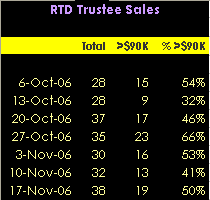
I wasn't expecting to see many of these. I was wrong. 9 were greater than $200K.
Friday, November 24, 2006
No One Knows
I'm a firm believer in fundamentals--in business, in personal life and in investing. Fundamentals are important because they are foundational; the structure on what everything else stands. When you have strong fundamentals and disciplines, you create a stronger, more accurate decision making environment. I will go to the earlier of my grave or the poorhouse believing that true investment fundamentals includes BOTH fundamental analysis and technical analysis.
While a facile command of fundamental and technical analysis is a laudable goal, that goal must exist within a very critical axiom. In fact every investor should recite as his/her daily investment mantra: "No one knows". I wish I had understood this simple, yet powerful, concept earlier on. It's not only applicable to investing but any topic you choose--including your health. As anyone who has faced difficult decisions regarding procedures/regimens knows, you're going to get divergent views. And when your health/life are on the line, those divergences are frightening. You only antidote to "no one knows" is knowledge and YOUR assessment of the risks involved in making decision x v. decision y.
In financial health decisions, one sees those divergences daily. On Friday, we had a whole new symptom to ponder: the falling dollar (You can read a professional's summary here. http://www.thestreet.com/_dm/markets/commodities/10324098.html.) Now I do not pretend to be qualified to explain to you all that it means; but I am qualified to tell you that you should have a rudimentary understanding of what that means. When asset classes have changing relative relationships with other asset classes, there's a bit of a yin yang dynamic unfolding that you should understand. What's bad for one is good for another (in terms of pricing). If the dollar is getting less valuable (relative to other currencies/asset classes) then something with intrinsic value, such as gold and oil, gains in value. Oil declines when the dollar is strong because it is priced in USD (less $'s to buy oil relative to other currencies.) and oil gains when the dollar declines (more $'s are needed because the dollars are valued less relative to other currencies).
So what does that really mean? For one, inflationary pressures will rise. Commodities will cost more for more USD's are required to buy a barrel of oil. There's another malefic result of a dollar going lower--higher interest rates. Why? Our bonds are USD denominated; therefore, if the dollar is going down relative to other currencies and asset classes, investors (and remember more than 50% of the holders of our bonds are foreigners) will require a greater return for those assets in the form of higher interest rates. Now just to mix it up and keep it interesting, you have some fundamental factors influencing oil: (1) OPEC's threatening to decrease supplies; and (2) increasing inventories.
But there's a beneficial result too....American made goods get cheaper and greater exports mean a reduced trade imbalance. Also, if you have ETF's understand the currency in which the share price is denominated. It will affect your returns. In general, Asian and European currency denominated ETF's will benefit from the dollar's falling. Those ETF's will gain in from the dollar's demise.
My point is not to give you any guidance but rather to coax you into developing an understanding of these dynamics and how they weave themselves into the tapestry of the investing climate. They are really important. I think that the best place to educate yourself on the business cycle and which asset classes do well or poorly is George Dagnino's site: https://peterdag.com/s_files/mLcn829S3eP2.pdf If you do nothing in your investment life do this.... Print out, read, and re-read that pdf. I would also urge you to look at his chart of the month. For fans of Bill Cara's site, you will see that George deploys stochastics to inform of the probabilities of moves in the market.
Remember, everyone has an opinion about what the stock market will do, where we are in the economic cycle, what the dollar, oil, gas, soy beans.....fill in the blank. There are several divergent opinions among great luminaries which means you need to tread carefully and understand YOUR risk environment. How? You must equip yourself to separate the wheat from the chafe. You can reduce your perplexions as a new investor through a basic command of economic cycles and of the asset classes that do better or worse at each stage of the cycle. When you do your head scratching, reach for the investor prayer beads and recite your mantra: "no one knows." No meaningful turn in the market or the economy is ever clear until you look in the rear view mirror. Until then, it's just blind mice trying to make sense of the elephant. Nevertheless, you'll be armed with knowledge to make informed decisions that are right for you.
While a facile command of fundamental and technical analysis is a laudable goal, that goal must exist within a very critical axiom. In fact every investor should recite as his/her daily investment mantra: "No one knows". I wish I had understood this simple, yet powerful, concept earlier on. It's not only applicable to investing but any topic you choose--including your health. As anyone who has faced difficult decisions regarding procedures/regimens knows, you're going to get divergent views. And when your health/life are on the line, those divergences are frightening. You only antidote to "no one knows" is knowledge and YOUR assessment of the risks involved in making decision x v. decision y.
In financial health decisions, one sees those divergences daily. On Friday, we had a whole new symptom to ponder: the falling dollar (You can read a professional's summary here. http://www.thestreet.com/_dm/markets/commodities/10324098.html.) Now I do not pretend to be qualified to explain to you all that it means; but I am qualified to tell you that you should have a rudimentary understanding of what that means. When asset classes have changing relative relationships with other asset classes, there's a bit of a yin yang dynamic unfolding that you should understand. What's bad for one is good for another (in terms of pricing). If the dollar is getting less valuable (relative to other currencies/asset classes) then something with intrinsic value, such as gold and oil, gains in value. Oil declines when the dollar is strong because it is priced in USD (less $'s to buy oil relative to other currencies.) and oil gains when the dollar declines (more $'s are needed because the dollars are valued less relative to other currencies).
So what does that really mean? For one, inflationary pressures will rise. Commodities will cost more for more USD's are required to buy a barrel of oil. There's another malefic result of a dollar going lower--higher interest rates. Why? Our bonds are USD denominated; therefore, if the dollar is going down relative to other currencies and asset classes, investors (and remember more than 50% of the holders of our bonds are foreigners) will require a greater return for those assets in the form of higher interest rates. Now just to mix it up and keep it interesting, you have some fundamental factors influencing oil: (1) OPEC's threatening to decrease supplies; and (2) increasing inventories.
But there's a beneficial result too....American made goods get cheaper and greater exports mean a reduced trade imbalance. Also, if you have ETF's understand the currency in which the share price is denominated. It will affect your returns. In general, Asian and European currency denominated ETF's will benefit from the dollar's falling. Those ETF's will gain in from the dollar's demise.
My point is not to give you any guidance but rather to coax you into developing an understanding of these dynamics and how they weave themselves into the tapestry of the investing climate. They are really important. I think that the best place to educate yourself on the business cycle and which asset classes do well or poorly is George Dagnino's site: https://peterdag.com/s_files/mLcn829S3eP2.pdf If you do nothing in your investment life do this.... Print out, read, and re-read that pdf. I would also urge you to look at his chart of the month. For fans of Bill Cara's site, you will see that George deploys stochastics to inform of the probabilities of moves in the market.
Remember, everyone has an opinion about what the stock market will do, where we are in the economic cycle, what the dollar, oil, gas, soy beans.....fill in the blank. There are several divergent opinions among great luminaries which means you need to tread carefully and understand YOUR risk environment. How? You must equip yourself to separate the wheat from the chafe. You can reduce your perplexions as a new investor through a basic command of economic cycles and of the asset classes that do better or worse at each stage of the cycle. When you do your head scratching, reach for the investor prayer beads and recite your mantra: "no one knows." No meaningful turn in the market or the economy is ever clear until you look in the rear view mirror. Until then, it's just blind mice trying to make sense of the elephant. Nevertheless, you'll be armed with knowledge to make informed decisions that are right for you.
Tuesday, November 21, 2006
Covering $hit with Snow--A tribute to my Armenian Grandmother.
My Armenian grandmother came to this country in 1920. She didn't know her real birthday. In spite of that, she claimed Jan 1, 1900 has her date of birth. Such a date! The first date of a new century! As I look at this market with my stupid, amateur gaze, I'm filled with incredulity. I'm reminded of phrase that my immigrant remembers-the-Armenian holocaust-but-we-thought-her-crazy grandmother uttered from time to time: "You cannot cover shit with snow". It's a wonderful aphorism is it not? Appropriate to this market.
So I write this blog post in honor of my simple, uneducated grandmother and the power of words and wisdom that do not require an education in our Western civilization sense, but rather that which is acquired from living life in the raw and on the edge. My grandmother--Alice was her name-- was sold to the Armenian church at the age of 12 (mother died in in child birth, stepmother wanted no part or husband's progeny) and placed, as a slave girl, with a Turkish couple in Constantinople until she reached majority age. Despite her simple roots, she harbored great wisdom garnered from years of living in the raw and on the edge of physical, emotional and monetary survival.
Many of us are so enamored with the educational and cultural trappings of ourselves and our class, that we forget the simple wisdoms of authentic people who struggle with the everyday of task of surviving. As Thanksgiving approaches, let us remember those simple wisdoms from authentic people and contemplate what small kindness we can extend to soften the edges in their lives.
So I write this blog post in honor of my simple, uneducated grandmother and the power of words and wisdom that do not require an education in our Western civilization sense, but rather that which is acquired from living life in the raw and on the edge. My grandmother--Alice was her name-- was sold to the Armenian church at the age of 12 (mother died in in child birth, stepmother wanted no part or husband's progeny) and placed, as a slave girl, with a Turkish couple in Constantinople until she reached majority age. Despite her simple roots, she harbored great wisdom garnered from years of living in the raw and on the edge of physical, emotional and monetary survival.
Many of us are so enamored with the educational and cultural trappings of ourselves and our class, that we forget the simple wisdoms of authentic people who struggle with the everyday of task of surviving. As Thanksgiving approaches, let us remember those simple wisdoms from authentic people and contemplate what small kindness we can extend to soften the edges in their lives.
Sunday, November 19, 2006
A favorite poem
I've spent most of my day in my office at home cleaning, filing, trashing. I moved my attention to the corkboard and found one of my favorite poems. This was in Aug 9 & 16, 2004 of the New Yorker.
The Kindness of the Blind
A poet is reading to the blind.
He did not suspect it was so hard.
His voice is breaking.
His hands are shaking.
He feels that here each sentence
is put to the test of the dark.
It will have to fend for itself,
without the lights or colors.
A perilous adventure
for the stars in his poems,
for the dawn, the rainbow, the clouds, neon lights, the moon,
for the fish until now silver under water,
and the hawk so silently high in the sky.
He is reading--for it is too late to stop--
of a boy in a jacket yellow in the green meadow,
of red rooftops easy to spot in the valley,
the restless numbers on the players' shirts,
and a nude stranger in the door cracked open.
He would like to passover--though it's not an option--
all those saints on the cathedral's ceiling,
that farewell wave from the train window,
the microscope lens, ray of light in the gem,
video screens, and mirrors, and the album with faces.
Yet great is the kindness of the blind,
great their compassion and generosity.
They listen, smile, and clap.
One of them even approaches
with a book held topsy-turvy
to ask for an invisible autograph.
-----Wislawa Szymborska
(translated, from the Polish, by Justyna Koskowska)
The Kindness of the Blind
A poet is reading to the blind.
He did not suspect it was so hard.
His voice is breaking.
His hands are shaking.
He feels that here each sentence
is put to the test of the dark.
It will have to fend for itself,
without the lights or colors.
A perilous adventure
for the stars in his poems,
for the dawn, the rainbow, the clouds, neon lights, the moon,
for the fish until now silver under water,
and the hawk so silently high in the sky.
He is reading--for it is too late to stop--
of a boy in a jacket yellow in the green meadow,
of red rooftops easy to spot in the valley,
the restless numbers on the players' shirts,
and a nude stranger in the door cracked open.
He would like to passover--though it's not an option--
all those saints on the cathedral's ceiling,
that farewell wave from the train window,
the microscope lens, ray of light in the gem,
video screens, and mirrors, and the album with faces.
Yet great is the kindness of the blind,
great their compassion and generosity.
They listen, smile, and clap.
One of them even approaches
with a book held topsy-turvy
to ask for an invisible autograph.
-----Wislawa Szymborska
(translated, from the Polish, by Justyna Koskowska)
Gary K's 11/17/06 Recommendations
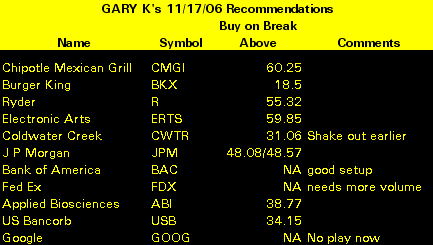 Have you visited Gary K? Gary K has one of the most informative, practicable shows. The link is the side panel.
His shown is downloadable. So you can listen at your convenience, and more importantly, you can skip through the Folicare ads.
Here are some of the stocks that Gary K mentioned in his Friday show.
I may do this from time to time. I offer this from the position of an information distiller.
Friday, November 17, 2006
Eulogy
It is with great sadness that I commit to eternal rest my BAC and AIG put that expired %^#$#!^ worthless today.
My thesis was that Fed rates would hold or even go up and that market would go down. Investment income would be hurt at AIG, but how was I to know that the hurricance season would be well a bust. Both BAC and AIG were experiencing rollover at the time of my purchase, but they did not roll. %#@#!%#% it.
Humorous Lesson: I should have gone out and bought some obscenely expensive wine and taken a bath in it and I would have had the same utility.
Real lesson: Never, ever, ever, buy a put or call option for an amount of money whose worthless expiration amount would make you cry. I didn't with either of these. If you are buying puts or calls, make sure that you understand your risks. I took a measured risk on both of these. I'm not crying. But the ouch factor is real.
My thesis was that Fed rates would hold or even go up and that market would go down. Investment income would be hurt at AIG, but how was I to know that the hurricance season would be well a bust. Both BAC and AIG were experiencing rollover at the time of my purchase, but they did not roll. %#@#!%#% it.
Humorous Lesson: I should have gone out and bought some obscenely expensive wine and taken a bath in it and I would have had the same utility.
Real lesson: Never, ever, ever, buy a put or call option for an amount of money whose worthless expiration amount would make you cry. I didn't with either of these. If you are buying puts or calls, make sure that you understand your risks. I took a measured risk on both of these. I'm not crying. But the ouch factor is real.
Thursday, November 16, 2006
Rememberances
Nona's post on my home brought a funny memory I wanted to share.
I have two cool things in my home. Now, I write this telling you that I have a modest home--if any of this comes off as arrogance in anyway, it is unintentional. As Mark and I were eating dinner this evening, we talked about the gratitude that we have for everything that we have. Our modest needs are easily fulfilled. But I will tell you, that if we ran with a different crowd, I would feel that we were wanting for something. I'm glad that my social aspirations are modest. Okay...now onto the cool things....
Cool thing #1. I have this baroque mantel made of solid walnut. I found it at an antique dealer and it was covered with antique white, leaded paint. In a word...gaudy. I paid $350 for it in 1985--lots of money for me.
I brought it home--like a cat bringing its master a treat. Rather than gratitude, I suffered scorn..two-fold scorn. One of my former Peat Marwick colleague's husband, Doug, (a banker but former summer plumber's helper helping Mark with the rough-in) AND my husband laughed at me when I brought it home. My husband mocked, "You paid HOW much for THAT?" I can still hear Doug and Mark's cackling. Now you have to understand that nothing is more unpleasant for me than "paying too much" for something. I'm not sure where that gene came from, but it's the honest truth, and it embarrasses me profoundly and has caused many a sleepless night.
Anyway....the next day, my husband is bitchin'(excuse the profanity) to Buck, the cabinet man. You have to know Buck. He is a master craftsman, but a very quiet, deliberate man. In addition to making lovely cabinetry, he restores antique automobiles...pristinely.
Buck listens to Mark's lament of having a wife bringing home such crap at high prices. After the tirade, Buck quietly says to Mark..."Do you want to double your money now?" That statement stops Mark (and gives me a priceless "I told you so moment" that wives must always have in their quiver!)dead. Buck then benevolently offers to take the mantle in his service van to this place risque-ly called "The City Stripper" to have it vat stripped. It cost $100 to have this done. Yes, that is alot of money While there, they receive many offers to buy the mantle for about 6x what I paid for it. Vindication. We built our downstairs fireplace to accomodate this mantel. I also have a fireplace in our bedroom. A very plain, beautiful solid cherry mantel adorns that. We've never used it, but at the time, we felt like a fireplace in a master bedroom would be a good resale value.
When I received the mantle back it required much TLC. Stripping any type of wood raises the grain. Much sanding was needed. It has rope moulding, dental molding, hand carved flowers and carved posts. I did it all and put several tung oil applications in between each sanding. It's beautiful. Likely larcenous as well, as the owner of the place that I bought if from spent some time in jail for stealing things out of older homes. The City Stripper guessed its age as mid 1800's. With its age and all that tung oil, it will likely have spontaneous combustion and burn my home down.
Second neat thing. I have this bronze light fixture from the University of Richmond. Some bright soul sold these "surplus" fixtures for $25 each. They are about 4 feet from stem to stern with white semi-opaque glass. We (Tim/Mark) framed our stairway to handle it. It's monstrously beautiful. After they realized what they had done, they offered some terrific tax credit--I think it was a $3K tax credit. The fixtures cost them $7800 to replace. I think I got a good deal, don't you? The beauty of being poor as we were at the time is that the tax credit did not really mean too much! I now have an SIL who works at University of Richmond. Strange karma indeed.
I have two cool things in my home. Now, I write this telling you that I have a modest home--if any of this comes off as arrogance in anyway, it is unintentional. As Mark and I were eating dinner this evening, we talked about the gratitude that we have for everything that we have. Our modest needs are easily fulfilled. But I will tell you, that if we ran with a different crowd, I would feel that we were wanting for something. I'm glad that my social aspirations are modest. Okay...now onto the cool things....
Cool thing #1. I have this baroque mantel made of solid walnut. I found it at an antique dealer and it was covered with antique white, leaded paint. In a word...gaudy. I paid $350 for it in 1985--lots of money for me.
I brought it home--like a cat bringing its master a treat. Rather than gratitude, I suffered scorn..two-fold scorn. One of my former Peat Marwick colleague's husband, Doug, (a banker but former summer plumber's helper helping Mark with the rough-in) AND my husband laughed at me when I brought it home. My husband mocked, "You paid HOW much for THAT?" I can still hear Doug and Mark's cackling. Now you have to understand that nothing is more unpleasant for me than "paying too much" for something. I'm not sure where that gene came from, but it's the honest truth, and it embarrasses me profoundly and has caused many a sleepless night.
Anyway....the next day, my husband is bitchin'(excuse the profanity) to Buck, the cabinet man. You have to know Buck. He is a master craftsman, but a very quiet, deliberate man. In addition to making lovely cabinetry, he restores antique automobiles...pristinely.
Buck listens to Mark's lament of having a wife bringing home such crap at high prices. After the tirade, Buck quietly says to Mark..."Do you want to double your money now?" That statement stops Mark (and gives me a priceless "I told you so moment" that wives must always have in their quiver!)dead. Buck then benevolently offers to take the mantle in his service van to this place risque-ly called "The City Stripper" to have it vat stripped. It cost $100 to have this done. Yes, that is alot of money While there, they receive many offers to buy the mantle for about 6x what I paid for it. Vindication. We built our downstairs fireplace to accomodate this mantel. I also have a fireplace in our bedroom. A very plain, beautiful solid cherry mantel adorns that. We've never used it, but at the time, we felt like a fireplace in a master bedroom would be a good resale value.
When I received the mantle back it required much TLC. Stripping any type of wood raises the grain. Much sanding was needed. It has rope moulding, dental molding, hand carved flowers and carved posts. I did it all and put several tung oil applications in between each sanding. It's beautiful. Likely larcenous as well, as the owner of the place that I bought if from spent some time in jail for stealing things out of older homes. The City Stripper guessed its age as mid 1800's. With its age and all that tung oil, it will likely have spontaneous combustion and burn my home down.
Second neat thing. I have this bronze light fixture from the University of Richmond. Some bright soul sold these "surplus" fixtures for $25 each. They are about 4 feet from stem to stern with white semi-opaque glass. We (Tim/Mark) framed our stairway to handle it. It's monstrously beautiful. After they realized what they had done, they offered some terrific tax credit--I think it was a $3K tax credit. The fixtures cost them $7800 to replace. I think I got a good deal, don't you? The beauty of being poor as we were at the time is that the tax credit did not really mean too much! I now have an SIL who works at University of Richmond. Strange karma indeed.
Wednesday, November 15, 2006
Canadian Energy Trusts
Cramer mentioned the Canadian Energy Trusts this p.m. His logic was similar to mine. ERF, the trust that I bought in my retirement account @ an average cost of $42.45 (I flipped some in my taxable account), was up immediately to $43, and it closed at $41.17. So I'm certain I'll be in the black again, but I must admit that I cringed when it was trading at $38. I had enough exposure in my portfolio that I did not buy more at this price. So, we'll see how this works out.
MIND had a nice increase today, closing up 4.4%. It's close to a small breakout. I have a very small position of 500 shares. I may add more if there's a decent breakout.
IVGN is still green but barely.
--------------------------------------
11.16.06 Update...certitude and the market are not compatible bedfellows. I think that if oil had not gone down $2 my comments would have stuck. But I'm egalitarian, and I would rather have cheaper oil than money to stave off starvation cum retirement.
MIND had a nice increase today, closing up 4.4%. It's close to a small breakout. I have a very small position of 500 shares. I may add more if there's a decent breakout.
IVGN is still green but barely.
--------------------------------------
11.16.06 Update...certitude and the market are not compatible bedfellows. I think that if oil had not gone down $2 my comments would have stuck. But I'm egalitarian, and I would rather have cheaper oil than money to stave off starvation cum retirement.
Tuesday, November 14, 2006
Alternate Universes
Hmmm....I've had a couple of folks note that formatting appeared strange. When I view the blog I do not see these problems; however on the forwarded page that one of my blogger-friends sent over there is odd HTML stuff. I'm not sure how to handle, but I appreciate your patience and apologize for the odd look.
Sunday, November 12, 2006
On Recessions and Bear Markets...a Marty Zweig Perspective
In the early 90’s I was a Consulting CFO for an institution. As such, I served as staff for the Investment Committee of the Board.We were interviewing a number of firms, Martin Zweig’s fund being one of them.I didn’t meet Marty Zweig, but I remember that the presenters did a bang up job presenting.I believe that we must have chosen his firm, as I received an autographed (07/21/92) “Leisa-I appreciate your confidence, Marty” of his book "Winning on Wall Street (WOWS)". I did not read the book until this past year or so. There is some shame in that admission.But the point of this post is not to brag about the autograph (it is my only brush with investment celebrity, though Barron’s did print the one and only Letter to the Editor that I wrote to them. Yes, I do live an uneventful life which is why these little snippets have outsized proportions in my delicate psyche.) In WOWS, Zweig lays out 3 conditions for a bear market.
Two Perplexions come to play in my wanting to write about Zweig’s conditions. First perplexion is that people cannot agree as to whether or not we are in a bull or bear market; and second, people cannot agree as to whether or not we are/will be in a recession. I conclude, therefore, that much of this confusion is due to the perpetual need to read the economic tea leaves or lick one’s index finger and hold it up to find out if the ill winds are blowing us toward something malefic. It’s Ed Young’s Seven Blind Mice but we have to winnow out all of the confusion among the 100 (or so) blind mice that serve as market pundits.
I like Zweig's objective parameters. It provides some empiricism for us to evaluate the opinions of other market opinion makers. Zweig writes:
Zweig defines a bear market as follows: “a decline of at least 15% in each of the three important stock averages:the Dow Jones Industrials, the S&P 500 Index and the Zweig Unweighted Price Index (or the Value Line Indes, if you prefer).” I suppose that one could throw in the NASDQ to replace the ZUPI/VL index. I’m not sure if anyone has addressed this. Based on his definition, as there was not at least a 15% decline in all three indices in June/July, I’m not sure that we had a bear market within this description. See table below of May highs/June-July lows for DJI, NASD and S&P.None of the main averages achieved a decline of this magnitude.
Extreme deflation characterized by a PPI index drop of 10% on a 6 month average of annualized m-t-m changes.Take current year m-t-m inc/dec and average it with the last 5 months (sum the mtm change each month for the last six months and divide by 6).If that 6 month average is at least –10% then you have cleared this test; (I've not calculated this. I don't think we are there. I think that with the ISM falling, we will BEGIN to see where that calculation becomes meaningful).
Ultra high price/earnings ratios.He labels 10-14 aS normal P/E range. Upper teens and twenties is what he calls high; and (we are in this level now).
Inverted yield curve.Zweig used the Moody’s Aaa Corporate Bonds yield as the long term rate and 6 month commercial paper rates as the short term rate. (I've not calculated this). Addendum 11.13.06--Of course we all know that we have an inverted yield curve, and SFO did a wonderful story on that which you can find here. http://www.sfomag.com/articledetail.asp?ID=1946685477&MonthNameID=July&YearID=2 I've just not calculated it using MZ's method. So, some food for thought as we think about recessions and market corrections.
Two Perplexions come to play in my wanting to write about Zweig’s conditions. First perplexion is that people cannot agree as to whether or not we are in a bull or bear market; and second, people cannot agree as to whether or not we are/will be in a recession. I conclude, therefore, that much of this confusion is due to the perpetual need to read the economic tea leaves or lick one’s index finger and hold it up to find out if the ill winds are blowing us toward something malefic. It’s Ed Young’s Seven Blind Mice but we have to winnow out all of the confusion among the 100 (or so) blind mice that serve as market pundits.
I like Zweig's objective parameters. It provides some empiricism for us to evaluate the opinions of other market opinion makers. Zweig writes:
”The big money is made or lost in stocks during the most violent bull and bear markets. The bad news for those who crave action is that the market does not behave dynamically all that often. Even within the great bull market advances, there are periods of lull. I would estimate that stocks spend only about 20% of the time in the most active phases of the bull trend and only about 10% in the severe downward periods of major bear markets.Roughly 70% of the time stocks either meander in a neutral trading range or undergo minor rallies or declines within their various bull and bear cycles.During that 70% span—let’s call it the neutral area—your overall market strategy does not matter all that much…."
Zweig defines a bear market as follows: “a decline of at least 15% in each of the three important stock averages:the Dow Jones Industrials, the S&P 500 Index and the Zweig Unweighted Price Index (or the Value Line Indes, if you prefer).” I suppose that one could throw in the NASDQ to replace the ZUPI/VL index. I’m not sure if anyone has addressed this. Based on his definition, as there was not at least a 15% decline in all three indices in June/July, I’m not sure that we had a bear market within this description. See table below of May highs/June-July lows for DJI, NASD and S&P.None of the main averages achieved a decline of this magnitude.
Extreme deflation characterized by a PPI index drop of 10% on a 6 month average of annualized m-t-m changes.Take current year m-t-m inc/dec and average it with the last 5 months (sum the mtm change each month for the last six months and divide by 6).If that 6 month average is at least –10% then you have cleared this test; (I've not calculated this. I don't think we are there. I think that with the ISM falling, we will BEGIN to see where that calculation becomes meaningful).
Ultra high price/earnings ratios.He labels 10-14 aS normal P/E range. Upper teens and twenties is what he calls high; and (we are in this level now).
Inverted yield curve.Zweig used the Moody’s Aaa Corporate Bonds yield as the long term rate and 6 month commercial paper rates as the short term rate. (I've not calculated this). Addendum 11.13.06--Of course we all know that we have an inverted yield curve, and SFO did a wonderful story on that which you can find here. http://www.sfomag.com/articledetail.asp?ID=1946685477&MonthNameID=July&YearID=2 I've just not calculated it using MZ's method. So, some food for thought as we think about recessions and market corrections.
Saturday, November 11, 2006

A Brilliant Fall Day
Today is one of those truly glorious days. Clear and 79 degrees...no matter that it is November. Virginia has the most beautiful shoulder months. After my Medicare post, I decided that I should re-engage with some healthful habits. I took my dogs out for a walk. I later came back and snapped a couple of pictures. The odd angle on the leaf is because the wind was blowing it.
We live on 6.5 beautiful wooded acres. We bought this land back in 1984. I was 24 years old, my husband 29. We were so very poor, as I was just out of college in 05/82, and my husband had been out of work for a while due to the recession (commercial electrician). But we managed to buy this piece of land because there was owner financing--something that I'm eternally grateful for.
We literally designed and built our own home. Because the land was so perfect, we were faced with the dilemma of building a home that we could afford with sufficient quality that we would not say in 20 years, we were still living in a "starter home". The financial aspect was daunting; and the physical aspect was almost impossible at times. My husband and a 65 year old carpenter/mason built the house. Tim is dead now, but he was a master craftsman. Tim and Mark hand cut all of the rafters, framed the structure without the benefit of pneumatic equipment, and mixed mortar and laid brick. My husband nailed every plank of red oak flooring...we put it everywhere except the kitchen and bathrooms. I still remember one sweltering August evening where the air was so thick with humidity we were drenched. I laid out each piece so that my husband could nail it. I wiped up every drop of sweat that cascaded off his nose onto the boards. We truly had sweat equity. I painted everything--every piece of trim, every wall, stained the cedar on the back of the house and trimmed the exterior doors and windows. I do not paint anymore. I did a lifetime of painting then.
We did most things right. We did a few things wrong. Our drywall contractor was a hack. Our cabinet man pointed that out. We didn't know. Buck said that the finish coat would not be acceptable because they had not put enough mud behind the tape. We had to hire another drywall contractor. Before he could start, Mark's job was to take a garden sprayer and spray every !#@%^#@ seam and pull the tape off. It took him two days, and by the end of the second day, he could barely move his arms his shoulders were so sore.
It took us nine months. We planned meticulously. We had to make our own decisions on very damn thing. No one offered us 3 choices of this or that. We had the universe of possibilities that we had to winnow down to meet our budget and our mutual tastes. I remember laying awake at night with my heart pounding (I didn't realize at the time that these were anxiety attacks) thinking about the credit card debt that was amassing (I used that in between draws) and the $400 per month Amoco bill that I was having trouble meeting. My husband wasn't working, and I was making $20K per year. And we decided early on that we would manage our budget to a payment that I could make solely on my salary, given that commercial electrical work had suffered so badly during that time. Our mortgage principal was $65K, and we secured a 20 year mortgage. We conservatively figured that we had saved about $50K doing much of the work ourselves.
Today we live in a home that we probably could not afford to buy currently. So when we have a beautiful day such as today, that is clear and crisp, I'm frequently reminded of those sweltering August days where sweat and expletives flowed freely. And I'm reminded how important planning, courage, confidence and a measure hope are to building your life. Of even greater importance is finding people who will support your work. So many helped us along the way--the engineering/contracting firm that our banker made us hire to ensure that if Mark and I floundered someone would step in and finish the house. Tim and Buck who gave us quality craftsmanship. My banker who made the draw process flexible and stopped by from time to time to check on us. Our parents who worried over our over committed physical and financial resources.
As I build my financial house, I'm reminded of the process of building my physical home. I'm certainly wiser now than I was then, but in many ways I'm like that 24 year old--I'm going to charge ahead. I'm going to plan meticulously, be realistic in my expectations and work hard. I have lots of support, and I've found lots of resources. Perhaps 20 odd years from now, I'll be writing of this financial house building launch as I am writing now of my house building launch.
We live on 6.5 beautiful wooded acres. We bought this land back in 1984. I was 24 years old, my husband 29. We were so very poor, as I was just out of college in 05/82, and my husband had been out of work for a while due to the recession (commercial electrician). But we managed to buy this piece of land because there was owner financing--something that I'm eternally grateful for.
We literally designed and built our own home. Because the land was so perfect, we were faced with the dilemma of building a home that we could afford with sufficient quality that we would not say in 20 years, we were still living in a "starter home". The financial aspect was daunting; and the physical aspect was almost impossible at times. My husband and a 65 year old carpenter/mason built the house. Tim is dead now, but he was a master craftsman. Tim and Mark hand cut all of the rafters, framed the structure without the benefit of pneumatic equipment, and mixed mortar and laid brick. My husband nailed every plank of red oak flooring...we put it everywhere except the kitchen and bathrooms. I still remember one sweltering August evening where the air was so thick with humidity we were drenched. I laid out each piece so that my husband could nail it. I wiped up every drop of sweat that cascaded off his nose onto the boards. We truly had sweat equity. I painted everything--every piece of trim, every wall, stained the cedar on the back of the house and trimmed the exterior doors and windows. I do not paint anymore. I did a lifetime of painting then.
We did most things right. We did a few things wrong. Our drywall contractor was a hack. Our cabinet man pointed that out. We didn't know. Buck said that the finish coat would not be acceptable because they had not put enough mud behind the tape. We had to hire another drywall contractor. Before he could start, Mark's job was to take a garden sprayer and spray every !#@%^#@ seam and pull the tape off. It took him two days, and by the end of the second day, he could barely move his arms his shoulders were so sore.
It took us nine months. We planned meticulously. We had to make our own decisions on very damn thing. No one offered us 3 choices of this or that. We had the universe of possibilities that we had to winnow down to meet our budget and our mutual tastes. I remember laying awake at night with my heart pounding (I didn't realize at the time that these were anxiety attacks) thinking about the credit card debt that was amassing (I used that in between draws) and the $400 per month Amoco bill that I was having trouble meeting. My husband wasn't working, and I was making $20K per year. And we decided early on that we would manage our budget to a payment that I could make solely on my salary, given that commercial electrical work had suffered so badly during that time. Our mortgage principal was $65K, and we secured a 20 year mortgage. We conservatively figured that we had saved about $50K doing much of the work ourselves.
Today we live in a home that we probably could not afford to buy currently. So when we have a beautiful day such as today, that is clear and crisp, I'm frequently reminded of those sweltering August days where sweat and expletives flowed freely. And I'm reminded how important planning, courage, confidence and a measure hope are to building your life. Of even greater importance is finding people who will support your work. So many helped us along the way--the engineering/contracting firm that our banker made us hire to ensure that if Mark and I floundered someone would step in and finish the house. Tim and Buck who gave us quality craftsmanship. My banker who made the draw process flexible and stopped by from time to time to check on us. Our parents who worried over our over committed physical and financial resources.
As I build my financial house, I'm reminded of the process of building my physical home. I'm certainly wiser now than I was then, but in many ways I'm like that 24 year old--I'm going to charge ahead. I'm going to plan meticulously, be realistic in my expectations and work hard. I have lots of support, and I've found lots of resources. Perhaps 20 odd years from now, I'll be writing of this financial house building launch as I am writing now of my house building launch.



Friday, November 10, 2006
Wednesday, November 08, 2006
Election
Our Virginia senate race as stilled not been called. It looks like Webb is ahead by the narrowest of margins. Certainly there will be a recount.
I voted around 2 p.m. yesterday. I had to wait 5 minutes--unusual, and certainly less time than than the folks in Denver had to wait. Anyway, the election official said that it was 2x the turnout as last election.
I voted around 2 p.m. yesterday. I had to wait 5 minutes--unusual, and certainly less time than than the folks in Denver had to wait. Anyway, the election official said that it was 2x the turnout as last election.
Tuesday, November 07, 2006
Trustee Sales Update

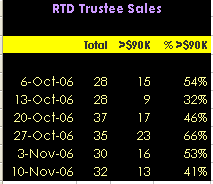
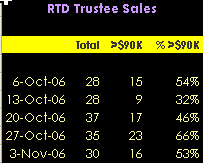
These listings were too compelling to ignore. The number of sales in the > than $300K range is noteworthy. Friends, these numbers are growing. NEVER have I seen this many large balances in one listing. NEVER. I'm not sure if I'm not sure if they will show up on Friday. I think that I'll start providing something like this in the future. In fact, I think that I'll send my other table to the editor of my paper and see if they post it in the letters to the editor. I'll see if I can find archival listings for same periods last year.
Today's Perplexion
The market has continued to astound. Tim Knight, perma bear extraordinaire, has almost capitulated, read his blog, Electile Dysfunction (http://tradertim.blogspot.com/). Rev Shark (Real Money, subscription required) calls the market "frothy. "
In my amateur view, there is a dissonance in the market that has to be resolved. That dissonance is the actual state of the US Economy and the global economy v. the perceived state of those economies. Part of the US economic dissonance (all call that ED) is the error rate in the jobs data. With the BLS making such an enormous error in the past--finding 800+K new jobs--it's hard to take the current information at its face value.
While I find conspiracy theories titillating (I'm an accountant, we get so few opportunities to be titillated), I don't necessarily subscribe to them. But one has to wonder IF the Fed were aware of the "real" employment numbers, would our rate hikes have been accelerated a bit. My answer to that hypothetical question would be yes.
When one is trying to find his/her way through the enormity of conflicting information, getting to basics helps (which includes throwing a few things out).


In my amateur view, there is a dissonance in the market that has to be resolved. That dissonance is the actual state of the US Economy and the global economy v. the perceived state of those economies. Part of the US economic dissonance (all call that ED) is the error rate in the jobs data. With the BLS making such an enormous error in the past--finding 800+K new jobs--it's hard to take the current information at its face value.
While I find conspiracy theories titillating (I'm an accountant, we get so few opportunities to be titillated), I don't necessarily subscribe to them. But one has to wonder IF the Fed were aware of the "real" employment numbers, would our rate hikes have been accelerated a bit. My answer to that hypothetical question would be yes.
When one is trying to find his/her way through the enormity of conflicting information, getting to basics helps (which includes throwing a few things out).
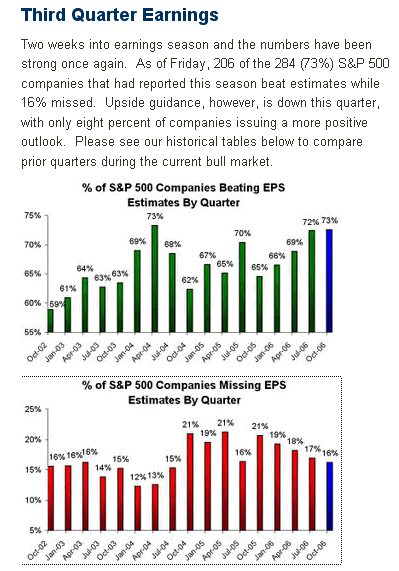
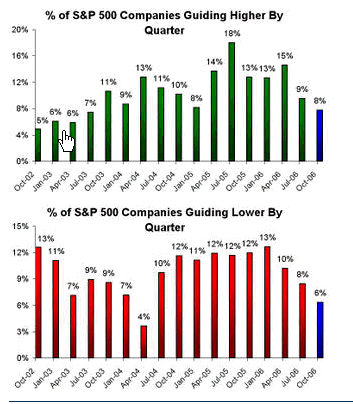
- While corporate profits have been phenomenal, the guidance has been lower for a majority of corporations. CAT and HON were notable. I'm surprised (okay, not really) how little air time has been given to this statistic This was pulled from Birinyi Associatiates and you can find it here http://tickersense.typepad.com/ticker_sense/2006/week44/index.html. To be fair, the % of companies guiding lower is declining; therefore, I would find this graph more compellingly ominous if the lower guidance were higher than the 6% guidance. There seems to be quite a few silent companies regarding future guidance...
- Gold is going up. Inflation worries? Demand fundamentals? (The same could be asked regarding oil, non-precious metals) Some mixture of both that confounds the average person? I'm betting on the latter.
- Election jitters....puhleeze....there's enough mischief and shame shared between the two parties that if they monetized it we'd have no national debt.
- Economic indicators? They are pointing to a slow down. Watch inventories. Increasing inventories mean decreasing prices and slowing production (margin squeeze). The ISM number is key. 50 is the magical number that is tell tale of a slowdown. We are only getting teased now.
- Housing? Greenspan says the worst is behind us. Is he even relevant now? I'm not really looking for an answer to that. It may be bottoming, but I see a long, flat bottom. The real key to who is ultimately right in the expected market direction will be the effect of housing slowdown on the economy. If it is benign, then that is fuel for the rising market fire. If it is malevolent, then you have the makings of a shock. I'm not sure if benign is the middle ground. I do think that we are still unfolding this data, and we'll have greater clarity in the next 90 days.
- Interest rates--I think that they will go up, or at least not come down for a while. So the inversion lasts a wee bit longer.
- Propensity of surprise indicator? High on each of these, so it throws out the whole thing! Just hang onto your seat and squeal with glee!
Friday, November 03, 2006
Pictures
I'm not great photographer, but I try. I went to Spain for 2 weeks on a wine tour. It was one of the most memorable things I have ever done. A splurge. No husband. No children. My goal was to master (okay learn) how to use my digital camera more facilely. I have an Olympus C-5060 (5.1 Megapixel).
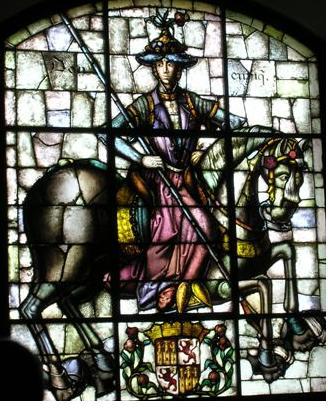
The fetching woman below is Queen Isabel. I snapped it in Spain (May 2005), in the place of her tomb. I'm forgetting the name of the place, but it was a monastery outside of Segovia. The place was fascinating. All of the kings/queens of Spain were buried here. It was one of the most wondrous places I have seen. Stately, somber. Green marble alcoves housed majestic black caskets with brass trims were in the lower chapel. In the upper levels were all of the lesser wives and children, cousins, etc. Beautiful crypts with alabaster carvings or plain carved facings. It's a place where the quiet envelopes you. A peaceful place.
The fetching woman below is Queen Isabel. I snapped it in Spain (May 2005), in the place of her tomb. I'm forgetting the name of the place, but it was a monastery outside of Segovia. The place was fascinating. All of the kings/queens of Spain were buried here. It was one of the most wondrous places I have seen. Stately, somber. Green marble alcoves housed majestic black caskets with brass trims were in the lower chapel. In the upper levels were all of the lesser wives and children, cousins, etc. Beautiful crypts with alabaster carvings or plain carved facings. It's a place where the quiet envelopes you. A peaceful place.

Some amateur technical talk....
 gemma star, I post this because after your comment, I looked at TU. I must have reviewed this stock before, because I see I did a few line studies.
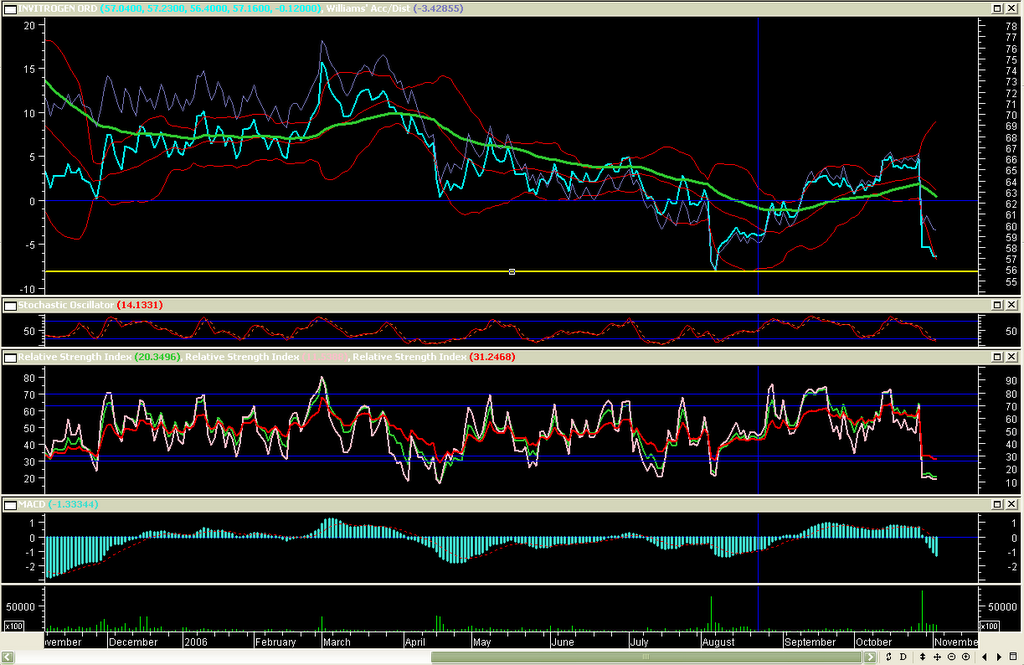
As my own belief is that fundamental and technical analysis are important to making investment decisions (though you have purists on either end who would vehemently disagree), I try to increase my technical skills. To do so, I have found it good practice to ambulance chase certain stocks on bad news and attempt to identify support. I don't commit capital unless I know something specific about the company. For IVGN, it was a company that I followed. If my IVGN breaches former support of $55.72, shown in the yellow line below, I'm outta there!
Canadian Energy Trusts, Redux
Here's something from Barron's that gives more color.... Also, if you are interested, check out Bill Cara here http://www.billcara.com/archives/2006/08/about_those_cdn.html
UP AND DOWN WALL STREET DAILY |
By RANDALL W. FORSYTH
The new tax treatment wouldn't take effect until 2011, however, and wouldn't even hit Canadian investors, explains Robert Willens, Lehman Brothers' tax expert. "For Canadians, it's irrelevant." Canadian investors can "impute" taxes paid by corporations, effectively getting around the double taxation of dividends, which the "primitive" U.S. tax system doesn't allow, he adds. As part of tax change, the Canadian corporate tax rate also will be lowered to 18.5%.
The only beneficiaries of the current royalty-trust structure are tax-exempt investors, such as retirement funds and endowments, and non-residents. "It's all about U.S. investors," Willens says of the proposed tax change, which he says will likely gain passage because it was proposed by the supposedly business-friendly Conservative government.
-------------------------------
So throw out my due process comment. But...it seems like the rest holds reasonably well.
Thursday, November 02, 2006
Canadian Energy Trusts. . .
take it on the chin. If I understand it correctly, existing trusts will be taxed in four years while any new trusts get the tax shaft next year. Now this sort of thing plays right into my bias of following the stampede and looking for the carnage, so long as there is some risk mitigation. My expectation is that something happening in 4 years is not a reason to give up the ghost now.
In looking over the trusts, I elected to buy some ERF. Here's a look at the chart (Click to enlarge):
 My average cost is $41.87 today. It closed at $42.29. They pay a .42 dividend on 11/08. Here's my thesis.:
Don Coxe (BMO Harris), who is no longer freely available, has been a huge proponent of geopolitically safe oil reserves. The Canadian oil plays fit that bill. I imagine though that any who have loaded the boat on these must be in pure agony now, for these oil trusts have declined 20+% over the news.
Now if my gourd is working correctly (and we are in the right season for gourds), the real risk is the price of oil, which I grant has been under much suspicion of late, and that's a discussion for another day. The price of oil affects earnings (near and far term) regardless of tax implications. And oil has been under pressure. But a 10% dividend rate is nothing to sniff at--and if in the US rates start to decline,--the search for yield will be relentless.
If there is such a thing as due process in Canada, there is a potential upside: the hew and cry may be so great that the politicians may come up with something more palatable for existing trusts while achieving their goal of abating the massive conversions to a trust.
In summary for ERF my investment thesis is
I found this article post post....I feel like my thinking is sound.
http://www.marketwatch.com/news/story/story.aspx?guid=%7BA46AED29-0D72-4965-82E9-E4F2CFD1FC57%7D
------------------------
An update on my other theses for IVGN and MIND. IVGN currently has an .82 (1.46%) per share gain over my entry point and MIND has a .04 (.4%) gain over my entry point. Pretty thin margins!
In looking over the trusts, I elected to buy some ERF. Here's a look at the chart (Click to enlarge):
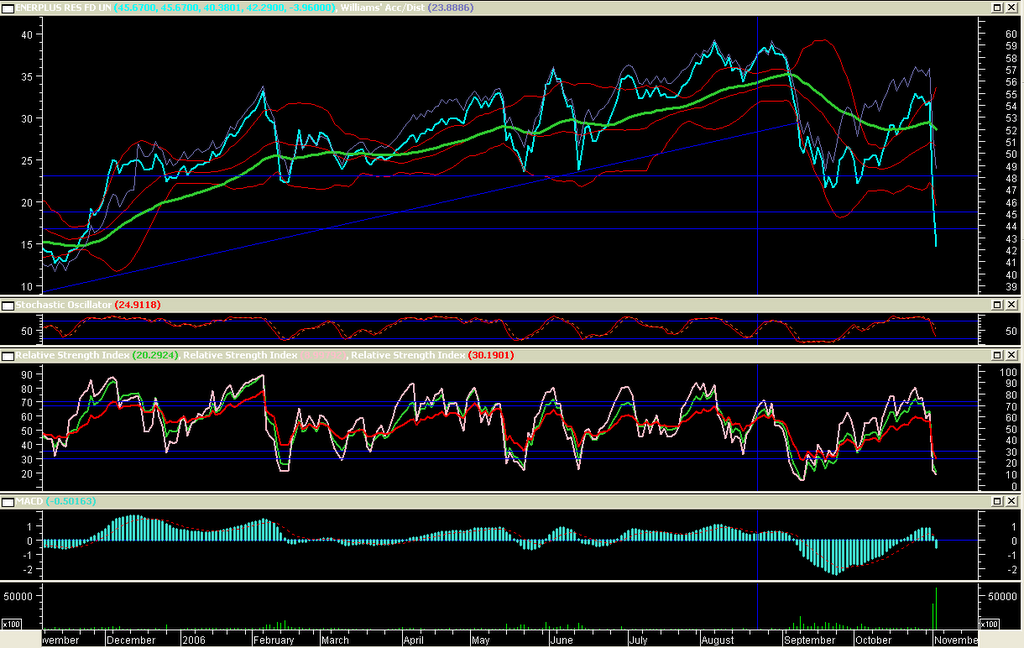 My average cost is $41.87 today. It closed at $42.29. They pay a .42 dividend on 11/08. Here's my thesis.:
Don Coxe (BMO Harris), who is no longer freely available, has been a huge proponent of geopolitically safe oil reserves. The Canadian oil plays fit that bill. I imagine though that any who have loaded the boat on these must be in pure agony now, for these oil trusts have declined 20+% over the news.
Now if my gourd is working correctly (and we are in the right season for gourds), the real risk is the price of oil, which I grant has been under much suspicion of late, and that's a discussion for another day. The price of oil affects earnings (near and far term) regardless of tax implications. And oil has been under pressure. But a 10% dividend rate is nothing to sniff at--and if in the US rates start to decline,--the search for yield will be relentless.
If there is such a thing as due process in Canada, there is a potential upside: the hew and cry may be so great that the politicians may come up with something more palatable for existing trusts while achieving their goal of abating the massive conversions to a trust.
In summary for ERF my investment thesis is
- + dividend of .42/share provides downside protection of same (though the shares may dip post 11/08)
- + greater clarity post exodus by clearer thinking may provide boost in share price
- - oil price decrease will deflate shares as income will be reduced
- +oil price increase will inflate shares..............
- - hew and cry may result in some repeal or softening...think about what that might do (but I don't know the predispositions of the Canadian government, but I think that some mitigation via due process could very well be likely--though complete conjecture, it is a possibility).
I found this article post post....I feel like my thinking is sound.
http://www.marketwatch.com/news/story/story.aspx?guid=%7BA46AED29-0D72-4965-82E9-E4F2CFD1FC57%7D
------------------------
An update on my other theses for IVGN and MIND. IVGN currently has an .82 (1.46%) per share gain over my entry point and MIND has a .04 (.4%) gain over my entry point. Pretty thin margins!
Tuesday, October 31, 2006
Did you know?
Here's a post that from Bill Cara's blog (it's mine, I just posted there first).
Through some genetic deficiency, I was perusing FRED's (Federal Reserve Bank of St. Louis) website a couple of days ago. I admit that I'm experiencing an unhealthy preoccupation with loan loss reserve trends. They have a wealth of schedules that report on such (in total, by region, by bank size).
Loan loss reserves are at historic low points (and they only show commercial and total losses, no consumer losses insofar as I can see). Anyway, I may just do something really geeky and start tracking these losses by bank size and region. If there is a credit problem as some have suggested, we should see it creeping in these numbers. It will be a bellweather of sorts. We'll see what develops.
One thing I found truly interesting is that from 1984 to 2004 the number of banks in the US fell by 53%. I understood about consolidation (indeed that was one of my investment thesis that paid off in the past), but I've not seen this number. I thought it intriguing. My friends and colleagues can always count on me to pull a "Did you know?" thing out of my pocket. I pulled this one out today. The person I shared it with was kind enough to pretend to find it interesting. Enterprising readers may want to use this in their arsenal should they be in cocktail conversation and find that their erudition is challenged. Keep this handy, it may serve as a needed deflection. Trust me, someone will be impressed that you know this...and surely your banker will be impressed.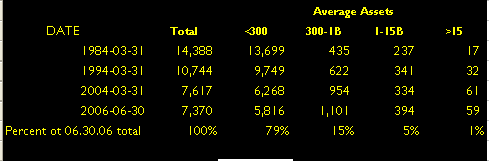
Sunday, October 29, 2006
http://biz.yahoo.com/ap/061028/america_the_bankrupt.html?.v=4
David Walker, US Comptroller General, who brings credit to my profession so sullied by the mischief of CFO's of Enron, WorldCom (and others), is doing a fiscal wake up tour. This is worth a read for any who wish to have an overview of some important issues.
I’m particularly interested in the Medicare part of it, most particularly the bolus of baby boomers heading toward Medicare. Having spent a few years in the disease management industry, I will tell you that the increasing incidence rates in chronic diseases is horrifying. Why does it matter?
It’s important to know that other people’s illness affects your pocketbook. Insurance companies spread the risk; they do not absorb the risk. And when risks are spread through the system, healthy people have to bear the burden of increased costs. Mind you, the risk is not pro-ratably spread, but it is spread nonetheless.
There are 6 major chronic diseases: diabetes, coronary artery disease (CAD), congestive heart failure (CHF), chronic pulmonary obstructive disorder (COPD) and asthma. Two additional conditions, hypertension (high blood pressure) and hyperlipidemia (high cholesterol) are also on the rise. Among the 8 conditions, there is high co-morbidity—meaning folks with multiple conditions. A person with coronary artery disease may also have diabetes, hypertension and hyperlipidemia. The prevalence rates (the % of people who have the disease) varies among the conditions and there is and varies among geographic area. For example, the Midwest has a notably smaller prevalence rate of asthma than the South.
Did you know that lifestyle is a major contributor to the increasing incidence rate (the number of NEW people who have the disease) of chronic diseases? Yep lifestyle. You can see it by going to the mall or the beach and looking at the bulging waistlines. The big three lifestyle variables are exercise, weight and smoking. Each of these lifestyle components is controllable by individuals. Other factors include age and genes, neither of which we can control.
The 80/20 rule is alive and well in health care spending. 20% of the folks will drive 80% of the costs. Here’s a couple of tables that lifted out of a paper that you can find here. http://content.healthaffairs.org/cgi/content/full/hlthaff.w3.603v1/DC1
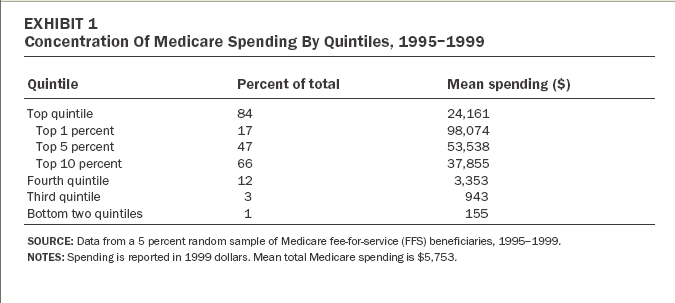
In Exhibit 1, it is notable the differences between the top 20% and the top 1, 5, 10% respectively. The very sick are very expensive.
Now look at Exhibit 2.
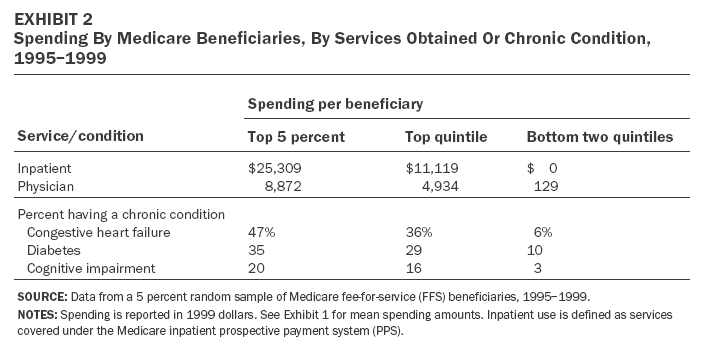
Of the top 5% in spending per beneficiary, 47% have CHF and 35% have diabetes. Chronic diseases are acetylcholene to health care costs.
The numbers are so large, that small changes yield big payoffs.
Friday, October 27, 2006
Some recent transactions
My best results (remember, I'm an amateur at best!) have come from picking up stocks that are taking it on the chin or are slowly rising from a TKO. My current portfolio is mostly cash and puts. Given that the indices have gone straight up my puts look terrible though in june/july they were up 150%.
Lesson 1: Never let a 150% gain get away...particularly if you have options.
Lesson 2: If you are buying puts, you ought to be hedging something other than a cash position.
I've been poking around for some long opportunities. Last week, I bought 500 shares of MIND (Mitcham Industries) @11.16 (including fees) They lease seismic equipment to oil exploration and had been beaten down pretty well. They were on my watch list, and I saw that they were improving.
Today I purchased 200 shares of IVGN @ $56.30 for my retirement account. It's a stock that I've followed for a while. They are getting beat up today on disappointing earnings, BUT, I had marked support in their chart (last earnings disappointment) and that level was not breached. I figured that I had a low risk entry point. As I write it is at $57.25. We'll see how this holds.
Lesson 1: Never let a 150% gain get away...particularly if you have options.
Lesson 2: If you are buying puts, you ought to be hedging something other than a cash position.
I've been poking around for some long opportunities. Last week, I bought 500 shares of MIND (Mitcham Industries) @11.16 (including fees) They lease seismic equipment to oil exploration and had been beaten down pretty well. They were on my watch list, and I saw that they were improving.
Today I purchased 200 shares of IVGN @ $56.30 for my retirement account. It's a stock that I've followed for a while. They are getting beat up today on disappointing earnings, BUT, I had marked support in their chart (last earnings disappointment) and that level was not breached. I figured that I had a low risk entry point. As I write it is at $57.25. We'll see how this holds.
Friday's Trustee Sales
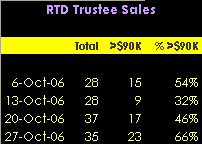 In looking at the numbers this week, I feel that it would be useful to have three breaks: <$90K, $90 - $180K, >180K. There were 6 > $180K this week. Very unusual.
Wednesday, October 25, 2006
Capex
I've been a frequent blogger naysayer on the role of capex in stepping in and taking over from the consumer. I'm feeling some vindication of that view with Walmart, Intel and Amazon giving their capex budgets the good ole "Marie Antoinette".
Sunday, October 22, 2006
Business Cycles
I had mentioned in a previous post about the importance of understanding macro cycles--never you mind of course that no one can agree where we are in the business cycle. Regardless of such disagreement, it's still important stuff. G. Dagnino has a terrific overview here.
http://peterdag.com/s_files/mLcn829S3eP2.pdf
I'll also add that George has nailed this cycle within his by-weekly newsletters.
http://peterdag.com/s_files/mLcn829S3eP2.pdf
I'll also add that George has nailed this cycle within his by-weekly newsletters.
Friday, October 20, 2006
On the forced feeding of services
I'm a long term Verizon Wireless customer. Yesterday I visited the Verizon Wireless store. My son's phone fell victim to a dramatic situation that resulted in its being tossed out the bus window. My husband's phone has suffered some abuse as well, but still usable as opposed to my son's MIA phone.
I picked out my phones which had the characteristic $50 rebate and the 2 year contract. I was then told that they would have to include a one month free trial of Vcast. I said no thank you, I didn't want it. The sales associate replied. "Okay, then, your phones just went up in price by $40."
I said, "This is nuts" and I walked out of the store. Why should I have to accept something that I know that I will not use and that requires me to "act" to avoid charges.? I'm still angry this morning. So much so that I'm tempted to buy my contracts out and switch to another service. Verizon has made a fortune off of me, and I find such "force feeding" of services poor customer relations. I'll complain to them today.
-------------------------
Heart pounding drama huh! I've concluded that my issue was due to being at an "authorized reseller". the location changed from a company-owned to an AR. I went on line, merely clicked "decline VCAST" and all was right as rain. Now, my son has to wait a few days before the phone comes but (1) I did not have to wait; (2) transaction took 5 minutes as opposed to 50; and (3) no rebate to hassle with; it is instantly given. Love it.
I picked out my phones which had the characteristic $50 rebate and the 2 year contract. I was then told that they would have to include a one month free trial of Vcast. I said no thank you, I didn't want it. The sales associate replied. "Okay, then, your phones just went up in price by $40."
I said, "This is nuts" and I walked out of the store. Why should I have to accept something that I know that I will not use and that requires me to "act" to avoid charges.? I'm still angry this morning. So much so that I'm tempted to buy my contracts out and switch to another service. Verizon has made a fortune off of me, and I find such "force feeding" of services poor customer relations. I'll complain to them today.
-------------------------
Heart pounding drama huh! I've concluded that my issue was due to being at an "authorized reseller". the location changed from a company-owned to an AR. I went on line, merely clicked "decline VCAST" and all was right as rain. Now, my son has to wait a few days before the phone comes but (1) I did not have to wait; (2) transaction took 5 minutes as opposed to 50; and (3) no rebate to hassle with; it is instantly given. Love it.
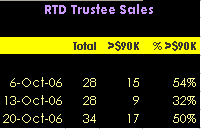
Thursday, October 19, 2006
Steelcase
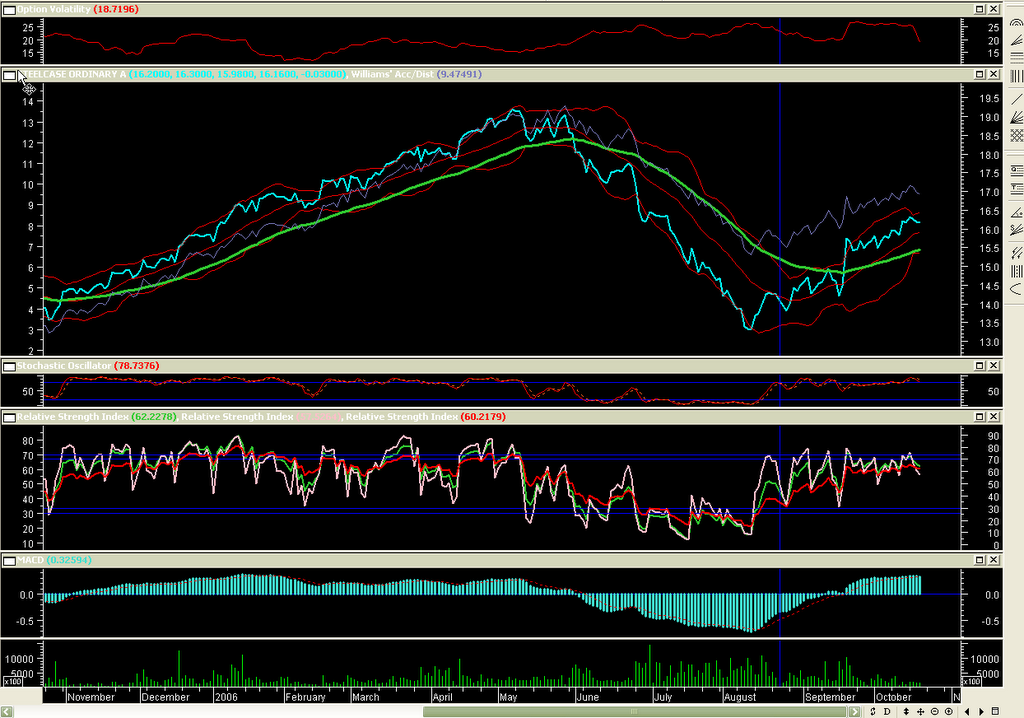 Here's Steelcase. The other "big three" is Hayworth. I believe that it is private. Good for them.

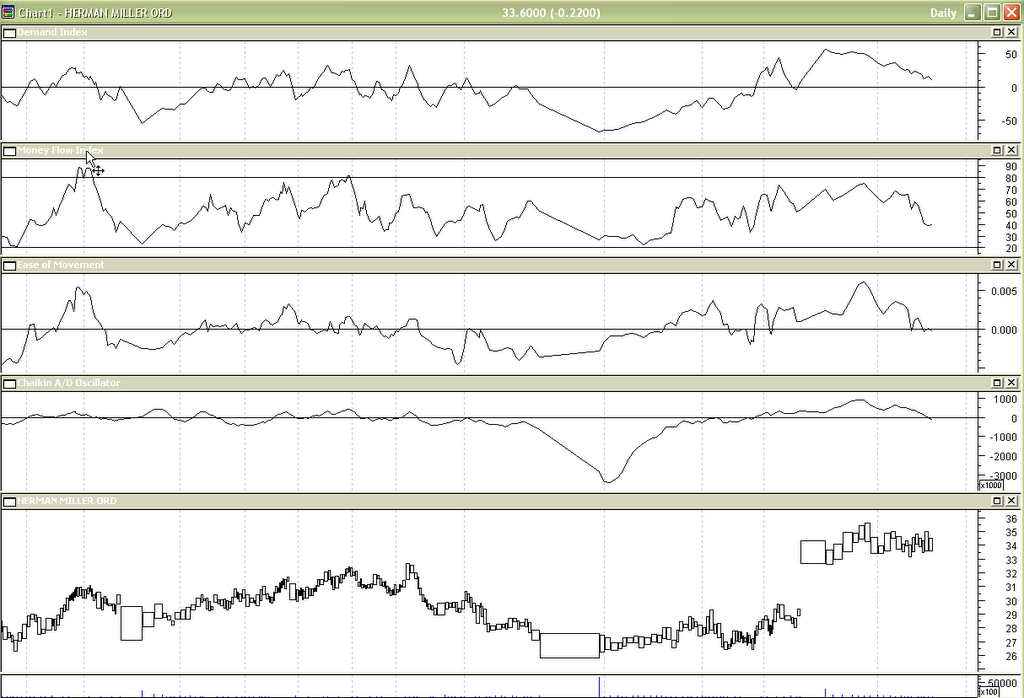 I'm just experimenting here on loading charts. The chart is from MetaStock's program. I use a screen capture (HyperSnap, which is a great program for my use).
The stock is Herman Miller, a top 3 furniture manufacturer. Notice that they had a torpedic advance. There was also a 15% short position at the time of their earnings announcement.
Having spent 10 years in the furniture business (at a dealer for HM), I have painful professional experience that commercial furniture always gets kicked in the stomach first when there's a recession. When no political or economic figure was talking recession in 1990/1991 my organization saw it's backlog decrease. Trust me that it is no fun sitting down with your banker and talking about recessionary pressures affecting your business when NO ONE else is speaking the "R" word. The response? No one is calling for a recession (meaning, you must really suck at your business to have this far a fall off). "They" finally did call a recession, and it cost the nation a president's re-election and me a bank loan. The good news was I lost the 10 lbs that all women claim to want to lose, and I was awarded a set of steel balls from one of the owners for my leadership during that time. Unless we have some aberration, we'll use Steelcase and Herman Miller as bellweathers for the economy. I'll do a weekly chart on their stock prices and post any useful news. We'll see what develops. We'll have a recession watch.
Oh well.....I don't have any technical mumbo jumbo to offer on this, but all of the momentum indicators are moving down in the upper chart. I've not worked with these indicators much. I don't claim to be a technician nor do I play one on TV, but I'm a student of it--a stinking amateur. Here's another look using the default format that I like to use.
I'm toying with shorting this stock. I'll post what I decide to do. So far, being short in this market has been painful. More in the oft promised mea culpa post. I'm generating testicular fortitude for that post, and I'm not quite ready--maybe a testosterone shot will help.
This chart tells me that HM is overbought. We'll see what happens next week.
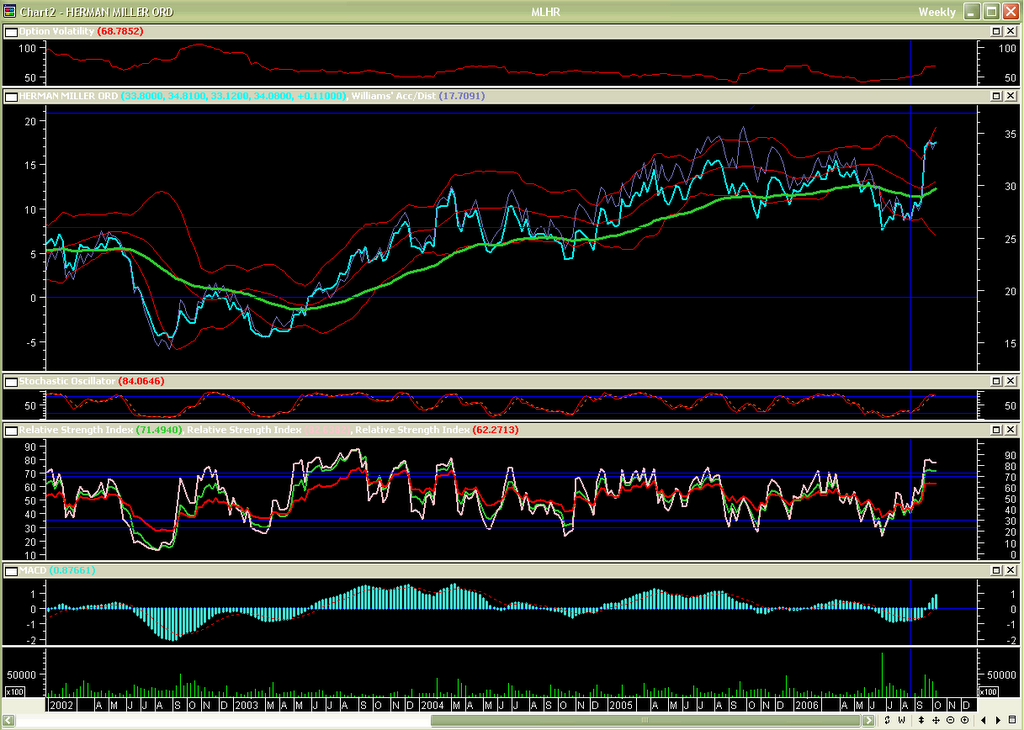
Wednesday, October 18, 2006
A Watch List Review
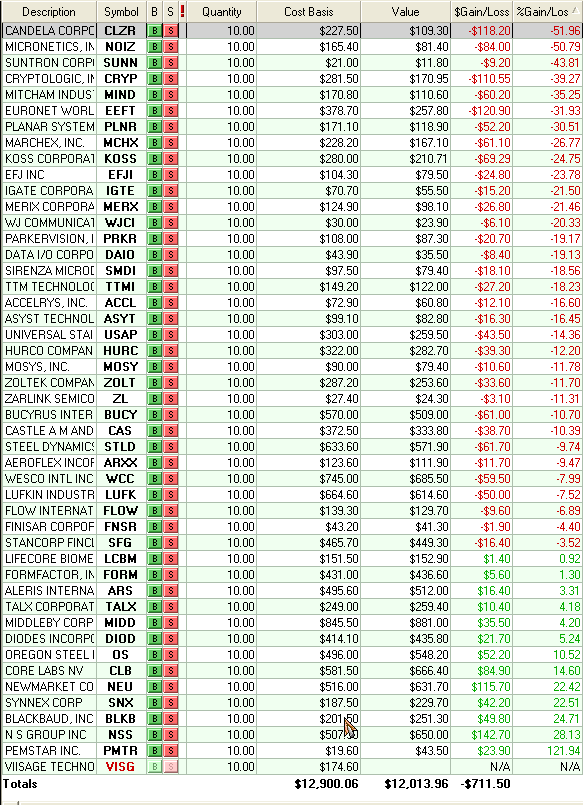 Here's a list (click to enlarge) of stocks on one of my "watch" lists. The list includes a hypothetical share quantity based on a "purchase" of 04.24.06 and values through yesterday's (10.17) close. Many of these stocks came from the ValueLine small/mid cap picks. It is sorted through largest % loss to date. Picking any one of these (unless it was Pemstar which was bought out, but performed extraordinarily well) could have been devastating to a portfolio. Buying all of them would have resulted in a small loss.
My worst stock purchase mistakes were where I did not do any "due diligence" (or homework). I've realized my best performance from doing my homework. I did homework on BUCY, LUFK, OS, NEU, SMDI , NSS and made money on these. Reading 10-Q's/K's (Edgar.com) and listening to conference calls are two critical homework assignments. You learn a lot about a company through the conference call. The personality of the executive team, for good or naught, comes through. Also, hearing commentary on their industrial outlook is important. Caution: don't expect conference call material presentation to be the Rosetta stone. You are still being "fed" information. Listen to the analyst questions and the response. As always, treat the executives as you would in a cross examination with your teenager: what they do not say is often more important than what they do say. Companies with superb leadership weather temporary storms, and every company experiences blips--some major, some minor.
While some may not consider fast growth and profitability blips, they are. Exponential growth creates an enormous strain on company resources (financial, infrastructure and people). Unbridled growth can create large implosions. Therefore, having a smart, agile executive team is key. Listening to their conference calls is one way to gauge smartness and agility. It's important, though, to not let charismatic personalities fool you into thinking management is smart. Having said that, it is best that the team doesn't put investors/analysts asleep on the call.
For those that have time, researching attractive sectors and the company leadership in those sectors builds a strong foundation in understanding the thesis for why you want to buy an individual stock. If you are not willing to do this research, you will not have a good understanding of the risks. The risks are illuminated in red above.
For individual investors compelled to make their own decisions, lack of work will translate into lack of results. Not only do you have to pick the right sector and the right stock, individual investors need to develop a keen awareness on when to hold 'em and when to fold 'em. It's not a skill that I've mastered, and I'll post some mea culpas on this.
Saturday, October 14, 2006
This Week’s Market Perplexions
That the market continues to go up is perplexing. As I understand it, the market has four theses to support its strong rise: (1) the consumer is still strong; (2) the Fed is done; (3) in the event that thesis (1) is wrong, then corporations will fill the gap with cap ex spending; and (4) price to earnings ratios are low.
Generally, scientific method requires a (hypo)thesis to be subjected to the rigors of empiricism. Slap evidential matter data garnered to support your thesis against the wall of scientific skepticism and see if it sticks. I’ll offer my personal and amateur observations regarding theses 1-3. Thesis 4 has too many oddities. And there should be a Thesis 5, Global Growth (which really has some merit). But 4 and 5 make my head hurt, so I’m being lazy and cowardly in ignoring them both here. Warning: Remember, I’m representing my point of view (POV) as that of a layperson.
Let’s tackle thesis (1): The consumer continues to be strong. Here is Econoday’s Retail Sales report:
Released on 10/13/06 For Sep 2006
Retail Sales, M/M change
Consensus 0.2 %
Actual -0.4 %
Retail Sales less autos, M/M change
Consensus 0.0 %
Actual -0.5 %
Retail sales missed by a large differential from consensus expectations. In my off-line life, if I miss something by that wide a gap, then it’s an alert to me that my thinking was wrong. Slapping these numbers against our thesis wall result in a puddle on the floor. They don’t stick. But if they don’t initially stick, you can keep changing them and throwing them until they eventually stick. Here’s a lifting from Mauldin’s free letter which you can find here http://frontlinethoughts.com/.
Unpacking these numbers led to a number of “positive” increases. One such positive was that furniture purchases were strong (up 1%). Strange news to hear on the same day that that Lazy Boy warns.
There are other matters balled up into this consumer thesis that center on the role of housing, debt and negative savings. I’m not going to tease those out. But it seems to me that (1) the consumer has been on a spending spree and (2) the source of funds can come from two places, (a) income and (b) debt. Income increases have not been high enough to sustain the current level of spending, so that leaves debt. Given the proliferation of mortgage equity financing over the last few years AND given the pressures in real estate and the potential for price deflation, we could only be looking at incremental gains here. My conclusion is that the consumer will continue to flounder.
Let’s tackle thesis (2): The fed is done raising rates and will reduce them in the near term. There are a few Fed heads out there stating with continuing emphaticalness (yes, this is a word, and I think that it should be emphaticism, but alas it is not a word) that inflation is a worry—more of a worry than a slowing economy. There is a paucity of public discussion about real interest rates. I’m not qualified to host one here, but it’s a concept that deserves a brief airing. What are real interest rates?
Real Interest Rate = Nominal Interest Rate - Inflation
If inflation is positive, which it generally is, then the real interest rate is lower than the nominal interest rate. If we have deflation and the inflation rate is negative, then the real interest rate will be larger.
Source: http://economics.about.com/cs/macrohelp/a/nominal_vs_real.htm
Let’s say that our nominal interest rate equals the fed funds rate, currently at 5.25%. If inflation is 3.25 %, then our real interest rate is 2.25%. To slow inflation, one has to have a high enough delta between the fed funds rate and inflation to serve as a brake to the careening car we call our economy. Remember those folks (much maligned I might add) calling for 6% Fed funds rate? Those were the folks who understood that real interest rates were too low to forestall inflation. I would posit, then, that the thesis that the Fed is done, doesn’t stick when it is slapped up against a wall either. Two strikes.
To use baseball vernacular (and I’d rather have needles stuck in my eyes than watch baseball), I really need a strike three to achieve any sort of climax here. Strike three is thesis 3, In the event that the consumer stalls, corporations would step in and fill the gap.
There are not too many folks more fiscally conservative than corporate CFO’s. So I’ll ask you, that if you were a savy CFO and believed that the economy is slowing (less revenues, less profits), are you going to go on a capex spending spree to get rid of your excess cash? If you didn’t say no, I would surmise that you’d be out of your CFO position soon—but it would be a less ignoble departure than that of those CFO’s participating in options scandals. To maintain (or mitigate a slide in) profitability in a slowing economy your margins are pressured. Margins are pressured because sales dollars are down (due to volume and pricing pressure). If your top line is pressured, you don’t load up on depreciable assets.
I would welcome seeing some credible numbers on how these capex numbers are going to mitigate the consumer slowdown. I have a feeling that we’ll just vacillate between the camp saying that consumer is not slowing down (by spinning the numbers) to the camp that says yes the consumer is slowing down but corporate capex will save the day. I’m in the third camp—saying that both will defy the current expectations. But my camp is a lonely one.
So all of this “stuff” is perplexing. To be true to valuing empiricism, I have to ask how might I be wrong. Global growth would certainly be an answer. But this post is already too long. Though I’m tempted to say that the market has a mind of its own, the market has no mind. The market is really a shower faucet. The knob on the right is hooked to endorphins, and the faucet on the left is hooked to adrenalin. Right now I think the faucet on the right is wide open.
If you have a weak plumbing system (and I think that the market’s plumbing system is weak given the theses points) if you’re showering in a comfortable temperature, singing away until someone does something unexpected in another part of the house (starting the washing machine or dishwasher, or maybe flushing a toilet) you will experience an unwelcomed rapid change of temperature—you’re gonna be freezing or scalded—neither is fun.
That the market continues to go up is perplexing. As I understand it, the market has four theses to support its strong rise: (1) the consumer is still strong; (2) the Fed is done; (3) in the event that thesis (1) is wrong, then corporations will fill the gap with cap ex spending; and (4) price to earnings ratios are low.
Generally, scientific method requires a (hypo)thesis to be subjected to the rigors of empiricism. Slap evidential matter data garnered to support your thesis against the wall of scientific skepticism and see if it sticks. I’ll offer my personal and amateur observations regarding theses 1-3. Thesis 4 has too many oddities. And there should be a Thesis 5, Global Growth (which really has some merit). But 4 and 5 make my head hurt, so I’m being lazy and cowardly in ignoring them both here. Warning: Remember, I’m representing my point of view (POV) as that of a layperson.
Let’s tackle thesis (1): The consumer continues to be strong. Here is Econoday’s Retail Sales report:
Released on 10/13/06 For Sep 2006
Retail Sales, M/M change
Consensus 0.2 %
Actual -0.4 %
Retail Sales less autos, M/M change
Consensus 0.0 %
Actual -0.5 %
Retail sales missed by a large differential from consensus expectations. In my off-line life, if I miss something by that wide a gap, then it’s an alert to me that my thinking was wrong. Slapping these numbers against our thesis wall result in a puddle on the floor. They don’t stick. But if they don’t initially stick, you can keep changing them and throwing them until they eventually stick. Here’s a lifting from Mauldin’s free letter which you can find here http://frontlinethoughts.com/.
“September retail sales posted a rather weak headline number. Expectations were for a rise of 0.3%. Mostly, the high expectations were because of the drop in gasoline prices. Economists assumed consumers would spend their energy "savings" on other items. The actual number was down 0.4%; and just as important, August sales were revised downward from 0.2% to a final 0.1%. It is important to pay attention to the direction of the revisions, as they will sometimes be a harbinger of trends.
So, are we finally starting to see a slowdown? Not if we look at the action of the stock market, which is again posting new 52-week highs as I write. Dow 12,000, here we come! And why can the market shrug off slowing consumption? Because the immediate spin was that the underlying data was really quite strong.”
Unpacking these numbers led to a number of “positive” increases. One such positive was that furniture purchases were strong (up 1%). Strange news to hear on the same day that that Lazy Boy warns.
There are other matters balled up into this consumer thesis that center on the role of housing, debt and negative savings. I’m not going to tease those out. But it seems to me that (1) the consumer has been on a spending spree and (2) the source of funds can come from two places, (a) income and (b) debt. Income increases have not been high enough to sustain the current level of spending, so that leaves debt. Given the proliferation of mortgage equity financing over the last few years AND given the pressures in real estate and the potential for price deflation, we could only be looking at incremental gains here. My conclusion is that the consumer will continue to flounder.
Let’s tackle thesis (2): The fed is done raising rates and will reduce them in the near term. There are a few Fed heads out there stating with continuing emphaticalness (yes, this is a word, and I think that it should be emphaticism, but alas it is not a word) that inflation is a worry—more of a worry than a slowing economy. There is a paucity of public discussion about real interest rates. I’m not qualified to host one here, but it’s a concept that deserves a brief airing. What are real interest rates?
Real Interest Rate = Nominal Interest Rate - Inflation
If inflation is positive, which it generally is, then the real interest rate is lower than the nominal interest rate. If we have deflation and the inflation rate is negative, then the real interest rate will be larger.
Source: http://economics.about.com/cs/macrohelp/a/nominal_vs_real.htm
Let’s say that our nominal interest rate equals the fed funds rate, currently at 5.25%. If inflation is 3.25 %, then our real interest rate is 2.25%. To slow inflation, one has to have a high enough delta between the fed funds rate and inflation to serve as a brake to the careening car we call our economy. Remember those folks (much maligned I might add) calling for 6% Fed funds rate? Those were the folks who understood that real interest rates were too low to forestall inflation. I would posit, then, that the thesis that the Fed is done, doesn’t stick when it is slapped up against a wall either. Two strikes.
To use baseball vernacular (and I’d rather have needles stuck in my eyes than watch baseball), I really need a strike three to achieve any sort of climax here. Strike three is thesis 3, In the event that the consumer stalls, corporations would step in and fill the gap.
There are not too many folks more fiscally conservative than corporate CFO’s. So I’ll ask you, that if you were a savy CFO and believed that the economy is slowing (less revenues, less profits), are you going to go on a capex spending spree to get rid of your excess cash? If you didn’t say no, I would surmise that you’d be out of your CFO position soon—but it would be a less ignoble departure than that of those CFO’s participating in options scandals. To maintain (or mitigate a slide in) profitability in a slowing economy your margins are pressured. Margins are pressured because sales dollars are down (due to volume and pricing pressure). If your top line is pressured, you don’t load up on depreciable assets.
I would welcome seeing some credible numbers on how these capex numbers are going to mitigate the consumer slowdown. I have a feeling that we’ll just vacillate between the camp saying that consumer is not slowing down (by spinning the numbers) to the camp that says yes the consumer is slowing down but corporate capex will save the day. I’m in the third camp—saying that both will defy the current expectations. But my camp is a lonely one.
So all of this “stuff” is perplexing. To be true to valuing empiricism, I have to ask how might I be wrong. Global growth would certainly be an answer. But this post is already too long. Though I’m tempted to say that the market has a mind of its own, the market has no mind. The market is really a shower faucet. The knob on the right is hooked to endorphins, and the faucet on the left is hooked to adrenalin. Right now I think the faucet on the right is wide open.
If you have a weak plumbing system (and I think that the market’s plumbing system is weak given the theses points) if you’re showering in a comfortable temperature, singing away until someone does something unexpected in another part of the house (starting the washing machine or dishwasher, or maybe flushing a toilet) you will experience an unwelcomed rapid change of temperature—you’re gonna be freezing or scalded—neither is fun.
Friday, October 13, 2006

Thursday, October 12, 2006

Tuesday, October 10, 2006
On Commodities
I've always been perplexed by the price of commodities. It appears to me that there ought to be a bifurcation in the price: one part fundamentals, one part perceived value. I was lamenting on Bill Cara's website that I wish someone would dissect the price into these two parts. He stated that
For a nascent student of capital markets, this was an "AHA" experience. I certainly understood that money flow is intrinsic to all asset classes and their valuations, but there was this underlying intellectual neediness to understand how one would parse between the two (fundamental v. technical) and come up with some definitive amount for the two. This question is precisely the type of question that someone with my background would ask (and go perpetually wanting) and really expect a logical answer. Job Cost accounting (blech...I hated it in school, and I still hate it, but I have to use it with my clients) teaches us to tease out discrete bits of activity and assign some value to it. But to tease out a fundamental value (demand/supply of the good) v. a technical value (demand/supply of the commodity from an investment attractiveness--meaning money flow!) is not going to happen.
I'm going to coin a new word: perplexion. It's like a contagion--it's an agent that causes perplexity! At first I was giddy thinking that I was clever and found a new word. While not in dictonary.com, I did a Google search, and look what I found (synchronicity at work). .
Totally irrelevant, but do take a look. http://www.perplexion.com/home.html Some cool pics.
I'll just co-opt the term for my nefarious purposes, and I stick with my original definition:
It also strikes me as an intriguing name for a book or a band. It might also serve as an accurate name for important people in your life (spouse, partner, child, boss, colleagues).
Most commodities are actually futures (financial) contracts
with no intent to actually trade the commodities -- so the commodity
fundamentals are not nearly as important to the major capital pools as the
money flows from one currency to the next.
For a nascent student of capital markets, this was an "AHA" experience. I certainly understood that money flow is intrinsic to all asset classes and their valuations, but there was this underlying intellectual neediness to understand how one would parse between the two (fundamental v. technical) and come up with some definitive amount for the two. This question is precisely the type of question that someone with my background would ask (and go perpetually wanting) and really expect a logical answer. Job Cost accounting (blech...I hated it in school, and I still hate it, but I have to use it with my clients) teaches us to tease out discrete bits of activity and assign some value to it. But to tease out a fundamental value (demand/supply of the good) v. a technical value (demand/supply of the commodity from an investment attractiveness--meaning money flow!) is not going to happen.
I'm going to coin a new word: perplexion. It's like a contagion--it's an agent that causes perplexity! At first I was giddy thinking that I was clever and found a new word. While not in dictonary.com, I did a Google search, and look what I found (synchronicity at work). .
PERPLEXION"The emotion experienced when comparing an image as seen by a camera,
with that seen previously through a viewfinder."
Totally irrelevant, but do take a look. http://www.perplexion.com/home.html Some cool pics.
PERPLEXION
"An agent that causes perplexity."
It also strikes me as an intriguing name for a book or a band. It might also serve as an accurate name for important people in your life (spouse, partner, child, boss, colleagues).
Saturday, October 07, 2006
Tool Box
Whatever you are doing, you need the right tools in addition to the right perspective. The photo below is that of a few tools one needs when fishing (yes, including the beer can!). I snapped this picture just this week while on a guided fishing trip on Cape Hatteras sound. We were searching for the elusive red drum. We snagged exactly one during our afternoon trip. Essentially the guide looks for "unusual" activity. We spotted some "unusual" activity--an area of ripples going against the wind direction. There were hundreds of these beautiful red/gold fish (think about water locusts). I'll skip the picture of the fish and get down to the point of this post.
I've been assembling my investor toolkit over the past year and a half. I'll tell you why it works for me. Yours may be different due to the amount of time or background you might have to understand the information. At the very least, you want to ask some intelligible questions about your investments--at least so that the person who is managing your money will feel some periodic accountability to answer those questions.
I consider the "toolkit" to be an amalgamation of interface (I use Fidelity's Active Trader Pro), investor perspective and information. There's an abundance of information as one can readily see by perusing bookstore shelves, internet sites (both free and paid) and periodicals. Sifting through that information is tricky. It's like wading through dark water, and if you are not careful you will have leeches hanging off of you. In fact, I have a few leeches--subscriptions that I need to cull through because their value is suspect.
About perspective: I'm a global learner--which means that discrete pieces of information do not mean a damn thing to me unless I understand the entire picture. Therefore, my perspective is a top-down one. Traders do not care about that sort of thing (at least from what I can tell from the blogs that I read), but I do. Why? I think that understanding the macro picture helps one understand the risk in the market. So if you didn't know that housing was starting to get into trouble in Q4 of 2005 (and I consider that macro view), then you didn't redeploy your capital in time to avoid the exodus. Bottom line: understand which asset classes you want to be in depending where we are in the economic cycle. It sounds simple....unfortunately, experts cannot even agree with where we are in the economic cycle. But knowledge will be your divining rod--cultivate your knowledge base.
Here are a few tools (I'll call this the de minimis toolbox) that I'll mention quickly.
I've been assembling my investor toolkit over the past year and a half. I'll tell you why it works for me. Yours may be different due to the amount of time or background you might have to understand the information. At the very least, you want to ask some intelligible questions about your investments--at least so that the person who is managing your money will feel some periodic accountability to answer those questions.
I consider the "toolkit" to be an amalgamation of interface (I use Fidelity's Active Trader Pro), investor perspective and information. There's an abundance of information as one can readily see by perusing bookstore shelves, internet sites (both free and paid) and periodicals. Sifting through that information is tricky. It's like wading through dark water, and if you are not careful you will have leeches hanging off of you. In fact, I have a few leeches--subscriptions that I need to cull through because their value is suspect.
About perspective: I'm a global learner--which means that discrete pieces of information do not mean a damn thing to me unless I understand the entire picture. Therefore, my perspective is a top-down one. Traders do not care about that sort of thing (at least from what I can tell from the blogs that I read), but I do. Why? I think that understanding the macro picture helps one understand the risk in the market. So if you didn't know that housing was starting to get into trouble in Q4 of 2005 (and I consider that macro view), then you didn't redeploy your capital in time to avoid the exodus. Bottom line: understand which asset classes you want to be in depending where we are in the economic cycle. It sounds simple....unfortunately, experts cannot even agree with where we are in the economic cycle. But knowledge will be your divining rod--cultivate your knowledge base.
Here are a few tools (I'll call this the de minimis toolbox) that I'll mention quickly.
- Peterdag.com: This is George Dagnino's website. Now, I do not mention this for any reason (no compensation or anything untoward) other than it provides comprehensive economic information. Check out the website. There some great free stuff on market cycles. Every investor needs to understand market cycles. Make sure that you have a good enough foundation in macro economics to understand cycles when you hear someone talking about it. Rather than enroll in a university program, you can get fully digested and understandable information through this service. The newsletter is bi-weekly. I also recommend George's book: Profiting in Bull and Bear Markets.
- Billcara.com: More macro view stuff. If you do nothing else, look at his week in review and his comments. Well worth your time.
- Stockcharts.com: It's worth developing some foundation in technical analysis. Go here to learn some basics.
Richmond VA Trustee Sales
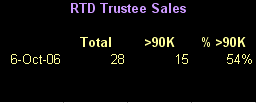
Each Saturday I will load the Trustee sales (TS's) for the Friday--that way there will be no duplication. I have a totally arbitrary cutoff of $90K as the line of demarcation. My expectation is that the higher frequency and the percentage of TS's over$90K, the more deeply felt the housing concerns. Note that just 6 months ago, this percentage in my area, Richmond, VA, was 10% or less. I take no joy in providing these statistics. Excluding personal health issues and those of loved ones, one's house is the insulate from the difficulties of life. When one's house becomes one of those difficulties--e. g. goes into foreclosure--it's affect on the psyche must be tremendous.
The Housing/ Consumer Conundrum
It appears to this perplexed investor that that there is a tremendous amount of unsatisfying commentary regarding the state of the housing market and the strength of the consumer. When in doubt, it is useful to be one’s own personal Sherlock Holmes. I’ll offer up my own amateur observations.
On interest rates: My home equity LOC began with an interest rate of 5.5% in June 2005. Now it is October 2006, and the rate has increased 45.5% to 8%. I thumb my nose at this increase because I’ve not a nickel borrowed against it. But if I had, then I’d be paying 45.5% more each month on top of any principal I was repaying. On a $100K balance, that’s an extra $200 per month, just in interest.
Outside of the conversation regarding about the effect of housing on the economy, this discussion has mostly been narrowed to primary mortgages. What I’ve not seen is any discussion about the number of folks who have second mortgages subject to this steady march of increasing rates. A house is still in the event of a default on ANY obligation for which the house is proffered as security. Keep a look out for any of these statistics and please share them if you see them.
You know that you are getting old when you read the obituaries and the foreclosures. I’ll accumulate foreclosure statistics from my weekly paper (the Richmond Times Dispatch) as an informal barometer of what is going on in at least one locality. I will say, though it is anecdotal, is that the % of notes >$90K is much greater in the last three months than it has ever been. Specifically, maybe 10% of the note balances were in this strata—now it is 40-65%, depending on when you look. I don’t know that I will have the time to strip out the duplicate running of notices, but I’ll at least provide a compilation of this breakdown.
From an investment perspective, I had this thesis that the Fed was not done as there was still real inflation in the system. I also felt like consumer and mortgage exposure in the larger banks was not being discounted. I had puts on BAC and WFC. Let’s just say that my opinion was not held by the larger investing public. I’m still awaiting their capitulation to my way of thinking! It’s often difficult for me to determine when I’m lacking in conviction vs. when I’m just plain wrong.
On the consumer: Let’s just say that the consumer may remain strong against all the perils that they face (high oil, slowing economy), but in the end, the consumer remains stupid. (I’m not trying to sound harsh). Consumers are spending their way into poverty. I recently heard that 52% of the population will be over 55 by 2012. Couple that statistic with not enough of us saving for retirement we have a brewing pot of economic mischief in the offing. I suppose that deferred pain is the mantra of the US consumer, and I'd be a liar if I didn't fall into that category at one time or another in my lifetime. Currently, we are in the parsimonious category--but we do eat well! I'm also adding a wine bar to my blog to show showcase a few discoveries that I enjoy and feel worth sharing.
If we can conclude anything about the consumer from this week’s retail numbers, the Wal-Mart strata of our populace is hurting and the middle to upper strata is doing okay judging by Target’s and JCPenney’s numbers (in addition to a host of other better-than-expected numbers). Nevertheless, the investment glee over retail stocks escapes me.
On interest rates: My home equity LOC began with an interest rate of 5.5% in June 2005. Now it is October 2006, and the rate has increased 45.5% to 8%. I thumb my nose at this increase because I’ve not a nickel borrowed against it. But if I had, then I’d be paying 45.5% more each month on top of any principal I was repaying. On a $100K balance, that’s an extra $200 per month, just in interest.
Outside of the conversation regarding about the effect of housing on the economy, this discussion has mostly been narrowed to primary mortgages. What I’ve not seen is any discussion about the number of folks who have second mortgages subject to this steady march of increasing rates. A house is still in the event of a default on ANY obligation for which the house is proffered as security. Keep a look out for any of these statistics and please share them if you see them.
You know that you are getting old when you read the obituaries and the foreclosures. I’ll accumulate foreclosure statistics from my weekly paper (the Richmond Times Dispatch) as an informal barometer of what is going on in at least one locality. I will say, though it is anecdotal, is that the % of notes >$90K is much greater in the last three months than it has ever been. Specifically, maybe 10% of the note balances were in this strata—now it is 40-65%, depending on when you look. I don’t know that I will have the time to strip out the duplicate running of notices, but I’ll at least provide a compilation of this breakdown.
From an investment perspective, I had this thesis that the Fed was not done as there was still real inflation in the system. I also felt like consumer and mortgage exposure in the larger banks was not being discounted. I had puts on BAC and WFC. Let’s just say that my opinion was not held by the larger investing public. I’m still awaiting their capitulation to my way of thinking! It’s often difficult for me to determine when I’m lacking in conviction vs. when I’m just plain wrong.
On the consumer: Let’s just say that the consumer may remain strong against all the perils that they face (high oil, slowing economy), but in the end, the consumer remains stupid. (I’m not trying to sound harsh). Consumers are spending their way into poverty. I recently heard that 52% of the population will be over 55 by 2012. Couple that statistic with not enough of us saving for retirement we have a brewing pot of economic mischief in the offing. I suppose that deferred pain is the mantra of the US consumer, and I'd be a liar if I didn't fall into that category at one time or another in my lifetime. Currently, we are in the parsimonious category--but we do eat well! I'm also adding a wine bar to my blog to show showcase a few discoveries that I enjoy and feel worth sharing.
If we can conclude anything about the consumer from this week’s retail numbers, the Wal-Mart strata of our populace is hurting and the middle to upper strata is doing okay judging by Target’s and JCPenney’s numbers (in addition to a host of other better-than-expected numbers). Nevertheless, the investment glee over retail stocks escapes me.
Sunday, October 01, 2006

Inaugural Post
What better time than the end of the third quarter to post my first blog. Perplexed? You betcha. Economic data is divergent--Philly is sinking; Chicago is rocking. I cannot wait to see the national numbers.
In May of 2005, I figured that it was time to get serious about understanding the financial markets. Since graduating from college (1982)—yes, I’m starting to feel old--I've been working my potookus off in addition to being a mother and spouse, seemingly in my spare time. So there was little time or energy to devote to the market study. I figured a few well-placed mutual funds would do fine. Not so.
With an accounting/financial background, I figured (naively) that the process would be both quick and straightforward. Hah! Now, 15 months into this odyssey, I've moved from that dangerous stage of not knowing what you don't know to the queasy stage of knowing what I don't know. While still an uncomfortable stage, at least it's less dangerous! While I'll keep my confessions of stupidity to a minimum, I'll offer up that all of the aphorisms that you read about I've violated in some way or another. There's a reason for those aphorisms--so if you are starting out, heed them.
The very first thing that quickly became apparent at the onset is that there are some very smart people who are very giving of their time (and opinions) about all aspects of investing. That's a true act of generosity, so if you are visiting those places and have comments, understand that it's like your kids' little league coach...they're volunteering. Meaning...play nicely.
The very second thing is that all of these very smart people have very divergent opinions about what they think the market was doing and was going to do. I would recommend that everyone read Ed Young’s Seven Blind Mice. Yes, it is a children’s book—a delightful one at that. If you have children in your life procure it and enjoy reading it with them. In my view it describes very accurately the value and context of the mélange of market commentary that you hear and read everyday. For those not familiar with the story, it’s about seven blind mice that are crawling over an elephant and trying to figure out what the heck it is. One goes down a leg and thinks it's a Roman column. You get the picture.
In May of 2005, I figured that it was time to get serious about understanding the financial markets. Since graduating from college (1982)—yes, I’m starting to feel old--I've been working my potookus off in addition to being a mother and spouse, seemingly in my spare time. So there was little time or energy to devote to the market study. I figured a few well-placed mutual funds would do fine. Not so.
With an accounting/financial background, I figured (naively) that the process would be both quick and straightforward. Hah! Now, 15 months into this odyssey, I've moved from that dangerous stage of not knowing what you don't know to the queasy stage of knowing what I don't know. While still an uncomfortable stage, at least it's less dangerous! While I'll keep my confessions of stupidity to a minimum, I'll offer up that all of the aphorisms that you read about I've violated in some way or another. There's a reason for those aphorisms--so if you are starting out, heed them.
The very first thing that quickly became apparent at the onset is that there are some very smart people who are very giving of their time (and opinions) about all aspects of investing. That's a true act of generosity, so if you are visiting those places and have comments, understand that it's like your kids' little league coach...they're volunteering. Meaning...play nicely.
The very second thing is that all of these very smart people have very divergent opinions about what they think the market was doing and was going to do. I would recommend that everyone read Ed Young’s Seven Blind Mice. Yes, it is a children’s book—a delightful one at that. If you have children in your life procure it and enjoy reading it with them. In my view it describes very accurately the value and context of the mélange of market commentary that you hear and read everyday. For those not familiar with the story, it’s about seven blind mice that are crawling over an elephant and trying to figure out what the heck it is. One goes down a leg and thinks it's a Roman column. You get the picture.
Bottom line: We are all blind mice trying to figure out how some discrete knowlege/understanding in our possession fits into the mosaic that looks like an elephant. In reality, it will look like a tiger, a gazelle, or even a platypus before any of us realize it's an elephant--and we will have placed our bets accordingly. Moral of the story? In the market, if it looks like a gazelle, but it is really an elephant and you do not recognize it as such, you will be eaten by a lion. To lose the jungle metaphor....the market will beat you up and take your lunch money. Wahhhhhhhh!!!!!!
Subscribe to:
Posts (Atom)