After noon-time, it ceases to be Christmas to me. So much preparation goes into to the launch, that after the magical morning time, it winds down quickly--or maybe that is me. I write this after having a pleasant afternoon reading my Les Halles cookbook (A. Bordain) and visiting winkie-land for a needed rest. Over the last three days, I've made untold dozens of cookies to give to family/neighbors and prepared for Christmas breakfast.
Normally, I do no cooking of Christmas meals. I go to my stepmother's (and previously my mother's) for Christmas Eve dinner, and on Christmas, we go to Mark's parents. However, because my MIL is suffering from osteoporosis, I offered to have Christmas breakfast while she was eating with us on Thanksgiving. I'm glad she agreed, for she's too frail to do Christmas dinner. Therefore, we had a fair amount of cleaning to do as well as prep for our breakfast. It was fabulous! We had Blood Mary's, sausage/grit casserole, homemade pecan rolls (yeast!), fresh orange slices, and pan fried potatoes.
I made the pecan rolls the day before. Yeast rolls need two risings. The initial rise which you punch down and then form your end product and a second rising prior to cooking. If you want fresh rolls in the morning, you have to refrigerate to impede the rising. The rolls were already in the pans and ready to be taken out of the fridge for the second rising. They were incredibly yummy, and I'll make them again. Trust me, everyone loves homemade yeast breads. Every undertaking has one of those..."why did I do that?" moments. Sectioning oranges provided that moment this year. I've never sectioned an orange in my life until last night. I did a whole bag of navel oranges. My fingers were soggy and wrinkled, but I had a bowlful of beautiful sections without a hint of pith or membrane. Effort was not greater than or equal to the reward. Strike that off of any future lists!
My Dad and my stepmother (my mother is deceased) were there along with her grown son who always visits for Christmas. My MIL and FIL came. I also invited a neighbor who was alone. We enjoyed our meal and pleasant conversation. It was a perfect Christmas.
I hope that your celebrations were equally enjoyable.
Monday, December 25, 2006


Saturday, December 23, 2006

Thursday, December 21, 2006
Housing Starts

Here's the privately owned housing starts recently released. Looking at the recent data, once can see the precipitous drop in these starts. As you know there has been much written regarding the linkage in the housing starts and how that data correlate (highly) with recessions. Thankfully, the good folks at the fed highlight our recessions for us which allows some reasonable review of the data performance against the backdrop of the business cycle.
Transforming the data to a % YOY change, yields the chart that you see below.

I found a couple of things surprising about looking at the data in this view.
- I would have expected the annual YOY % increase to be a little spikier given all of the "boom" information that we've heard. Our current increases are dwarfed by the other spikes.
- It does appear that we have a bit further to go on the downward side (if one can infer anything reasonable from the data presented) to reach the depths of decline that have presaged other recessions.
Wednesday, December 20, 2006
Tidings of Comfort and Joy
With the week rapidly closing, I wanted to express tidings of comfort and joy for the holidays. Finding comfort and joy in the ordinary spaces of our lives erases the contentious boundaries that we sometimes draw around our religious, political or lifestyle choices. I'll express a wish, a hope and gratitude for the coming year.
A Wish: May each of you find comfort and joy in your ordinary spaces.
A Hope: That you will share--with reckless enthusiasm and boundless generosity--your comfort and joy with others.
Gratitude: For visiting my blog, sharing your ideas and offering encouragement as I undertake this new process.
A Wish: May each of you find comfort and joy in your ordinary spaces.
A Hope: That you will share--with reckless enthusiasm and boundless generosity--your comfort and joy with others.
Gratitude: For visiting my blog, sharing your ideas and offering encouragement as I undertake this new process.
Tuesday, December 19, 2006
On Mobility (Zurich Axiom VI)
The Sixth Major Axiom
"Never hesitate to abandon a venture if something more attractive comes into view." (Blogger's note: apply this to investments, not your love life).
-----------------------------------
These strategies are very appropos to one's career. I worked for someone for a very long time (about 10 years as employee then as consultant), and I realized that they would never be able to pay me what I knew I was worth. I left for another opportunity that granted an immediate 30% increase in salary. Within 4 years and yet another opportunity later, I had quadrupled my annual pay. Looking back, it seems like a no-brainer. But when you work with people for a very long time and you feel a sense of ownership and loyalty...well, it's easier to stay than leave sometimes (at least for my disposition!).
"Avoid putting down roots. They impede motion."Minor Axiom IX
"Do not become trapped in a souring venture because of sentiments like loyalty and nostalgia."Minor Axiom X
"Never hesitate to abandon a venture if something more attractive comes into view." (Blogger's note: apply this to investments, not your love life).
-----------------------------------
These strategies are very appropos to one's career. I worked for someone for a very long time (about 10 years as employee then as consultant), and I realized that they would never be able to pay me what I knew I was worth. I left for another opportunity that granted an immediate 30% increase in salary. Within 4 years and yet another opportunity later, I had quadrupled my annual pay. Looking back, it seems like a no-brainer. But when you work with people for a very long time and you feel a sense of ownership and loyalty...well, it's easier to stay than leave sometimes (at least for my disposition!).
Monday, December 18, 2006
Rumi Axiom 3
Spring overall. But inside us
there's another unity.
Behind each eye here,
one glowing weather.
Every forest branch moves differently
in the breeze, but as they sway
they connect at the roots.
Rumi
Birdsong, translated by Coleman Barks.
--------------------------------------------------
I've not picked up this Rumi book in years. I had a few poems that I enjoyed, and I've shared a couple here. It's a slim volume. As I opened it this evening (long day of work 12+ hours), the book opened here and my eye was drawn to this. I was surprised that the page was not dog eared.
I share these poems because I think that they have deep meaning. They have nothing to do with investing, but everything to do with being human. Too often we forget our humanity, and it is something worth our remembering.
there's another unity.
Behind each eye here,
one glowing weather.
Every forest branch moves differently
in the breeze, but as they sway
they connect at the roots.
Rumi
Birdsong, translated by Coleman Barks.
--------------------------------------------------
I've not picked up this Rumi book in years. I had a few poems that I enjoyed, and I've shared a couple here. It's a slim volume. As I opened it this evening (long day of work 12+ hours), the book opened here and my eye was drawn to this. I was surprised that the page was not dog eared.
I share these poems because I think that they have deep meaning. They have nothing to do with investing, but everything to do with being human. Too often we forget our humanity, and it is something worth our remembering.


The Chum-enator

This is Macy, some month's ago as a sweet puppy. She's 40 lbs now. Another picture to follow. I have this habit of assigning odd nicknames to animals. My mother has this silly dog back when I was in college. Her name was Sheba, a part collie/shepherd mix. For some reason, I called her Chumley. I've resurrected that name in a bastardized variation. I call Macy, Chum-chum. Yeah, it's stupid. Little Chum-chum is part American bull-dog/lab-beagle mix.
I've never NOT had a dog in my life. Not one second has my existence on earth been bereft of a dog. However, after being around dogs for 46 years, I had to buy a dog obedience book. We also have 2 bird dogs (Lucie 13.5, Greta, 10.5) and a poodle, miniature (Chloe, 14) (miniature). No obedience problems there. As an aside, I have three cats.
I found an expensive pair of shoes--chumified. I found a not-so-expensive pair of shoes--chumified. Remember my Montaigne book? Chumified.When your 18 year old daughter brings a puppy home and says, "I'll take care of it. (unspoken--I'm going to school, I have a boyfriend, I work and I'll never be here you sucker)" I want you to remember Chum. Everything that you hold dear in life might be chummified.
These material things are subject to puppy curiosity and worse. That is not why I need a dog obedience book. I was walking my dogs when little Chum thought it okay to bust up into a neighbor's yard to challenge their yellow and black labs. Each was twice as big as she. She ignored my commands. I managed to get her and hauled all 40 lbs of her 50 yards away. I was gasping and wheezing. Had there been an altercation, I would likely be writing about shredded Chum.
Over the holidays I will devour my dog obedience books and learn the ways of the dog whisperer's. I'll show chum who is Alpha! I have read Cesar Milan's book. It helped a bit, but I needed more specific instruction.
Sunday, December 17, 2006
On Patterns (Zurich Axiom V)
Major Axiom V
Minor Axiom VI
Minor Axiom VII
Gunther's Speculative Strategy: The Axiom warns you not to see order where order does not exist. This doesn't mean you should despair of ever finding an advantageous bet or a promising investment. On the contrary you should study the speculative medium in which you are interested. . . and when you see something that looks good, take your best shot.
"But do not be hypnotized by an illusion of order. Your studying may have improved the odds in your favor, but you still cannot ignore the overwhelmingly large role of chance in a venture."
--------------------------------------------------------
I have a confession. I read this Axiom when I was overly enamored with technical analysis. In hindsight, I realize how true this Axiom is. And what's also contemporary about writing this Axiom V this p.m. is that it dovetails with the Fisher admonitions of embedded in the three questions.
The technicians/chartists got things horribly wrong this year. My over reliance on the "magic" of technical analysis and charts was foolish. But as a novice, I really didn't know. It seemed so "fool-proof". Well, I'm the fool that proved it otherwise! A wiser fool.
"Chaos is not dangerous until it begins to look orderly. "Minor Axiom V
"Beware the Historian's Trap."Gunther states that "The Historian's Trap is a particular kind of orderly illusion. It is based on the age-old but entirely unwarranted belief that history repeats itself.. . . Don't fall into this trap."
Minor Axiom VI
"Beware the chartist's Illusion"Gunther..."The Chartist's Ilusion is often a graphic extension of the Historian's Trap. "
Minor Axiom VII
"Beware the Correlation and Causality Delusions."Minor Axiom VIII
"Beware the Gambler's Fallacy."Gunther: "The Gambler's Fallacy is a peculiar variety of orderly illusion. In this case the perceived order is not in the chaotic work all around, but inside, in the self. . . you are temporarily in a state in which random events will be influenced in your favor."
Gunther's Speculative Strategy: The Axiom warns you not to see order where order does not exist. This doesn't mean you should despair of ever finding an advantageous bet or a promising investment. On the contrary you should study the speculative medium in which you are interested. . . and when you see something that looks good, take your best shot.
"But do not be hypnotized by an illusion of order. Your studying may have improved the odds in your favor, but you still cannot ignore the overwhelmingly large role of chance in a venture."
--------------------------------------------------------
I have a confession. I read this Axiom when I was overly enamored with technical analysis. In hindsight, I realize how true this Axiom is. And what's also contemporary about writing this Axiom V this p.m. is that it dovetails with the Fisher admonitions of embedded in the three questions.
The technicians/chartists got things horribly wrong this year. My over reliance on the "magic" of technical analysis and charts was foolish. But as a novice, I really didn't know. It seemed so "fool-proof". Well, I'm the fool that proved it otherwise! A wiser fool.
Color Palette
I spent an obscene amount of time working on some colors for the blog. I hope that you like the new result. I changed the background color to another non-but-almost-black color. I think that it is easier to read.
All of these colors are out of a very specific color palette. Here it is! I find this stuff fascinating.

All of these colors are out of a very specific color palette. Here it is! I find this stuff fascinating.

Anecdotal Shopping Information
Two comments made to me yesterday--December 16th, 8 days before Christmas-- by husbando and 18 year old daughter--shopper extraordinaire.
Husbando (who went to HD to purchase gift certificates): There was no one in Home Depot
Daughter (who has been to every mall in our area): Everwhere we have gone, we've had no trouble parking.
Strikes me as a perplexion in the making. Perhaps there will a blowout for on-line shopping concerns.
Husbando (who went to HD to purchase gift certificates): There was no one in Home Depot
Daughter (who has been to every mall in our area): Everwhere we have gone, we've had no trouble parking.
Strikes me as a perplexion in the making. Perhaps there will a blowout for on-line shopping concerns.

Fathoming the Unfathomable
Of course we are always receptive to stuff once our noggins get acclimated to something. If you buy a particular make of car, your eye will spot that car easily among the dozens of makes, models and colors. I found it interesting to run across the following items after my post regarding Fisher.
Here's Doug Kass' view of things that might happen in 2007
http://www.thestreet.com/_htmlttt/newsanalysis/investing/10327100.html
Jim Puplova had an interesting article on Rogue Waves. It's a nice summary of some credit mishaps that could potentially develop.
http://www.financialsense.com/stormwatch/2006/1215.html
Here's Doug Kass' view of things that might happen in 2007
http://www.thestreet.com/_htmlttt/newsanalysis/investing/10327100.html
Jim Puplova had an interesting article on Rogue Waves. It's a nice summary of some credit mishaps that could potentially develop.
http://www.financialsense.com/stormwatch/2006/1215.html
Saturday, December 16, 2006
The Ubiquitous Ken Fisher
Jim Puplova ( http://www.netcastdaily.com/fsnewshour.htm) interviews Ken Fisher in his 2nd hour of December 16 broadcast. I think that listening is worth your time. I have a bias against ubiquitous folks like Fisher (Martha Stewart, Oprah Winfrey etc). But I was quite intrigued by the Fisher interview, and I plan to mend my bias a bit.
His book is "The Three Questions that Count". Here they are:
His book is "The Three Questions that Count". Here they are:
- What do I believe that is false? [This is a nuance--what do I believe to be right, but is really false. Not what do I believe to be false.]
- What can I fathom that others find unfathomable? [Perhaps just thinking about #1 and #3 satisfies this!]
- What is my brain doing to blind-side me? [Think emotions/biases/herd thinking]
- If most folks agree with you do not look at that as confirmation that you are right, but that you might be wrong;
- If you hear/read about investment ideas in the market, they've probably already been priced in;
- The older any argument is, it loses its power (think Y2K); and
- Whatever category of stock that has been hot for the last 5 years may not be hot for the next years. [You've seen that too in how folks pick mutual funds--the last five years have been great, I'll park my money there].
Friday, December 15, 2006
DIA/SPY KA-Puts and other Digressions
Well, today is the day that my DIA and SPY puts went kaput. They never recovered any value from my last post presaging their demise. Sniff.
The good news is that my KB has increased 3.47% this week. We'll see how this position develops.
----------------------------------
http://cowles.econ.yale.edu/P/au/PINDEX.htm
The Cowles Foundation has several erudite papers that some of you may find interesting. I picked up James Tobin's, "Consumer Debt and Spending: Some Evidence from Analysis of a Survey". It's a paper that is older than I am, but it had some conclusions that I thought I'd share. I've used HyperSnap to capture the screen shot. I hope that it turns out. I'm too lazy to type.

We've seen this argument given our tapped out 2006 consumer.

Hmmm......

We have a negative savings rate! [L annotation 12.16.06: see my later post on the savings rate, and whether or not that is just a mythology. What item 2 suggests, then, is that absent looking at other sources of liquidity ( home equity, investment accounts).

So sentiment is dislocated from purchasing decisions?
Of course all of this may be old and outdated, but it struck a chord.
The good news is that my KB has increased 3.47% this week. We'll see how this position develops.
----------------------------------
http://cowles.econ.yale.edu/P/au/PINDEX.htm
The Cowles Foundation has several erudite papers that some of you may find interesting. I picked up James Tobin's, "Consumer Debt and Spending: Some Evidence from Analysis of a Survey". It's a paper that is older than I am, but it had some conclusions that I thought I'd share. I've used HyperSnap to capture the screen shot. I hope that it turns out. I'm too lazy to type.

We've seen this argument given our tapped out 2006 consumer.

Hmmm......

We have a negative savings rate! [L annotation 12.16.06: see my later post on the savings rate, and whether or not that is just a mythology. What item 2 suggests, then, is that absent looking at other sources of liquidity ( home equity, investment accounts).

So sentiment is dislocated from purchasing decisions?
Of course all of this may be old and outdated, but it struck a chord.

Tuesday, December 12, 2006
Mea Culpa
A reader was kind enough to e-mail me privately to remind me that South Korea (the origins of Kookmin) is not in Hong Kong. Crossed brain wires. I appreciated the heads up. Rather than surreptitiously correcting it, I thought I'd just do a mea culpa.
Monday, December 11, 2006
MIND (Mitcham Industries)
Today I had one of those lovely days when you check your stocks and you see a large jump. My Mitcham Industries (MIND) was trading at $15.5 in AH. My basis was $11.16. My trailing stop loss kicked in and I sold it for an average of $13.78 or a 23% gain. Not bad for a holding of 60 days. The stock closed down $13.02. So it had a pretty wide swing today. The stock had run up before earnings, and the comps at first glance looked terrific. But peeking below the covers, there was a bit of a "whiff".
I'm initiating a position in Kookmin bank. I've owned KB in the past I've done well with it. My thesis is that as a leading Honk Kong bank, it will (1) be a hedge for USD and (2) allow participation in the strengthening Asian economy--too include China, as Hong Kong banks will be beneficiaries.
They were supposed to by Korean Exchange Bank which was bought by Lone Star Funds--all sorts of finger pointing is going on, but Korean officials are stating collusion etc. It will be interesting to see how this plays out as Koomin was to purchase KEB from Lone Star.
I'm initiating a position in Kookmin bank. I've owned KB in the past I've done well with it. My thesis is that as a leading Honk Kong bank, it will (1) be a hedge for USD and (2) allow participation in the strengthening Asian economy--too include China, as Hong Kong banks will be beneficiaries.
They were supposed to by Korean Exchange Bank which was bought by Lone Star Funds--all sorts of finger pointing is going on, but Korean officials are stating collusion etc. It will be interesting to see how this plays out as Koomin was to purchase KEB from Lone Star.
Sunday, December 10, 2006
N=?
In my last job prior to doing my current second career stint as a Consulting CFO, I had the job of understanding stuff that made my head hurt: biostatistics. There are lots of reasons why being a CFO is the second hardest job in the world--being a CEO is the hardest--but the number one main reason is that you have to understand every %^@$%&%* aspect of your business, even if it is outside your realm of expertise--experience and/or education. But a CFO (a good one anyway) has to know everything that can possible go wrong and advise the president and other executive team members of such looming dangers. It's the executive team's job to mitigate these dangers. I've always believed that the CFO is the key supporting team member who spearheads this effort.
My last "business" was disease management. I hated statistics in college. I had a combination of brilliant-but-unintelligible Asian professors (I'm not being mean, but when you are a doofus student trying to learn statistics, getting concepts from professors where English is their second language is tough--and I admire them that they have a second language and the balls to teach in it) to southern-backwater "there is nothing worse than bringing an unwanted child into this world" teaching me mean, median, mean, confidence intervals and n='s. Trust me, I'm not levying any judgment, but as a 18 year old college student, it was tough to garner any sense of "this is going to help me in business life". So young. So stupid.
Dial forward 23 years. What can I say but, "Wrong. Wrong. Wrong. " Public accounting....statistical sampling--that was just 3 years out, and they gave you a sheet that any 12 year old could fill out. After public accounting, I didn't use it, didn't need it. However, had I worked for some Fortune 500 Company that used Deming models for quality and the like, I'd have to slog through it again. I was in middle market, so no statistical models for me until.....2001. Selection bias and regression to the mean were dancing in my head at night as I (with my team) were negotiating multi-year, multi-million dollar disease management contracts. One of my favorite sayings to staff members and colleagues (just to make sure they understood the magnitude of my question), "If you had to bet the farm, would you state that (fill in the blank)?" These were not just ordinary contracts; these were 100%-fees-at-risk-if- you-were-wrong contracts (and you are a sub of a Fortune 500). Horrific, wake-up-in the middle-of-the-night-heart-thumping stress. When you are making "bet-the-farm" decisions you have to ask the questions of team members in "bet-the-farm" vernacular, just so that there is no misunderstanding regarding the import of the question, OR the responsibility that you are levying on them. Of course, you give those valuable but squirming team members the option of saying "I don't know."
My point is that when we look at the "no-recession-in-history-but....(fill in the blank) had a (fill in the blank)"....you have to understand that the "n"---the number of occurrences-- is so f'in (I was in advertising and the vernacular at the time was such that a sentence without the "f word" was incomprehensible to staffers younger than 30) small that there is no way that these relationships have any statistical validity.
An "n" of 10, or whatever the number (and apologies that I have not done my homework to give you "n") has no statistical significance. The "n" is not large enough to give you a high degree of confidence. It's anecdotal. So while yield curves or my spouting off Zweig observations or any of the stuff that "talking heads" might espouse MIGHT sound weighty and convincing, these things are really not. The "n" is too small to have a high degree of confidence. That doesn't mean that there is not a high correlation, it just means that the "n" is not high enough for you to have certitude.
P.S. I'd happily be taken to task for any utterance above, though please provide a rational explanation that fits within the confines of accepted statistical theory.
My last "business" was disease management. I hated statistics in college. I had a combination of brilliant-but-unintelligible Asian professors (I'm not being mean, but when you are a doofus student trying to learn statistics, getting concepts from professors where English is their second language is tough--and I admire them that they have a second language and the balls to teach in it) to southern-backwater "there is nothing worse than bringing an unwanted child into this world" teaching me mean, median, mean, confidence intervals and n='s. Trust me, I'm not levying any judgment, but as a 18 year old college student, it was tough to garner any sense of "this is going to help me in business life". So young. So stupid.
Dial forward 23 years. What can I say but, "Wrong. Wrong. Wrong. " Public accounting....statistical sampling--that was just 3 years out, and they gave you a sheet that any 12 year old could fill out. After public accounting, I didn't use it, didn't need it. However, had I worked for some Fortune 500 Company that used Deming models for quality and the like, I'd have to slog through it again. I was in middle market, so no statistical models for me until.....2001. Selection bias and regression to the mean were dancing in my head at night as I (with my team) were negotiating multi-year, multi-million dollar disease management contracts. One of my favorite sayings to staff members and colleagues (just to make sure they understood the magnitude of my question), "If you had to bet the farm, would you state that (fill in the blank)?" These were not just ordinary contracts; these were 100%-fees-at-risk-if- you-were-wrong contracts (and you are a sub of a Fortune 500). Horrific, wake-up-in the middle-of-the-night-heart-thumping stress. When you are making "bet-the-farm" decisions you have to ask the questions of team members in "bet-the-farm" vernacular, just so that there is no misunderstanding regarding the import of the question, OR the responsibility that you are levying on them. Of course, you give those valuable but squirming team members the option of saying "I don't know."
My point is that when we look at the "no-recession-in-history-but....(fill in the blank) had a (fill in the blank)"....you have to understand that the "n"---the number of occurrences-- is so f'in (I was in advertising and the vernacular at the time was such that a sentence without the "f word" was incomprehensible to staffers younger than 30) small that there is no way that these relationships have any statistical validity.
An "n" of 10, or whatever the number (and apologies that I have not done my homework to give you "n") has no statistical significance. The "n" is not large enough to give you a high degree of confidence. It's anecdotal. So while yield curves or my spouting off Zweig observations or any of the stuff that "talking heads" might espouse MIGHT sound weighty and convincing, these things are really not. The "n" is too small to have a high degree of confidence. That doesn't mean that there is not a high correlation, it just means that the "n" is not high enough for you to have certitude.
P.S. I'd happily be taken to task for any utterance above, though please provide a rational explanation that fits within the confines of accepted statistical theory.
Saturday, December 09, 2006
Montaigne
It's always a welcome diversion to be reminded of something that sends one to the book stack, and Russell surely provided one (Thank You!) in quoting Montaigne.
One of the best investments that I ever made was when I was 16/17, I subscribed to "The Classics Club". These are the books with sage cloth, red/gold black bindings or the beige vinyl books with the gold and read spines you see in movie props. I think that they came every other month or so. I have about 50 or so, and at one point in my life made good progress in plowing through them. As I reflected on Russell's post and remembered my book, I am reminded by looking at the chapters below of the great wisdom in those tomes. I've got my eye on a couple of chapters. More later.
Here are the chapters in my book:
Book I
One of the best investments that I ever made was when I was 16/17, I subscribed to "The Classics Club". These are the books with sage cloth, red/gold black bindings or the beige vinyl books with the gold and read spines you see in movie props. I think that they came every other month or so. I have about 50 or so, and at one point in my life made good progress in plowing through them. As I reflected on Russell's post and remembered my book, I am reminded by looking at the chapters below of the great wisdom in those tomes. I've got my eye on a couple of chapters. More later.
Here are the chapters in my book:
Book I
- Of Idleness
- Of the Education of Children
- It is Folly to Measure the True and False by our Own Capacity
- Of Friendship
- Of Cannibals
- Of Solitude
- Of Democritus and Heraclitus
- Of the Inconsistency of Our Actions
- Of Presumption
- Of Giving the Lie
- Of Repentance
- Of Three Kinds of Association
- Of Vanity
- Of Experience
Friday, December 08, 2006
Non Confirmations--Wondering Out Loud
Much has been made this year with the "non-confirmation" of the Dow Transports vs. the Dow. Tim Wood on Financialsense.com offers this
http://www.financialsense.com/Market/wrapup.htm
However, I couldn't help but wonder about the following. Remember the ISM Manufacturing numbers. That is going down. The service sector number this week made some a little brave, and today non-farm payroll number was better than expected.
Here's my wonderment: If we are moving away from a manufacturing base (and we know we are because we make too much damn money here to produce anything that anyone can afford) and if we are more of a service based economy, then is the non-confirmation of the transports that big of a deal?
It's a rhetorical question. I'd like to form some other thoughts on this. But it is something that bears some consideration.
http://www.financialsense.com/Market/wrapup.htm
However, I couldn't help but wonder about the following. Remember the ISM Manufacturing numbers. That is going down. The service sector number this week made some a little brave, and today non-farm payroll number was better than expected.
Here's my wonderment: If we are moving away from a manufacturing base (and we know we are because we make too much damn money here to produce anything that anyone can afford) and if we are more of a service based economy, then is the non-confirmation of the transports that big of a deal?
It's a rhetorical question. I'd like to form some other thoughts on this. But it is something that bears some consideration.
Subscriptions Review
I have this unfortunate habit of diving headlong into things that I find of interest to me. I say unfortunate in that I have difficulty in sustaining an interest those things. This blog may be one of those things...but we'll see.
An interest that has not waned is my interest in continuing my investor education. I have now a solid 15 months under my belt, and I'm still fully engaged and making progress. However, as part of my enamouredness (why isn't this word enamourment?) with my education, I oversubscribed to various information. As the subscriptions come to the end of their term, evaluating their usefulness. I'll list these here.
An interest that has not waned is my interest in continuing my investor education. I have now a solid 15 months under my belt, and I'm still fully engaged and making progress. However, as part of my enamouredness (why isn't this word enamourment?) with my education, I oversubscribed to various information. As the subscriptions come to the end of their term, evaluating their usefulness. I'll list these here.
- The Street.com's Real Money and Jim Cramer's Action Alerts. I've kept the RM subscription and canned the Action Alerts. I kept RM because there is a wealth of commentary that I would miss.
- Stock Chart's.com--charting and John Murphy. John Murphy is a terrific technical analyst, and I've enjoyed his column. This week ended that subscription. His commentary is no longer daily, but rather 3x per week. While I like StockChart, I have MetaStock, so I didn't feel the need to duplicate that.
- Meta Stock End of Day: I would not give up my MetaStock End of Day. The Monthly subscription to Reuter's Data Link is about $25 per month. I adore the charting, the expert commentator's and the grouping of stocks by sectors. It makes it easy to do individual stock scan's within sectors that I'm interested in reviewing.
- Hirsch Org (Stock Trader's Almanac--including the monthly subscription): I'm on the fence on this one. They are so well followed that you have to wonder if you are getting a leg up.
- PeterDag: No brainer. Keep. George Dagnino is a trusted source, and he has a long history of accuracy. I'd be FAR better off if I had been more of a disciple.

Thursday, December 07, 2006
Conspiracies!
http://www.engdahl.oilgeopolitics.net/Geopolitics___Eurasia/Russian_Giant/russian_giant.html
I found the above article fascinating. I hope that you will take time to read it if you have an interest in understanding better political bedfellows. Utterly, stupendously fascinating (remember my background, though, so it doesn't take much to titillate my imagination). I don't know if it's a conspiracy or not, but boy, does it make you connect the dots. This article helped me understand and appreciate the political landscape a bit more. I think that we are often (okay I'll speak for myself)...I am oblivious to the strong undercurrents at play in the international arena.
I don't know why I'm surprised by the machinations and the types of thinking that go on. Truly, is a political plan any different than a business plan? I'd now argue no. I've spent my corporate life having to devise and execute these plans. Why should the business of running a country be any different. How are you going to get oil? How are you going take care of your deficit? How do you keep an edge on your competitors? These are all necessary things. And when I see these alliances, strange allegiances, covert plans, overt initiatives, I've naively been surprised. I suppose I just live in a bubble world.
I found the above article fascinating. I hope that you will take time to read it if you have an interest in understanding better political bedfellows. Utterly, stupendously fascinating (remember my background, though, so it doesn't take much to titillate my imagination). I don't know if it's a conspiracy or not, but boy, does it make you connect the dots. This article helped me understand and appreciate the political landscape a bit more. I think that we are often (okay I'll speak for myself)...I am oblivious to the strong undercurrents at play in the international arena.
I don't know why I'm surprised by the machinations and the types of thinking that go on. Truly, is a political plan any different than a business plan? I'd now argue no. I've spent my corporate life having to devise and execute these plans. Why should the business of running a country be any different. How are you going to get oil? How are you going take care of your deficit? How do you keep an edge on your competitors? These are all necessary things. And when I see these alliances, strange allegiances, covert plans, overt initiatives, I've naively been surprised. I suppose I just live in a bubble world.
My Commentary on Forecasts
First, as I was writing the Axiom IV was struck by the "nobody knows" language. I've not picked up this book in over a year or so, and I remembered my recent post about "No one knows." I wasn't plagiarizing. I suppose that I was moved enough by my recent experience to write about it, and I Gunther's admonitions were long forgotten.
The reason that I wrote Gunther's speculative strategy was this: I thought he was dead wrong. (Brazen ass that I was). I thought that forecasts did make sense and you could look at the horizon and increase your odds. I was dead wrong and poorer for it. But it was a really good, hard lesson to learn quickly and the braying has long abated. I'm just nodding now in agreement.
The reason that I wrote Gunther's speculative strategy was this: I thought he was dead wrong. (Brazen ass that I was). I thought that forecasts did make sense and you could look at the horizon and increase your odds. I was dead wrong and poorer for it. But it was a really good, hard lesson to learn quickly and the braying has long abated. I'm just nodding now in agreement.
On Forecasts (Major Axiom IV)
"Human behaviour cannot be predicted. Distrust anyone who claims to know the future, however dimly."
-------------------------------------------------------
Each of Gunther's chapters ends with a speculative strategy. I'd like to detail the one in this chapter. I'll write a separate post as to why I think that this is important.
"The Fourth Axiom tells you not to build your speculative program on a basis of forecasts, because it won't work. Disregard all prognositcations. In the world of money, which is a work shaped by human behaviour, nobody has the foggiest notion of what will happen in the future. Nobody." (Emphasis his). . . The successful speculator bases no moves on what supposedly will happne but reacts instead to what does happen.
"Design your speculative program on the basis of quick reactions to events that you can actually see developing in the present. Naturally, in selecting an investment and committing money to it, you harbor hope that its future will be bright. The hope is presumably based on careful study and hard thinking.....But don' let that harden into an oarcular pronouncement: 'It is bound to succeed because interest rates will come down.' Never lose sight of the possibility that you have made a bad bet.
-------------------------------------------------------
Each of Gunther's chapters ends with a speculative strategy. I'd like to detail the one in this chapter. I'll write a separate post as to why I think that this is important.
"The Fourth Axiom tells you not to build your speculative program on a basis of forecasts, because it won't work. Disregard all prognositcations. In the world of money, which is a work shaped by human behaviour, nobody has the foggiest notion of what will happen in the future. Nobody." (Emphasis his). . . The successful speculator bases no moves on what supposedly will happne but reacts instead to what does happen.
"Design your speculative program on the basis of quick reactions to events that you can actually see developing in the present. Naturally, in selecting an investment and committing money to it, you harbor hope that its future will be bright. The hope is presumably based on careful study and hard thinking.....But don' let that harden into an oarcular pronouncement: 'It is bound to succeed because interest rates will come down.' Never lose sight of the possibility that you have made a bad bet.
Wednesday, December 06, 2006
Rumi Axiom 2
The way of love is not
a subtle argument.
The door there
is devastation.
Birds make great sky-circles
of their freedom.
How do they learn it?
They fall, and falling,
they're given wings.
from Birdsong
translated by Coleman Barks.
a subtle argument.
The door there
is devastation.
Birds make great sky-circles
of their freedom.
How do they learn it?
They fall, and falling,
they're given wings.
from Birdsong
translated by Coleman Barks.
Rumi Axiom 1
There is a desert
I long to be walking,
a wide emptiness,
peace beyond any
understanding of it.
from Birdsong
Translated by Coleman Barks
I long to be walking,
a wide emptiness,
peace beyond any
understanding of it.
from Birdsong
Translated by Coleman Barks
Sunday, December 03, 2006
Santayana on Investing
To love decoration is to enjoy synthesis: in other words, it is to have hungry senses and unused powers of attention. This hunger, when it cannot well be fed by recollecting things past, relishes a profusion of things simultaneous. Nothing is so much respected by unintelligent people as elaboration and complexity. They are simply dazed and overawed at seeing at once so much more than they can master. To overwhelm the senses is, for them, the only way of filling the mind. It takes cultivation to appreciate in art, as in philosophy, the consummate value of what is simple and finite, because it has found its pure function and ultimate import in the world. What is just, what is delicately and silently adjusted to its special office, and thereby in truth to all ultimate issues, seems to the vulgar something obvious and poor.
----------------------------------------
I was struck by this paragraph taken from "Reason in Art", and I was reminded by the advice that many give about investing...most recently seeing Gartman's rules which strike at this very simplicity and elegance. (See the Big Picture and/or John Mauldin). For folks using TA, the admonitions to use a few indicators to have a balanced view and to provide more than one tecinical confirmation. So we should cultivate ourselves as investors to appreciate in our investment plans...."the consummate value of what is simple and finite, because it has found its pure function and ultimate import in the world."
ISM Numbers
 The ISM number is an important number. According to my "Secrets of Economic Indicators" (1)...."It is the first piece of news on the economy of of the gate every month and the most influential statistic released by the private sector."
Note that there are two of these surveys--one for the manufacturing sector and one for the service sector. According to Bauomohl, the manufacturing survey grabs the most attention.
Look at the table. You can see why readings below 50 are cause for concern. We should watch this data very closely.
Did you know? Federal Reserve Officials are briefed on the data before it is reported.
The Survey is sent out to 400 member companies around the country and represents 20 different industries. Corporate purchasing managers are asked if activity is rising, falling or unchanged in the following:
- New orders
- Production
- Employment
- Supplier deliveries (speed of delivery)
- Inventories
- Customers' inventories (they guess and their customer's inventories)
- Commodity prices
- Backlog of orders
- New export orders
- Imports
(1) Bernard Baumohl, Wharton School Publishing, 5th edition, copyright 2005,
Saturday, December 02, 2006
George Santayana....an odd, meandering post
If you were to look at my profile, you will see that one of my favorites books is the "Life of Reason" by George Santayana. You may not know who he is, and if you are interested, you can read about him here: http://en.wikipedia.org/wiki/George_Santayana. I'm confident you are familiar with the following aphorism: "Those who forget the lessons of history are doomed to repeat it"...bad paraphrase, but it's my "humming a few bars for you".
I stumbled up Santayana in a used book store in Lynchburg (The Little Givens Bookstore) which had a pretty extensive used book section. One of my favorite past times is going to used bookstores and wandering the stacks. I find that books jump out at you at times--a sign, of course, that you are ready for the topic, if you place any stock in "book karma".
When I picked up the book The Life of Reason, a frayed hardback, I could tell that it was a well-loved book. This particular book was a bit of a Reader's Digest version. As I opened the book and read the prose I was astounded about the incredible elegance of the use of language. It was like prose-poetry. Yet, I had never heard of this man. [Santayana was Spanish, and English was his second language. What I would give to have half the command of it as he. For those of you who didn't bother with with the Wikipedia link, he was a philosopher, taught at Harvard, and studied under William James).
So after purchasing the book and reading a bit and becoming even further struck by his extraordinarily deft and musical command of the written word, I asked a few people I knew if they were familiar with his work. I honestly couldn't understand why this man was not more well known. One of my book club members is one of the most erudite people I know. He's a theologian, clinical psychologist and business consultant. All bases covered there! I asked him about Santayana, and his face broke out into a grin. "How funny you should ask," he said. "I did my master's dissertation on him." As it turns out, Santayana was a student of Arthur Schopenhauer's works. Don gave me one of Santayana's works for Christmas--an exceedingly thoughtful gift that I will cherish.
You see, I'm one of those nerdy folks who has read AS's, "The World as Will and Representation". I also have (and have read) his "On the Fourfold Root of the Principle of Sufficient Reason." (I know this should be underlined, but there is no facile way to do this in this Blogger format). What's interesting about AS, is that he was one of the first Western philosopher's to study Eastern religion and incorporate it into his works. He was a curmudgeonly fellow, too. In fact, Ebeneezer Scrooge was likely patterned after AS! So it is indeed serendipitous that I also stumbled upon Santayana who was a disciple of sorts of AS's works. Also of interest, is that AS was such a ferocious note taker on the books that he read that the pencil would sometimes gouge the pages. (I have formed the habit of never reading unless I have pen and paper. I have a pen and paper fetish that I'll speak more about when I'm in a different mood.) Now understand, because I say that I have these incredible works and have read them, by no means suggests that I fully understand them. But I have this one wish that when I die, people will look at the books that I have and say...Wow! (Fluff over stuff, you know!)
But as I pick up GS's book to tell you about it, I'm reminded that it is time to revisit it. Great works by wondrous thinkers have deeper meanings than any of us can fully access on first reading. I remember reading John Adam's biography and his habit of reading Cicero's (?, oh pox on my bad memory) over and over. So tomorrow, I will settle in and read a chapter or two, and marvel again at such mastery over our language. And as I pick up GS, I'm reminded of Ernst Cassirer who wrote "Language and Myth", and who referenced GS's wonderful work "The Sense of Beauty".
And for those of you thinking what the heck does any of this have to do with investing...I leave you with E. O. Wilson. E. O. Wilson is an evolutionary socio-biologist. He wrote "Consilience" where is posits: "that the sciences, humanities, and arts have a common goal: to give a purpose to understanding the details, to lend to all inquirers "a conviction, far deeper than a mere working proposition, that the world is orderly and can be explained by a small number of natural laws." This is the essence of consilience." (From Wikipedia).
And as we think about how psychology, economics, base emotions (fear, greed), etc. politics, finance, mathematics, statistics, all conspire to move the world, then I think that affects investing! These are the great thinkers that introduced new concepts on integrating divergent disciplines into coherence.
And I'll leave you with my favorite GS quote and a suggestion.
Favorite Quote: "The definition of a zealot is when the efforts are redoubled when the aim is lost."
Suggestion: Pick up a book on something that you know little about but on which you'd like to learn more and read it.
Perhaps one of my NY's resolutions will be this. For the balance of my life, I will spend one year devoted to either one person's works or various works on particular subject and read all that I can. String theory, Italo Calvino, William Gass, chaos theory, flowers, training dogs,...whatever. Imagine the depth and richness that you will cultivate in your life.
I stumbled up Santayana in a used book store in Lynchburg (The Little Givens Bookstore) which had a pretty extensive used book section. One of my favorite past times is going to used bookstores and wandering the stacks. I find that books jump out at you at times--a sign, of course, that you are ready for the topic, if you place any stock in "book karma".
When I picked up the book The Life of Reason, a frayed hardback, I could tell that it was a well-loved book. This particular book was a bit of a Reader's Digest version. As I opened the book and read the prose I was astounded about the incredible elegance of the use of language. It was like prose-poetry. Yet, I had never heard of this man. [Santayana was Spanish, and English was his second language. What I would give to have half the command of it as he. For those of you who didn't bother with with the Wikipedia link, he was a philosopher, taught at Harvard, and studied under William James).
So after purchasing the book and reading a bit and becoming even further struck by his extraordinarily deft and musical command of the written word, I asked a few people I knew if they were familiar with his work. I honestly couldn't understand why this man was not more well known. One of my book club members is one of the most erudite people I know. He's a theologian, clinical psychologist and business consultant. All bases covered there! I asked him about Santayana, and his face broke out into a grin. "How funny you should ask," he said. "I did my master's dissertation on him." As it turns out, Santayana was a student of Arthur Schopenhauer's works. Don gave me one of Santayana's works for Christmas--an exceedingly thoughtful gift that I will cherish.
You see, I'm one of those nerdy folks who has read AS's, "The World as Will and Representation". I also have (and have read) his "On the Fourfold Root of the Principle of Sufficient Reason." (I know this should be underlined, but there is no facile way to do this in this Blogger format). What's interesting about AS, is that he was one of the first Western philosopher's to study Eastern religion and incorporate it into his works. He was a curmudgeonly fellow, too. In fact, Ebeneezer Scrooge was likely patterned after AS! So it is indeed serendipitous that I also stumbled upon Santayana who was a disciple of sorts of AS's works. Also of interest, is that AS was such a ferocious note taker on the books that he read that the pencil would sometimes gouge the pages. (I have formed the habit of never reading unless I have pen and paper. I have a pen and paper fetish that I'll speak more about when I'm in a different mood.) Now understand, because I say that I have these incredible works and have read them, by no means suggests that I fully understand them. But I have this one wish that when I die, people will look at the books that I have and say...Wow! (Fluff over stuff, you know!)
But as I pick up GS's book to tell you about it, I'm reminded that it is time to revisit it. Great works by wondrous thinkers have deeper meanings than any of us can fully access on first reading. I remember reading John Adam's biography and his habit of reading Cicero's (?, oh pox on my bad memory) over and over. So tomorrow, I will settle in and read a chapter or two, and marvel again at such mastery over our language. And as I pick up GS, I'm reminded of Ernst Cassirer who wrote "Language and Myth", and who referenced GS's wonderful work "The Sense of Beauty".
And for those of you thinking what the heck does any of this have to do with investing...I leave you with E. O. Wilson. E. O. Wilson is an evolutionary socio-biologist. He wrote "Consilience" where is posits: "that the sciences, humanities, and arts have a common goal: to give a purpose to understanding the details, to lend to all inquirers "a conviction, far deeper than a mere working proposition, that the world is orderly and can be explained by a small number of natural laws." This is the essence of consilience." (From Wikipedia).
And as we think about how psychology, economics, base emotions (fear, greed), etc. politics, finance, mathematics, statistics, all conspire to move the world, then I think that affects investing! These are the great thinkers that introduced new concepts on integrating divergent disciplines into coherence.
And I'll leave you with my favorite GS quote and a suggestion.
Favorite Quote: "The definition of a zealot is when the efforts are redoubled when the aim is lost."
Suggestion: Pick up a book on something that you know little about but on which you'd like to learn more and read it.
Perhaps one of my NY's resolutions will be this. For the balance of my life, I will spend one year devoted to either one person's works or various works on particular subject and read all that I can. String theory, Italo Calvino, William Gass, chaos theory, flowers, training dogs,...whatever. Imagine the depth and richness that you will cultivate in your life.
On Hope (Major Axiom III)
Major Axiom III: When the ship starts to sink, don't pray. Jump
Minor Axiom IV: Accept small losses cheerfully as a fact of life. Expect to experience several while awaiting a large gain.
------------------------------------------
Obstacles: fear of regret, unwillingness to abandon part of an investment, and difficulty in admitting a mistake.
-----------------------------------
L comment: Studies in Behavioral Finance focus on the emotional issues noted in Obstacles. This is one axiom with which I have not quibbles.
Minor Axiom IV: Accept small losses cheerfully as a fact of life. Expect to experience several while awaiting a large gain.
------------------------------------------
Obstacles: fear of regret, unwillingness to abandon part of an investment, and difficulty in admitting a mistake.
-----------------------------------
L comment: Studies in Behavioral Finance focus on the emotional issues noted in Obstacles. This is one axiom with which I have not quibbles.
On Greed (Zurich Axiom 2)
Major Axiom 2: Always take your profit too soon.
Minor Axiom III: Decide in advance what gain you want from a venture, and when you get it, get out.
Minor Axiom III: Decide in advance what gain you want from a venture, and when you get it, get out.
Friday, December 01, 2006
Diversification
I happen to think that diversification is important. I agree that over-diversification is dilutive. One strategy that I think makes terrific sense is where you own 2-3 leaders in 4-5 sectors (yeah, I know that gets you to 15 stocks or perhaps more!). As certain sectors outperform, you systematically move money into your lagging sectors (lagging sectors--not sick dog stocks that should be euthanized). As I was beginning my education (which I know will last a lifetime) on understanding investing, I naively thought that once I had mastered the understanding of cycles that all would be clear. Somehow I thought that the sector rotation signal would be like a Zen meditation bell ringing softly and clearly signaling it's time to switch. "Ting" --oh, it's time to move out of commodities and into financials. "Ting" oh it it's time to be in tech. "Ting" oh it's time to stuff everything in a mattress. Hah! Wrong again. The only "Ting" that I've come across is "Ting", Leisa you were a fool to think that it would clear at all. Okay, an initial fool in thinking it would be clear, but a wiser fool in understanding that the fuzziness is in the inflection points that that this sector rotational thing happens in fits and starts in that transition period.
My only certitude is that I do not know what is going to happen, and I'm confident that no one else does either. But like a wise Indian, I'll keep my ear to the ground, and I'll watch carefully for scatological evidence (no tasting though to determine if there are iron deficiencies in the beast that I'm tracking which is the market direction) and make the best decisions based on the empiricism before me. I think that reading quality publications and listening to respected voices (not pundits) and equipping yourself to discern probabilities will put you ahead. I don't wish to sound arrogant because I know (and admit) that I'm a complete dummy about much of this. Nevertheless, I did gain some singular confidence in questioning the moves in the bond market. I weighed the evidence, and while the bond market was betting on cuts as early as Spring of this year, I said that the other data did not support that based on my understanding. So the confidence that I'm talking about is individual investor confidence. And one gains confidence by stubbing his/her toe and scraping a knee or two.
My conclusion, then, is that if you maintain a presence in major sectors, appropriately weighted for your considered view on the economic cycle, then you will be exposed to the move when it happens, and you will shield your portfolio from undue sector risk, but you will expose yourself to the beneficial moves. If any wish to argue that making unduly weighted sector bets are smart rather than hazardous, I'd offer this years HMO and oil/oil service sector routs. One only has to see what happened to the HMO's in April when the buzz was that medical cost ratios would increase--an anathema for HMO's. The rout was swift and severe. Oh, it recovered, but these stocks (AET, WLP, CI, UNH) dropped 15 - 24%--in 2 days. You can keep your good stocks, just reduce your exposure when their sector is not shining.
George Dagnino (of Peter Dag) has great advice--"we move slowly". His model portfolio is comprised of leaders in each sector. As he sees sectors falling out of favor, he slowly reduces portfolio exposure--considered, measured moves. I believe that following this simple but powerful advice gives you appropriate diversification and ample stakes in your investment/econcomic thesis.
My only certitude is that I do not know what is going to happen, and I'm confident that no one else does either. But like a wise Indian, I'll keep my ear to the ground, and I'll watch carefully for scatological evidence (no tasting though to determine if there are iron deficiencies in the beast that I'm tracking which is the market direction) and make the best decisions based on the empiricism before me. I think that reading quality publications and listening to respected voices (not pundits) and equipping yourself to discern probabilities will put you ahead. I don't wish to sound arrogant because I know (and admit) that I'm a complete dummy about much of this. Nevertheless, I did gain some singular confidence in questioning the moves in the bond market. I weighed the evidence, and while the bond market was betting on cuts as early as Spring of this year, I said that the other data did not support that based on my understanding. So the confidence that I'm talking about is individual investor confidence. And one gains confidence by stubbing his/her toe and scraping a knee or two.
My conclusion, then, is that if you maintain a presence in major sectors, appropriately weighted for your considered view on the economic cycle, then you will be exposed to the move when it happens, and you will shield your portfolio from undue sector risk, but you will expose yourself to the beneficial moves. If any wish to argue that making unduly weighted sector bets are smart rather than hazardous, I'd offer this years HMO and oil/oil service sector routs. One only has to see what happened to the HMO's in April when the buzz was that medical cost ratios would increase--an anathema for HMO's. The rout was swift and severe. Oh, it recovered, but these stocks (AET, WLP, CI, UNH) dropped 15 - 24%--in 2 days. You can keep your good stocks, just reduce your exposure when their sector is not shining.
George Dagnino (of Peter Dag) has great advice--"we move slowly". His model portfolio is comprised of leaders in each sector. As he sees sectors falling out of favor, he slowly reduces portfolio exposure--considered, measured moves. I believe that following this simple but powerful advice gives you appropriate diversification and ample stakes in your investment/econcomic thesis.

Flat Lining Sales
 I found this on FRED. It will be interesting to watch the plateau in retail/food services sales and see how far it extends.
Note the activity pre-2001
Thursday, November 30, 2006
On Risk (Zurich Axiom 1)
Major Axiom 1: Worry is not a sickness but a sign of health. If you are not worried, you are not risking enough.
Minor Axiom 1: Always play for meaningful stakes.
Minor Axiom 2: Resist the allure of diversification (I see your stunned look)
Three flaws regarding diversification:
As we work through these axioms, we'll see that they will violate much of what you've learned. Understand that my posting these is not an endorsement (and I'm not qualified to endorse anything but a check made payable to me) but rather a chance to explore an interesting view of risk/reward.
Minor Axiom 1: Always play for meaningful stakes.
Minor Axiom 2: Resist the allure of diversification (I see your stunned look)
Three flaws regarding diversification:
- It forces you to violate the precept of Minor Axiom I - that you should always play for meaningful stakes.
- By diversifying, you create a situation in which gains and losses are likely to cancel each other out.
- By diversifying, you become a juggler trying to keep too many balls in the air at once.
As we work through these axioms, we'll see that they will violate much of what you've learned. Understand that my posting these is not an endorsement (and I'm not qualified to endorse anything but a check made payable to me) but rather a chance to explore an interesting view of risk/reward.
Zurich Axioms
Max Gunther wrote "The Zurich Axioms" (published by Harriman House copyright 2004). His book is in 12 chapters. I thought that I would put up his 12 axioms in 12 posts (maximum utility) and some may be moved to discuss.
To provide a road map, I'll give an overview of the Chapters.
To provide a road map, I'll give an overview of the Chapters.
- On Risk
- On Greed
- On Hope
- On Forecasts
- On Patterns
- On Mobility
- On Intuition
- On Religion and the Occult
- On Optimism and Pessimism
- On Consensus
- On Stubborness
- On Planning
Resilient expecations
Let's see, we had a 8.5% drop in durable goods orders (that is a pretty telling economic indicator), the dollar is stubbing its toe and oil is increasing--and the markets along with it.
Jeffrey Saut stated on Monday, something that I very much believe. That is, the opportunity for investors is where there is a gap between perception and reality in the market. To be sure, it is also a place of great danger, because you can be right, but your timing can be so off, that being "right" eventually only means having your money spirited away currently.
First off, I'm happy to say that my MIND is doing terrifically well, up 11.37%, and that ERF is continuing to perform well, up 8.39%. Both are tied to oil, and oil has been steadily going up. Now, you think that would be bad for the market. I also own some KRY, a gold miner, and that has gone up 30% since my purchase. These successes soften my worthless puts on the DOW and S&P that will expire in DEC.
John Murphy stated recently that commodities peak AFTER the stocks peak, prior to bad things happening. Commodities are definitely on the rise. But this rise is NOT tied to resurging economic activity. Has the market peaked? I wouldn't hazard a guess, but we clearly can see that the market has had renewed vitality and commodities are now better performers with energy gaining almost 2% yesterday. I'm also mindful that in a slowing economy commodities move downward.
Yesterday we had a stronger than expected GDP number, but that also came after another noted investment house (1) recast 4th quarter GDP as zero. How I have made sense of the market that makes no sense is this: Concrete information has outweighed "forecast" information. Concrete information comes in the form of backward looking "confirmed" glorious news: wonderful corporate earnings and confirmed 3rd quarter GDP growth. Plus, we also have great liquidity and lots of folks willing to throw themselves on the rails to board the train that got away while they were buying their put tickets!
As people are imperfect synthesizers of information, they will fall victim to their biases/emotions. You do, I do, we all do. Accordingly, if you have a positive OR negative outlook, your lens will filter for all of the things that support your view, and you'll dismiss ideas contrary to your view. The positive bias has great corporate earnings, some sliver of positive news on home sales increasing (never-you-mind it's at deep discounts), GDP being greater than expected. These are concrete things that stave off uncertain future information like expected decline in corporate earnings or slowing GDP.
I would contend, then, that for those with a positive bias on the market, there is a disequilibrium in the amount of weighting they have placed on positive news v. negative news. Perception does not equal reality. Until that balance changes and a tipping point reached where the positive news gets eroded by negative news, we'll continue to have liquidity and performance anxiety fuel the market's surge. But after year end, performance anxiety takes a break and 4th quarter earnings will become reality (remember lots of folks warned). The earnings and forecasts will be the most telling, and if the numbers are bad there is no performance anxiety propping them up. BUT, for folks like me looking for dour numbers, if the numbers are good, that's a different fuel altogether.
And for any that want to say that the market is a perfect discounter, I would argue that the bond market was wrong about interest rates most of the last 12 months. Ultimately the market gets it right--and market corrections are nothing if not a supreme act of contrition for wallowing in perception rather than walking in reality.
(1) Deutsche Bank has also lowered their forecast:
Jeffrey Saut stated on Monday, something that I very much believe. That is, the opportunity for investors is where there is a gap between perception and reality in the market. To be sure, it is also a place of great danger, because you can be right, but your timing can be so off, that being "right" eventually only means having your money spirited away currently.
First off, I'm happy to say that my MIND is doing terrifically well, up 11.37%, and that ERF is continuing to perform well, up 8.39%. Both are tied to oil, and oil has been steadily going up. Now, you think that would be bad for the market. I also own some KRY, a gold miner, and that has gone up 30% since my purchase. These successes soften my worthless puts on the DOW and S&P that will expire in DEC.
John Murphy stated recently that commodities peak AFTER the stocks peak, prior to bad things happening. Commodities are definitely on the rise. But this rise is NOT tied to resurging economic activity. Has the market peaked? I wouldn't hazard a guess, but we clearly can see that the market has had renewed vitality and commodities are now better performers with energy gaining almost 2% yesterday. I'm also mindful that in a slowing economy commodities move downward.
Yesterday we had a stronger than expected GDP number, but that also came after another noted investment house (1) recast 4th quarter GDP as zero. How I have made sense of the market that makes no sense is this: Concrete information has outweighed "forecast" information. Concrete information comes in the form of backward looking "confirmed" glorious news: wonderful corporate earnings and confirmed 3rd quarter GDP growth. Plus, we also have great liquidity and lots of folks willing to throw themselves on the rails to board the train that got away while they were buying their put tickets!
As people are imperfect synthesizers of information, they will fall victim to their biases/emotions. You do, I do, we all do. Accordingly, if you have a positive OR negative outlook, your lens will filter for all of the things that support your view, and you'll dismiss ideas contrary to your view. The positive bias has great corporate earnings, some sliver of positive news on home sales increasing (never-you-mind it's at deep discounts), GDP being greater than expected. These are concrete things that stave off uncertain future information like expected decline in corporate earnings or slowing GDP.
I would contend, then, that for those with a positive bias on the market, there is a disequilibrium in the amount of weighting they have placed on positive news v. negative news. Perception does not equal reality. Until that balance changes and a tipping point reached where the positive news gets eroded by negative news, we'll continue to have liquidity and performance anxiety fuel the market's surge. But after year end, performance anxiety takes a break and 4th quarter earnings will become reality (remember lots of folks warned). The earnings and forecasts will be the most telling, and if the numbers are bad there is no performance anxiety propping them up. BUT, for folks like me looking for dour numbers, if the numbers are good, that's a different fuel altogether.
And for any that want to say that the market is a perfect discounter, I would argue that the bond market was wrong about interest rates most of the last 12 months. Ultimately the market gets it right--and market corrections are nothing if not a supreme act of contrition for wallowing in perception rather than walking in reality.
(1) Deutsche Bank has also lowered their forecast:
In light of continued weakness in the economic data, we are cutting our fourth quarter real GDP growth forecast to zero from the +1.0% that we were originally predicting.
Sunday, November 26, 2006
Friday Trustee Sales

I wasn't expecting to see many of these. I was wrong. 9 were greater than $200K.
Friday, November 24, 2006
No One Knows
I'm a firm believer in fundamentals--in business, in personal life and in investing. Fundamentals are important because they are foundational; the structure on what everything else stands. When you have strong fundamentals and disciplines, you create a stronger, more accurate decision making environment. I will go to the earlier of my grave or the poorhouse believing that true investment fundamentals includes BOTH fundamental analysis and technical analysis.
While a facile command of fundamental and technical analysis is a laudable goal, that goal must exist within a very critical axiom. In fact every investor should recite as his/her daily investment mantra: "No one knows". I wish I had understood this simple, yet powerful, concept earlier on. It's not only applicable to investing but any topic you choose--including your health. As anyone who has faced difficult decisions regarding procedures/regimens knows, you're going to get divergent views. And when your health/life are on the line, those divergences are frightening. You only antidote to "no one knows" is knowledge and YOUR assessment of the risks involved in making decision x v. decision y.
In financial health decisions, one sees those divergences daily. On Friday, we had a whole new symptom to ponder: the falling dollar (You can read a professional's summary here. http://www.thestreet.com/_dm/markets/commodities/10324098.html.) Now I do not pretend to be qualified to explain to you all that it means; but I am qualified to tell you that you should have a rudimentary understanding of what that means. When asset classes have changing relative relationships with other asset classes, there's a bit of a yin yang dynamic unfolding that you should understand. What's bad for one is good for another (in terms of pricing). If the dollar is getting less valuable (relative to other currencies/asset classes) then something with intrinsic value, such as gold and oil, gains in value. Oil declines when the dollar is strong because it is priced in USD (less $'s to buy oil relative to other currencies.) and oil gains when the dollar declines (more $'s are needed because the dollars are valued less relative to other currencies).
So what does that really mean? For one, inflationary pressures will rise. Commodities will cost more for more USD's are required to buy a barrel of oil. There's another malefic result of a dollar going lower--higher interest rates. Why? Our bonds are USD denominated; therefore, if the dollar is going down relative to other currencies and asset classes, investors (and remember more than 50% of the holders of our bonds are foreigners) will require a greater return for those assets in the form of higher interest rates. Now just to mix it up and keep it interesting, you have some fundamental factors influencing oil: (1) OPEC's threatening to decrease supplies; and (2) increasing inventories.
But there's a beneficial result too....American made goods get cheaper and greater exports mean a reduced trade imbalance. Also, if you have ETF's understand the currency in which the share price is denominated. It will affect your returns. In general, Asian and European currency denominated ETF's will benefit from the dollar's falling. Those ETF's will gain in from the dollar's demise.
My point is not to give you any guidance but rather to coax you into developing an understanding of these dynamics and how they weave themselves into the tapestry of the investing climate. They are really important. I think that the best place to educate yourself on the business cycle and which asset classes do well or poorly is George Dagnino's site: https://peterdag.com/s_files/mLcn829S3eP2.pdf If you do nothing in your investment life do this.... Print out, read, and re-read that pdf. I would also urge you to look at his chart of the month. For fans of Bill Cara's site, you will see that George deploys stochastics to inform of the probabilities of moves in the market.
Remember, everyone has an opinion about what the stock market will do, where we are in the economic cycle, what the dollar, oil, gas, soy beans.....fill in the blank. There are several divergent opinions among great luminaries which means you need to tread carefully and understand YOUR risk environment. How? You must equip yourself to separate the wheat from the chafe. You can reduce your perplexions as a new investor through a basic command of economic cycles and of the asset classes that do better or worse at each stage of the cycle. When you do your head scratching, reach for the investor prayer beads and recite your mantra: "no one knows." No meaningful turn in the market or the economy is ever clear until you look in the rear view mirror. Until then, it's just blind mice trying to make sense of the elephant. Nevertheless, you'll be armed with knowledge to make informed decisions that are right for you.
While a facile command of fundamental and technical analysis is a laudable goal, that goal must exist within a very critical axiom. In fact every investor should recite as his/her daily investment mantra: "No one knows". I wish I had understood this simple, yet powerful, concept earlier on. It's not only applicable to investing but any topic you choose--including your health. As anyone who has faced difficult decisions regarding procedures/regimens knows, you're going to get divergent views. And when your health/life are on the line, those divergences are frightening. You only antidote to "no one knows" is knowledge and YOUR assessment of the risks involved in making decision x v. decision y.
In financial health decisions, one sees those divergences daily. On Friday, we had a whole new symptom to ponder: the falling dollar (You can read a professional's summary here. http://www.thestreet.com/_dm/markets/commodities/10324098.html.) Now I do not pretend to be qualified to explain to you all that it means; but I am qualified to tell you that you should have a rudimentary understanding of what that means. When asset classes have changing relative relationships with other asset classes, there's a bit of a yin yang dynamic unfolding that you should understand. What's bad for one is good for another (in terms of pricing). If the dollar is getting less valuable (relative to other currencies/asset classes) then something with intrinsic value, such as gold and oil, gains in value. Oil declines when the dollar is strong because it is priced in USD (less $'s to buy oil relative to other currencies.) and oil gains when the dollar declines (more $'s are needed because the dollars are valued less relative to other currencies).
So what does that really mean? For one, inflationary pressures will rise. Commodities will cost more for more USD's are required to buy a barrel of oil. There's another malefic result of a dollar going lower--higher interest rates. Why? Our bonds are USD denominated; therefore, if the dollar is going down relative to other currencies and asset classes, investors (and remember more than 50% of the holders of our bonds are foreigners) will require a greater return for those assets in the form of higher interest rates. Now just to mix it up and keep it interesting, you have some fundamental factors influencing oil: (1) OPEC's threatening to decrease supplies; and (2) increasing inventories.
But there's a beneficial result too....American made goods get cheaper and greater exports mean a reduced trade imbalance. Also, if you have ETF's understand the currency in which the share price is denominated. It will affect your returns. In general, Asian and European currency denominated ETF's will benefit from the dollar's falling. Those ETF's will gain in from the dollar's demise.
My point is not to give you any guidance but rather to coax you into developing an understanding of these dynamics and how they weave themselves into the tapestry of the investing climate. They are really important. I think that the best place to educate yourself on the business cycle and which asset classes do well or poorly is George Dagnino's site: https://peterdag.com/s_files/mLcn829S3eP2.pdf If you do nothing in your investment life do this.... Print out, read, and re-read that pdf. I would also urge you to look at his chart of the month. For fans of Bill Cara's site, you will see that George deploys stochastics to inform of the probabilities of moves in the market.
Remember, everyone has an opinion about what the stock market will do, where we are in the economic cycle, what the dollar, oil, gas, soy beans.....fill in the blank. There are several divergent opinions among great luminaries which means you need to tread carefully and understand YOUR risk environment. How? You must equip yourself to separate the wheat from the chafe. You can reduce your perplexions as a new investor through a basic command of economic cycles and of the asset classes that do better or worse at each stage of the cycle. When you do your head scratching, reach for the investor prayer beads and recite your mantra: "no one knows." No meaningful turn in the market or the economy is ever clear until you look in the rear view mirror. Until then, it's just blind mice trying to make sense of the elephant. Nevertheless, you'll be armed with knowledge to make informed decisions that are right for you.
Tuesday, November 21, 2006
Covering $hit with Snow--A tribute to my Armenian Grandmother.
My Armenian grandmother came to this country in 1920. She didn't know her real birthday. In spite of that, she claimed Jan 1, 1900 has her date of birth. Such a date! The first date of a new century! As I look at this market with my stupid, amateur gaze, I'm filled with incredulity. I'm reminded of phrase that my immigrant remembers-the-Armenian holocaust-but-we-thought-her-crazy grandmother uttered from time to time: "You cannot cover shit with snow". It's a wonderful aphorism is it not? Appropriate to this market.
So I write this blog post in honor of my simple, uneducated grandmother and the power of words and wisdom that do not require an education in our Western civilization sense, but rather that which is acquired from living life in the raw and on the edge. My grandmother--Alice was her name-- was sold to the Armenian church at the age of 12 (mother died in in child birth, stepmother wanted no part or husband's progeny) and placed, as a slave girl, with a Turkish couple in Constantinople until she reached majority age. Despite her simple roots, she harbored great wisdom garnered from years of living in the raw and on the edge of physical, emotional and monetary survival.
Many of us are so enamored with the educational and cultural trappings of ourselves and our class, that we forget the simple wisdoms of authentic people who struggle with the everyday of task of surviving. As Thanksgiving approaches, let us remember those simple wisdoms from authentic people and contemplate what small kindness we can extend to soften the edges in their lives.
So I write this blog post in honor of my simple, uneducated grandmother and the power of words and wisdom that do not require an education in our Western civilization sense, but rather that which is acquired from living life in the raw and on the edge. My grandmother--Alice was her name-- was sold to the Armenian church at the age of 12 (mother died in in child birth, stepmother wanted no part or husband's progeny) and placed, as a slave girl, with a Turkish couple in Constantinople until she reached majority age. Despite her simple roots, she harbored great wisdom garnered from years of living in the raw and on the edge of physical, emotional and monetary survival.
Many of us are so enamored with the educational and cultural trappings of ourselves and our class, that we forget the simple wisdoms of authentic people who struggle with the everyday of task of surviving. As Thanksgiving approaches, let us remember those simple wisdoms from authentic people and contemplate what small kindness we can extend to soften the edges in their lives.
Sunday, November 19, 2006
A favorite poem
I've spent most of my day in my office at home cleaning, filing, trashing. I moved my attention to the corkboard and found one of my favorite poems. This was in Aug 9 & 16, 2004 of the New Yorker.
The Kindness of the Blind
A poet is reading to the blind.
He did not suspect it was so hard.
His voice is breaking.
His hands are shaking.
He feels that here each sentence
is put to the test of the dark.
It will have to fend for itself,
without the lights or colors.
A perilous adventure
for the stars in his poems,
for the dawn, the rainbow, the clouds, neon lights, the moon,
for the fish until now silver under water,
and the hawk so silently high in the sky.
He is reading--for it is too late to stop--
of a boy in a jacket yellow in the green meadow,
of red rooftops easy to spot in the valley,
the restless numbers on the players' shirts,
and a nude stranger in the door cracked open.
He would like to passover--though it's not an option--
all those saints on the cathedral's ceiling,
that farewell wave from the train window,
the microscope lens, ray of light in the gem,
video screens, and mirrors, and the album with faces.
Yet great is the kindness of the blind,
great their compassion and generosity.
They listen, smile, and clap.
One of them even approaches
with a book held topsy-turvy
to ask for an invisible autograph.
-----Wislawa Szymborska
(translated, from the Polish, by Justyna Koskowska)
The Kindness of the Blind
A poet is reading to the blind.
He did not suspect it was so hard.
His voice is breaking.
His hands are shaking.
He feels that here each sentence
is put to the test of the dark.
It will have to fend for itself,
without the lights or colors.
A perilous adventure
for the stars in his poems,
for the dawn, the rainbow, the clouds, neon lights, the moon,
for the fish until now silver under water,
and the hawk so silently high in the sky.
He is reading--for it is too late to stop--
of a boy in a jacket yellow in the green meadow,
of red rooftops easy to spot in the valley,
the restless numbers on the players' shirts,
and a nude stranger in the door cracked open.
He would like to passover--though it's not an option--
all those saints on the cathedral's ceiling,
that farewell wave from the train window,
the microscope lens, ray of light in the gem,
video screens, and mirrors, and the album with faces.
Yet great is the kindness of the blind,
great their compassion and generosity.
They listen, smile, and clap.
One of them even approaches
with a book held topsy-turvy
to ask for an invisible autograph.
-----Wislawa Szymborska
(translated, from the Polish, by Justyna Koskowska)
Gary K's 11/17/06 Recommendations
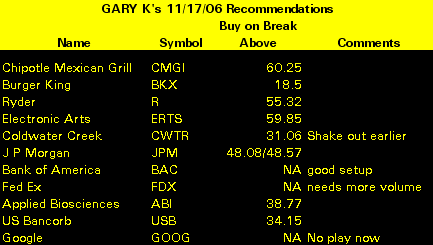 Have you visited Gary K? Gary K has one of the most informative, practicable shows. The link is the side panel.
His shown is downloadable. So you can listen at your convenience, and more importantly, you can skip through the Folicare ads.
Here are some of the stocks that Gary K mentioned in his Friday show.
I may do this from time to time. I offer this from the position of an information distiller.
Friday, November 17, 2006
Eulogy
It is with great sadness that I commit to eternal rest my BAC and AIG put that expired %^#$#!^ worthless today.
My thesis was that Fed rates would hold or even go up and that market would go down. Investment income would be hurt at AIG, but how was I to know that the hurricance season would be well a bust. Both BAC and AIG were experiencing rollover at the time of my purchase, but they did not roll. %#@#!%#% it.
Humorous Lesson: I should have gone out and bought some obscenely expensive wine and taken a bath in it and I would have had the same utility.
Real lesson: Never, ever, ever, buy a put or call option for an amount of money whose worthless expiration amount would make you cry. I didn't with either of these. If you are buying puts or calls, make sure that you understand your risks. I took a measured risk on both of these. I'm not crying. But the ouch factor is real.
My thesis was that Fed rates would hold or even go up and that market would go down. Investment income would be hurt at AIG, but how was I to know that the hurricance season would be well a bust. Both BAC and AIG were experiencing rollover at the time of my purchase, but they did not roll. %#@#!%#% it.
Humorous Lesson: I should have gone out and bought some obscenely expensive wine and taken a bath in it and I would have had the same utility.
Real lesson: Never, ever, ever, buy a put or call option for an amount of money whose worthless expiration amount would make you cry. I didn't with either of these. If you are buying puts or calls, make sure that you understand your risks. I took a measured risk on both of these. I'm not crying. But the ouch factor is real.
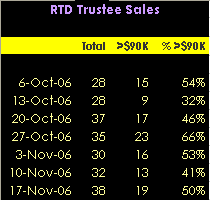
Thursday, November 16, 2006
Rememberances
Nona's post on my home brought a funny memory I wanted to share.
I have two cool things in my home. Now, I write this telling you that I have a modest home--if any of this comes off as arrogance in anyway, it is unintentional. As Mark and I were eating dinner this evening, we talked about the gratitude that we have for everything that we have. Our modest needs are easily fulfilled. But I will tell you, that if we ran with a different crowd, I would feel that we were wanting for something. I'm glad that my social aspirations are modest. Okay...now onto the cool things....
Cool thing #1. I have this baroque mantel made of solid walnut. I found it at an antique dealer and it was covered with antique white, leaded paint. In a word...gaudy. I paid $350 for it in 1985--lots of money for me.
I brought it home--like a cat bringing its master a treat. Rather than gratitude, I suffered scorn..two-fold scorn. One of my former Peat Marwick colleague's husband, Doug, (a banker but former summer plumber's helper helping Mark with the rough-in) AND my husband laughed at me when I brought it home. My husband mocked, "You paid HOW much for THAT?" I can still hear Doug and Mark's cackling. Now you have to understand that nothing is more unpleasant for me than "paying too much" for something. I'm not sure where that gene came from, but it's the honest truth, and it embarrasses me profoundly and has caused many a sleepless night.
Anyway....the next day, my husband is bitchin'(excuse the profanity) to Buck, the cabinet man. You have to know Buck. He is a master craftsman, but a very quiet, deliberate man. In addition to making lovely cabinetry, he restores antique automobiles...pristinely.
Buck listens to Mark's lament of having a wife bringing home such crap at high prices. After the tirade, Buck quietly says to Mark..."Do you want to double your money now?" That statement stops Mark (and gives me a priceless "I told you so moment" that wives must always have in their quiver!)dead. Buck then benevolently offers to take the mantle in his service van to this place risque-ly called "The City Stripper" to have it vat stripped. It cost $100 to have this done. Yes, that is alot of money While there, they receive many offers to buy the mantle for about 6x what I paid for it. Vindication. We built our downstairs fireplace to accomodate this mantel. I also have a fireplace in our bedroom. A very plain, beautiful solid cherry mantel adorns that. We've never used it, but at the time, we felt like a fireplace in a master bedroom would be a good resale value.
When I received the mantle back it required much TLC. Stripping any type of wood raises the grain. Much sanding was needed. It has rope moulding, dental molding, hand carved flowers and carved posts. I did it all and put several tung oil applications in between each sanding. It's beautiful. Likely larcenous as well, as the owner of the place that I bought if from spent some time in jail for stealing things out of older homes. The City Stripper guessed its age as mid 1800's. With its age and all that tung oil, it will likely have spontaneous combustion and burn my home down.
Second neat thing. I have this bronze light fixture from the University of Richmond. Some bright soul sold these "surplus" fixtures for $25 each. They are about 4 feet from stem to stern with white semi-opaque glass. We (Tim/Mark) framed our stairway to handle it. It's monstrously beautiful. After they realized what they had done, they offered some terrific tax credit--I think it was a $3K tax credit. The fixtures cost them $7800 to replace. I think I got a good deal, don't you? The beauty of being poor as we were at the time is that the tax credit did not really mean too much! I now have an SIL who works at University of Richmond. Strange karma indeed.
I have two cool things in my home. Now, I write this telling you that I have a modest home--if any of this comes off as arrogance in anyway, it is unintentional. As Mark and I were eating dinner this evening, we talked about the gratitude that we have for everything that we have. Our modest needs are easily fulfilled. But I will tell you, that if we ran with a different crowd, I would feel that we were wanting for something. I'm glad that my social aspirations are modest. Okay...now onto the cool things....
Cool thing #1. I have this baroque mantel made of solid walnut. I found it at an antique dealer and it was covered with antique white, leaded paint. In a word...gaudy. I paid $350 for it in 1985--lots of money for me.
I brought it home--like a cat bringing its master a treat. Rather than gratitude, I suffered scorn..two-fold scorn. One of my former Peat Marwick colleague's husband, Doug, (a banker but former summer plumber's helper helping Mark with the rough-in) AND my husband laughed at me when I brought it home. My husband mocked, "You paid HOW much for THAT?" I can still hear Doug and Mark's cackling. Now you have to understand that nothing is more unpleasant for me than "paying too much" for something. I'm not sure where that gene came from, but it's the honest truth, and it embarrasses me profoundly and has caused many a sleepless night.
Anyway....the next day, my husband is bitchin'(excuse the profanity) to Buck, the cabinet man. You have to know Buck. He is a master craftsman, but a very quiet, deliberate man. In addition to making lovely cabinetry, he restores antique automobiles...pristinely.
Buck listens to Mark's lament of having a wife bringing home such crap at high prices. After the tirade, Buck quietly says to Mark..."Do you want to double your money now?" That statement stops Mark (and gives me a priceless "I told you so moment" that wives must always have in their quiver!)dead. Buck then benevolently offers to take the mantle in his service van to this place risque-ly called "The City Stripper" to have it vat stripped. It cost $100 to have this done. Yes, that is alot of money While there, they receive many offers to buy the mantle for about 6x what I paid for it. Vindication. We built our downstairs fireplace to accomodate this mantel. I also have a fireplace in our bedroom. A very plain, beautiful solid cherry mantel adorns that. We've never used it, but at the time, we felt like a fireplace in a master bedroom would be a good resale value.
When I received the mantle back it required much TLC. Stripping any type of wood raises the grain. Much sanding was needed. It has rope moulding, dental molding, hand carved flowers and carved posts. I did it all and put several tung oil applications in between each sanding. It's beautiful. Likely larcenous as well, as the owner of the place that I bought if from spent some time in jail for stealing things out of older homes. The City Stripper guessed its age as mid 1800's. With its age and all that tung oil, it will likely have spontaneous combustion and burn my home down.
Second neat thing. I have this bronze light fixture from the University of Richmond. Some bright soul sold these "surplus" fixtures for $25 each. They are about 4 feet from stem to stern with white semi-opaque glass. We (Tim/Mark) framed our stairway to handle it. It's monstrously beautiful. After they realized what they had done, they offered some terrific tax credit--I think it was a $3K tax credit. The fixtures cost them $7800 to replace. I think I got a good deal, don't you? The beauty of being poor as we were at the time is that the tax credit did not really mean too much! I now have an SIL who works at University of Richmond. Strange karma indeed.
Wednesday, November 15, 2006
Canadian Energy Trusts
Cramer mentioned the Canadian Energy Trusts this p.m. His logic was similar to mine. ERF, the trust that I bought in my retirement account @ an average cost of $42.45 (I flipped some in my taxable account), was up immediately to $43, and it closed at $41.17. So I'm certain I'll be in the black again, but I must admit that I cringed when it was trading at $38. I had enough exposure in my portfolio that I did not buy more at this price. So, we'll see how this works out.
MIND had a nice increase today, closing up 4.4%. It's close to a small breakout. I have a very small position of 500 shares. I may add more if there's a decent breakout.
IVGN is still green but barely.
--------------------------------------
11.16.06 Update...certitude and the market are not compatible bedfellows. I think that if oil had not gone down $2 my comments would have stuck. But I'm egalitarian, and I would rather have cheaper oil than money to stave off starvation cum retirement.
MIND had a nice increase today, closing up 4.4%. It's close to a small breakout. I have a very small position of 500 shares. I may add more if there's a decent breakout.
IVGN is still green but barely.
--------------------------------------
11.16.06 Update...certitude and the market are not compatible bedfellows. I think that if oil had not gone down $2 my comments would have stuck. But I'm egalitarian, and I would rather have cheaper oil than money to stave off starvation cum retirement.
Tuesday, November 14, 2006
Alternate Universes
Hmmm....I've had a couple of folks note that formatting appeared strange. When I view the blog I do not see these problems; however on the forwarded page that one of my blogger-friends sent over there is odd HTML stuff. I'm not sure how to handle, but I appreciate your patience and apologize for the odd look.
Sunday, November 12, 2006
On Recessions and Bear Markets...a Marty Zweig Perspective
In the early 90’s I was a Consulting CFO for an institution. As such, I served as staff for the Investment Committee of the Board.We were interviewing a number of firms, Martin Zweig’s fund being one of them.I didn’t meet Marty Zweig, but I remember that the presenters did a bang up job presenting.I believe that we must have chosen his firm, as I received an autographed (07/21/92) “Leisa-I appreciate your confidence, Marty” of his book "Winning on Wall Street (WOWS)". I did not read the book until this past year or so. There is some shame in that admission.But the point of this post is not to brag about the autograph (it is my only brush with investment celebrity, though Barron’s did print the one and only Letter to the Editor that I wrote to them. Yes, I do live an uneventful life which is why these little snippets have outsized proportions in my delicate psyche.) In WOWS, Zweig lays out 3 conditions for a bear market.
Two Perplexions come to play in my wanting to write about Zweig’s conditions. First perplexion is that people cannot agree as to whether or not we are in a bull or bear market; and second, people cannot agree as to whether or not we are/will be in a recession. I conclude, therefore, that much of this confusion is due to the perpetual need to read the economic tea leaves or lick one’s index finger and hold it up to find out if the ill winds are blowing us toward something malefic. It’s Ed Young’s Seven Blind Mice but we have to winnow out all of the confusion among the 100 (or so) blind mice that serve as market pundits.
I like Zweig's objective parameters. It provides some empiricism for us to evaluate the opinions of other market opinion makers. Zweig writes:
Zweig defines a bear market as follows: “a decline of at least 15% in each of the three important stock averages:the Dow Jones Industrials, the S&P 500 Index and the Zweig Unweighted Price Index (or the Value Line Indes, if you prefer).” I suppose that one could throw in the NASDQ to replace the ZUPI/VL index. I’m not sure if anyone has addressed this. Based on his definition, as there was not at least a 15% decline in all three indices in June/July, I’m not sure that we had a bear market within this description. See table below of May highs/June-July lows for DJI, NASD and S&P.None of the main averages achieved a decline of this magnitude.
Extreme deflation characterized by a PPI index drop of 10% on a 6 month average of annualized m-t-m changes.Take current year m-t-m inc/dec and average it with the last 5 months (sum the mtm change each month for the last six months and divide by 6).If that 6 month average is at least –10% then you have cleared this test; (I've not calculated this. I don't think we are there. I think that with the ISM falling, we will BEGIN to see where that calculation becomes meaningful).
Ultra high price/earnings ratios.He labels 10-14 aS normal P/E range. Upper teens and twenties is what he calls high; and (we are in this level now).
Inverted yield curve.Zweig used the Moody’s Aaa Corporate Bonds yield as the long term rate and 6 month commercial paper rates as the short term rate. (I've not calculated this). Addendum 11.13.06--Of course we all know that we have an inverted yield curve, and SFO did a wonderful story on that which you can find here. http://www.sfomag.com/articledetail.asp?ID=1946685477&MonthNameID=July&YearID=2 I've just not calculated it using MZ's method. So, some food for thought as we think about recessions and market corrections.
Two Perplexions come to play in my wanting to write about Zweig’s conditions. First perplexion is that people cannot agree as to whether or not we are in a bull or bear market; and second, people cannot agree as to whether or not we are/will be in a recession. I conclude, therefore, that much of this confusion is due to the perpetual need to read the economic tea leaves or lick one’s index finger and hold it up to find out if the ill winds are blowing us toward something malefic. It’s Ed Young’s Seven Blind Mice but we have to winnow out all of the confusion among the 100 (or so) blind mice that serve as market pundits.
I like Zweig's objective parameters. It provides some empiricism for us to evaluate the opinions of other market opinion makers. Zweig writes:
”The big money is made or lost in stocks during the most violent bull and bear markets. The bad news for those who crave action is that the market does not behave dynamically all that often. Even within the great bull market advances, there are periods of lull. I would estimate that stocks spend only about 20% of the time in the most active phases of the bull trend and only about 10% in the severe downward periods of major bear markets.Roughly 70% of the time stocks either meander in a neutral trading range or undergo minor rallies or declines within their various bull and bear cycles.During that 70% span—let’s call it the neutral area—your overall market strategy does not matter all that much…."
Zweig defines a bear market as follows: “a decline of at least 15% in each of the three important stock averages:the Dow Jones Industrials, the S&P 500 Index and the Zweig Unweighted Price Index (or the Value Line Indes, if you prefer).” I suppose that one could throw in the NASDQ to replace the ZUPI/VL index. I’m not sure if anyone has addressed this. Based on his definition, as there was not at least a 15% decline in all three indices in June/July, I’m not sure that we had a bear market within this description. See table below of May highs/June-July lows for DJI, NASD and S&P.None of the main averages achieved a decline of this magnitude.
Extreme deflation characterized by a PPI index drop of 10% on a 6 month average of annualized m-t-m changes.Take current year m-t-m inc/dec and average it with the last 5 months (sum the mtm change each month for the last six months and divide by 6).If that 6 month average is at least –10% then you have cleared this test; (I've not calculated this. I don't think we are there. I think that with the ISM falling, we will BEGIN to see where that calculation becomes meaningful).
Ultra high price/earnings ratios.He labels 10-14 aS normal P/E range. Upper teens and twenties is what he calls high; and (we are in this level now).
Inverted yield curve.Zweig used the Moody’s Aaa Corporate Bonds yield as the long term rate and 6 month commercial paper rates as the short term rate. (I've not calculated this). Addendum 11.13.06--Of course we all know that we have an inverted yield curve, and SFO did a wonderful story on that which you can find here. http://www.sfomag.com/articledetail.asp?ID=1946685477&MonthNameID=July&YearID=2 I've just not calculated it using MZ's method. So, some food for thought as we think about recessions and market corrections.
Saturday, November 11, 2006
A Brilliant Fall Day
Today is one of those truly glorious days. Clear and 79 degrees...no matter that it is November. Virginia has the most beautiful shoulder months. After my Medicare post, I decided that I should re-engage with some healthful habits. I took my dogs out for a walk. I later came back and snapped a couple of pictures. The odd angle on the leaf is because the wind was blowing it.
We live on 6.5 beautiful wooded acres. We bought this land back in 1984. I was 24 years old, my husband 29. We were so very poor, as I was just out of college in 05/82, and my husband had been out of work for a while due to the recession (commercial electrician). But we managed to buy this piece of land because there was owner financing--something that I'm eternally grateful for.
We literally designed and built our own home. Because the land was so perfect, we were faced with the dilemma of building a home that we could afford with sufficient quality that we would not say in 20 years, we were still living in a "starter home". The financial aspect was daunting; and the physical aspect was almost impossible at times. My husband and a 65 year old carpenter/mason built the house. Tim is dead now, but he was a master craftsman. Tim and Mark hand cut all of the rafters, framed the structure without the benefit of pneumatic equipment, and mixed mortar and laid brick. My husband nailed every plank of red oak flooring...we put it everywhere except the kitchen and bathrooms. I still remember one sweltering August evening where the air was so thick with humidity we were drenched. I laid out each piece so that my husband could nail it. I wiped up every drop of sweat that cascaded off his nose onto the boards. We truly had sweat equity. I painted everything--every piece of trim, every wall, stained the cedar on the back of the house and trimmed the exterior doors and windows. I do not paint anymore. I did a lifetime of painting then.
We did most things right. We did a few things wrong. Our drywall contractor was a hack. Our cabinet man pointed that out. We didn't know. Buck said that the finish coat would not be acceptable because they had not put enough mud behind the tape. We had to hire another drywall contractor. Before he could start, Mark's job was to take a garden sprayer and spray every !#@%^#@ seam and pull the tape off. It took him two days, and by the end of the second day, he could barely move his arms his shoulders were so sore.
It took us nine months. We planned meticulously. We had to make our own decisions on very damn thing. No one offered us 3 choices of this or that. We had the universe of possibilities that we had to winnow down to meet our budget and our mutual tastes. I remember laying awake at night with my heart pounding (I didn't realize at the time that these were anxiety attacks) thinking about the credit card debt that was amassing (I used that in between draws) and the $400 per month Amoco bill that I was having trouble meeting. My husband wasn't working, and I was making $20K per year. And we decided early on that we would manage our budget to a payment that I could make solely on my salary, given that commercial electrical work had suffered so badly during that time. Our mortgage principal was $65K, and we secured a 20 year mortgage. We conservatively figured that we had saved about $50K doing much of the work ourselves.
Today we live in a home that we probably could not afford to buy currently. So when we have a beautiful day such as today, that is clear and crisp, I'm frequently reminded of those sweltering August days where sweat and expletives flowed freely. And I'm reminded how important planning, courage, confidence and a measure hope are to building your life. Of even greater importance is finding people who will support your work. So many helped us along the way--the engineering/contracting firm that our banker made us hire to ensure that if Mark and I floundered someone would step in and finish the house. Tim and Buck who gave us quality craftsmanship. My banker who made the draw process flexible and stopped by from time to time to check on us. Our parents who worried over our over committed physical and financial resources.
As I build my financial house, I'm reminded of the process of building my physical home. I'm certainly wiser now than I was then, but in many ways I'm like that 24 year old--I'm going to charge ahead. I'm going to plan meticulously, be realistic in my expectations and work hard. I have lots of support, and I've found lots of resources. Perhaps 20 odd years from now, I'll be writing of this financial house building launch as I am writing now of my house building launch.
We live on 6.5 beautiful wooded acres. We bought this land back in 1984. I was 24 years old, my husband 29. We were so very poor, as I was just out of college in 05/82, and my husband had been out of work for a while due to the recession (commercial electrician). But we managed to buy this piece of land because there was owner financing--something that I'm eternally grateful for.
We literally designed and built our own home. Because the land was so perfect, we were faced with the dilemma of building a home that we could afford with sufficient quality that we would not say in 20 years, we were still living in a "starter home". The financial aspect was daunting; and the physical aspect was almost impossible at times. My husband and a 65 year old carpenter/mason built the house. Tim is dead now, but he was a master craftsman. Tim and Mark hand cut all of the rafters, framed the structure without the benefit of pneumatic equipment, and mixed mortar and laid brick. My husband nailed every plank of red oak flooring...we put it everywhere except the kitchen and bathrooms. I still remember one sweltering August evening where the air was so thick with humidity we were drenched. I laid out each piece so that my husband could nail it. I wiped up every drop of sweat that cascaded off his nose onto the boards. We truly had sweat equity. I painted everything--every piece of trim, every wall, stained the cedar on the back of the house and trimmed the exterior doors and windows. I do not paint anymore. I did a lifetime of painting then.
We did most things right. We did a few things wrong. Our drywall contractor was a hack. Our cabinet man pointed that out. We didn't know. Buck said that the finish coat would not be acceptable because they had not put enough mud behind the tape. We had to hire another drywall contractor. Before he could start, Mark's job was to take a garden sprayer and spray every !#@%^#@ seam and pull the tape off. It took him two days, and by the end of the second day, he could barely move his arms his shoulders were so sore.
It took us nine months. We planned meticulously. We had to make our own decisions on very damn thing. No one offered us 3 choices of this or that. We had the universe of possibilities that we had to winnow down to meet our budget and our mutual tastes. I remember laying awake at night with my heart pounding (I didn't realize at the time that these were anxiety attacks) thinking about the credit card debt that was amassing (I used that in between draws) and the $400 per month Amoco bill that I was having trouble meeting. My husband wasn't working, and I was making $20K per year. And we decided early on that we would manage our budget to a payment that I could make solely on my salary, given that commercial electrical work had suffered so badly during that time. Our mortgage principal was $65K, and we secured a 20 year mortgage. We conservatively figured that we had saved about $50K doing much of the work ourselves.
Today we live in a home that we probably could not afford to buy currently. So when we have a beautiful day such as today, that is clear and crisp, I'm frequently reminded of those sweltering August days where sweat and expletives flowed freely. And I'm reminded how important planning, courage, confidence and a measure hope are to building your life. Of even greater importance is finding people who will support your work. So many helped us along the way--the engineering/contracting firm that our banker made us hire to ensure that if Mark and I floundered someone would step in and finish the house. Tim and Buck who gave us quality craftsmanship. My banker who made the draw process flexible and stopped by from time to time to check on us. Our parents who worried over our over committed physical and financial resources.
As I build my financial house, I'm reminded of the process of building my physical home. I'm certainly wiser now than I was then, but in many ways I'm like that 24 year old--I'm going to charge ahead. I'm going to plan meticulously, be realistic in my expectations and work hard. I have lots of support, and I've found lots of resources. Perhaps 20 odd years from now, I'll be writing of this financial house building launch as I am writing now of my house building launch.


Friday, November 10, 2006
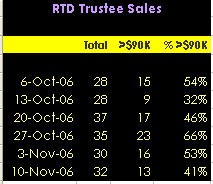
Wednesday, November 08, 2006
Election
Our Virginia senate race as stilled not been called. It looks like Webb is ahead by the narrowest of margins. Certainly there will be a recount.
I voted around 2 p.m. yesterday. I had to wait 5 minutes--unusual, and certainly less time than than the folks in Denver had to wait. Anyway, the election official said that it was 2x the turnout as last election.
I voted around 2 p.m. yesterday. I had to wait 5 minutes--unusual, and certainly less time than than the folks in Denver had to wait. Anyway, the election official said that it was 2x the turnout as last election.
Tuesday, November 07, 2006
Trustee Sales Update

These listings were too compelling to ignore. The number of sales in the > than $300K range is noteworthy. Friends, these numbers are growing. NEVER have I seen this many large balances in one listing. NEVER. I'm not sure if I'm not sure if they will show up on Friday. I think that I'll start providing something like this in the future. In fact, I think that I'll send my other table to the editor of my paper and see if they post it in the letters to the editor. I'll see if I can find archival listings for same periods last year.
Today's Perplexion
The market has continued to astound. Tim Knight, perma bear extraordinaire, has almost capitulated, read his blog, Electile Dysfunction (http://tradertim.blogspot.com/). Rev Shark (Real Money, subscription required) calls the market "frothy. "
In my amateur view, there is a dissonance in the market that has to be resolved. That dissonance is the actual state of the US Economy and the global economy v. the perceived state of those economies. Part of the US economic dissonance (all call that ED) is the error rate in the jobs data. With the BLS making such an enormous error in the past--finding 800+K new jobs--it's hard to take the current information at its face value.
While I find conspiracy theories titillating (I'm an accountant, we get so few opportunities to be titillated), I don't necessarily subscribe to them. But one has to wonder IF the Fed were aware of the "real" employment numbers, would our rate hikes have been accelerated a bit. My answer to that hypothetical question would be yes.
When one is trying to find his/her way through the enormity of conflicting information, getting to basics helps (which includes throwing a few things out).


In my amateur view, there is a dissonance in the market that has to be resolved. That dissonance is the actual state of the US Economy and the global economy v. the perceived state of those economies. Part of the US economic dissonance (all call that ED) is the error rate in the jobs data. With the BLS making such an enormous error in the past--finding 800+K new jobs--it's hard to take the current information at its face value.
While I find conspiracy theories titillating (I'm an accountant, we get so few opportunities to be titillated), I don't necessarily subscribe to them. But one has to wonder IF the Fed were aware of the "real" employment numbers, would our rate hikes have been accelerated a bit. My answer to that hypothetical question would be yes.
When one is trying to find his/her way through the enormity of conflicting information, getting to basics helps (which includes throwing a few things out).
- While corporate profits have been phenomenal, the guidance has been lower for a majority of corporations. CAT and HON were notable. I'm surprised (okay, not really) how little air time has been given to this statistic This was pulled from Birinyi Associatiates and you can find it here http://tickersense.typepad.com/ticker_sense/2006/week44/index.html. To be fair, the % of companies guiding lower is declining; therefore, I would find this graph more compellingly ominous if the lower guidance were higher than the 6% guidance. There seems to be quite a few silent companies regarding future guidance...
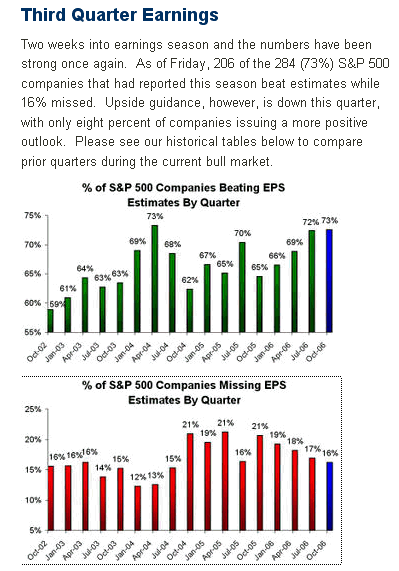
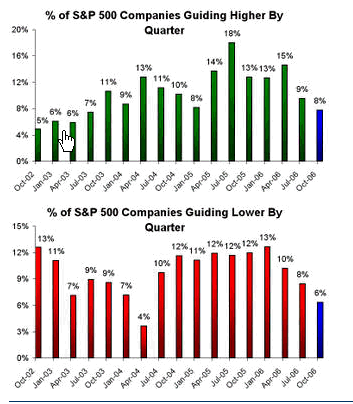
- Gold is going up. Inflation worries? Demand fundamentals? (The same could be asked regarding oil, non-precious metals) Some mixture of both that confounds the average person? I'm betting on the latter.
- Election jitters....puhleeze....there's enough mischief and shame shared between the two parties that if they monetized it we'd have no national debt.
- Economic indicators? They are pointing to a slow down. Watch inventories. Increasing inventories mean decreasing prices and slowing production (margin squeeze). The ISM number is key. 50 is the magical number that is tell tale of a slowdown. We are only getting teased now.
- Housing? Greenspan says the worst is behind us. Is he even relevant now? I'm not really looking for an answer to that. It may be bottoming, but I see a long, flat bottom. The real key to who is ultimately right in the expected market direction will be the effect of housing slowdown on the economy. If it is benign, then that is fuel for the rising market fire. If it is malevolent, then you have the makings of a shock. I'm not sure if benign is the middle ground. I do think that we are still unfolding this data, and we'll have greater clarity in the next 90 days.
- Interest rates--I think that they will go up, or at least not come down for a while. So the inversion lasts a wee bit longer.
- Propensity of surprise indicator? High on each of these, so it throws out the whole thing! Just hang onto your seat and squeal with glee!
Friday, November 03, 2006
Pictures
I'm not great photographer, but I try. I went to Spain for 2 weeks on a wine tour. It was one of the most memorable things I have ever done. A splurge. No husband. No children. My goal was to master (okay learn) how to use my digital camera more facilely. I have an Olympus C-5060 (5.1 Megapixel).
The fetching woman below is Queen Isabel. I snapped it in Spain (May 2005), in the place of her tomb. I'm forgetting the name of the place, but it was a monastery outside of Segovia. The place was fascinating. All of the kings/queens of Spain were buried here. It was one of the most wondrous places I have seen. Stately, somber. Green marble alcoves housed majestic black caskets with brass trims were in the lower chapel. In the upper levels were all of the lesser wives and children, cousins, etc. Beautiful crypts with alabaster carvings or plain carved facings. It's a place where the quiet envelopes you. A peaceful place.
The fetching woman below is Queen Isabel. I snapped it in Spain (May 2005), in the place of her tomb. I'm forgetting the name of the place, but it was a monastery outside of Segovia. The place was fascinating. All of the kings/queens of Spain were buried here. It was one of the most wondrous places I have seen. Stately, somber. Green marble alcoves housed majestic black caskets with brass trims were in the lower chapel. In the upper levels were all of the lesser wives and children, cousins, etc. Beautiful crypts with alabaster carvings or plain carved facings. It's a place where the quiet envelopes you. A peaceful place.

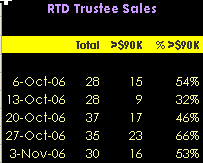
Some amateur technical talk....
 gemma star, I post this because after your comment, I looked at TU. I must have reviewed this stock before, because I see I did a few line studies.
As my own belief is that fundamental and technical analysis are important to making investment decisions (though you have purists on either end who would vehemently disagree), I try to increase my technical skills. To do so, I have found it good practice to ambulance chase certain stocks on bad news and attempt to identify support. I don't commit capital unless I know something specific about the company. For IVGN, it was a company that I followed. If my IVGN breaches former support of $55.72, shown in the yellow line below, I'm outta there!
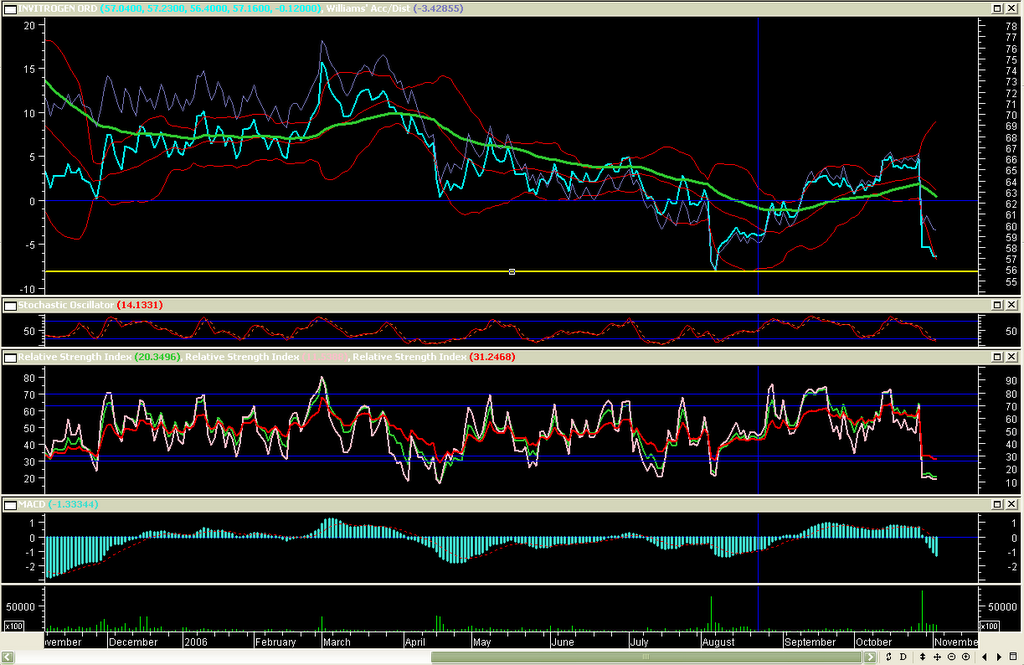
Canadian Energy Trusts, Redux
Here's something from Barron's that gives more color.... Also, if you are interested, check out Bill Cara here http://www.billcara.com/archives/2006/08/about_those_cdn.html
UP AND DOWN WALL STREET DAILY |
By RANDALL W. FORSYTH
The new tax treatment wouldn't take effect until 2011, however, and wouldn't even hit Canadian investors, explains Robert Willens, Lehman Brothers' tax expert. "For Canadians, it's irrelevant." Canadian investors can "impute" taxes paid by corporations, effectively getting around the double taxation of dividends, which the "primitive" U.S. tax system doesn't allow, he adds. As part of tax change, the Canadian corporate tax rate also will be lowered to 18.5%.
The only beneficiaries of the current royalty-trust structure are tax-exempt investors, such as retirement funds and endowments, and non-residents. "It's all about U.S. investors," Willens says of the proposed tax change, which he says will likely gain passage because it was proposed by the supposedly business-friendly Conservative government.
-------------------------------
So throw out my due process comment. But...it seems like the rest holds reasonably well.
Thursday, November 02, 2006
Canadian Energy Trusts. . .
take it on the chin. If I understand it correctly, existing trusts will be taxed in four years while any new trusts get the tax shaft next year. Now this sort of thing plays right into my bias of following the stampede and looking for the carnage, so long as there is some risk mitigation. My expectation is that something happening in 4 years is not a reason to give up the ghost now.
In looking over the trusts, I elected to buy some ERF. Here's a look at the chart (Click to enlarge):
 My average cost is $41.87 today. It closed at $42.29. They pay a .42 dividend on 11/08. Here's my thesis.:
Don Coxe (BMO Harris), who is no longer freely available, has been a huge proponent of geopolitically safe oil reserves. The Canadian oil plays fit that bill. I imagine though that any who have loaded the boat on these must be in pure agony now, for these oil trusts have declined 20+% over the news.
Now if my gourd is working correctly (and we are in the right season for gourds), the real risk is the price of oil, which I grant has been under much suspicion of late, and that's a discussion for another day. The price of oil affects earnings (near and far term) regardless of tax implications. And oil has been under pressure. But a 10% dividend rate is nothing to sniff at--and if in the US rates start to decline,--the search for yield will be relentless.
If there is such a thing as due process in Canada, there is a potential upside: the hew and cry may be so great that the politicians may come up with something more palatable for existing trusts while achieving their goal of abating the massive conversions to a trust.
In summary for ERF my investment thesis is
I found this article post post....I feel like my thinking is sound.
http://www.marketwatch.com/news/story/story.aspx?guid=%7BA46AED29-0D72-4965-82E9-E4F2CFD1FC57%7D
------------------------
An update on my other theses for IVGN and MIND. IVGN currently has an .82 (1.46%) per share gain over my entry point and MIND has a .04 (.4%) gain over my entry point. Pretty thin margins!
In looking over the trusts, I elected to buy some ERF. Here's a look at the chart (Click to enlarge):
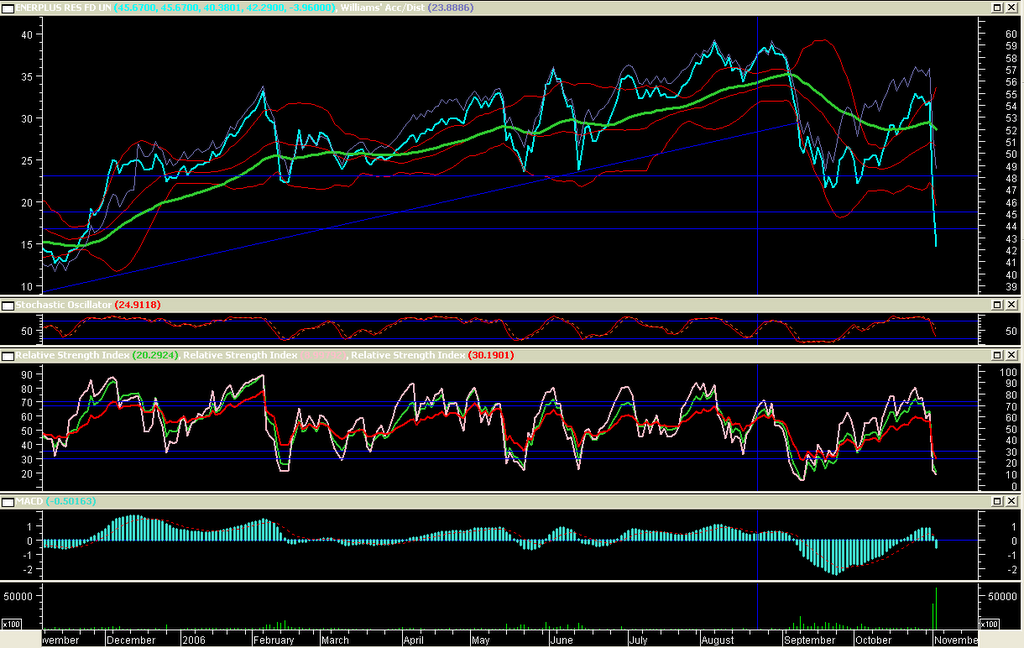 My average cost is $41.87 today. It closed at $42.29. They pay a .42 dividend on 11/08. Here's my thesis.:
Don Coxe (BMO Harris), who is no longer freely available, has been a huge proponent of geopolitically safe oil reserves. The Canadian oil plays fit that bill. I imagine though that any who have loaded the boat on these must be in pure agony now, for these oil trusts have declined 20+% over the news.
Now if my gourd is working correctly (and we are in the right season for gourds), the real risk is the price of oil, which I grant has been under much suspicion of late, and that's a discussion for another day. The price of oil affects earnings (near and far term) regardless of tax implications. And oil has been under pressure. But a 10% dividend rate is nothing to sniff at--and if in the US rates start to decline,--the search for yield will be relentless.
If there is such a thing as due process in Canada, there is a potential upside: the hew and cry may be so great that the politicians may come up with something more palatable for existing trusts while achieving their goal of abating the massive conversions to a trust.
In summary for ERF my investment thesis is
- + dividend of .42/share provides downside protection of same (though the shares may dip post 11/08)
- + greater clarity post exodus by clearer thinking may provide boost in share price
- - oil price decrease will deflate shares as income will be reduced
- +oil price increase will inflate shares..............
- - hew and cry may result in some repeal or softening...think about what that might do (but I don't know the predispositions of the Canadian government, but I think that some mitigation via due process could very well be likely--though complete conjecture, it is a possibility).
I found this article post post....I feel like my thinking is sound.
http://www.marketwatch.com/news/story/story.aspx?guid=%7BA46AED29-0D72-4965-82E9-E4F2CFD1FC57%7D
------------------------
An update on my other theses for IVGN and MIND. IVGN currently has an .82 (1.46%) per share gain over my entry point and MIND has a .04 (.4%) gain over my entry point. Pretty thin margins!
Subscribe to:
Posts (Atom)