I fell off a cliff due to work responsibilities (my busiest time of year). I'm back with the weekly sector report for the week ending 03/04/2017.
You can find the complete report here.
The report is a large PDF file which you can download or review through Box.com's previewer. It contains the weekly charts for both the broad industry/supersectors as per the Dow Jones Sector Hierarchy and then all of the subsectors.
I hope that you find this useful in your market research.
Saturday, March 04, 2017
Monday, January 23, 2017
Weely Sector Report | 01/20/2017
Below are the 24 major sectors (alpha order) and their comparative performance to the Total Stock Market Index. There is an even split 12|12 positive|negative for the week.

I have also provide a chartbook for you for ALL of the DJUS Sectors for those of you who wish to see more granular performance which you can find HERE. I find that looking at chartbooks provides the best context for understanding discrete market information as it clearly shows which cylinders are hitting and which are missing--e.g. secotor rotation.

I have also provide a chartbook for you for ALL of the DJUS Sectors for those of you who wish to see more granular performance which you can find HERE. I find that looking at chartbooks provides the best context for understanding discrete market information as it clearly shows which cylinders are hitting and which are missing--e.g. secotor rotation.


Wednesday, January 18, 2017
SQM

Today's chart is SQM. I picked this up in a chart scan, and I entered a position. This stock has a favorable chart formation on a monthly basis. The area in green represents the longest volume bar where the price memory may still be strong.
Below is a weekly chart. I prefer to do my stock scans on a weekly chart as there is less noise.

The chart has made a strong move with pullbacks to the WEMA(21). It has also pushed through the volume at price bars where the BLUE SKY area, the area I find allows for price to move through easily (chart ether!). Now, this may not be so, but these short bars tell me that there is not much price muscle memory here $32 - $46.
I found the chart first, and then found the fundamentals.
- It is a producer of lithium--a favorable commodity in the world of rechargeable everything. Motley Fool did a write up on them, which you can find here.
- Institutional ownership is less than 20% (per J3SG) -- so there is room for growth here (so long as there is a compelling value proposition.) (I note that Finviz and J3SG have different Institutional percentages. I have no idea why. Finviz notes 43%. Either one has room for attracting buyers.
Anyway, it is worth a look. I'll update later, hopefully not with a PFFFTTT!
Embracing My Inner Nerd
The importance of having effective systems cannot be overestimated. I mentioned in a previous post that I led a one-woman revolution and deleted every single chart in my Stockcharts account. That was 9 years of chart growth.
It took me several days of invested time to rebuild my chart framework. Utilizing the excellent framework of the the Dow Jones industry/sector build, my charts are presented numerically, so they order perfectly in accordance with their industry/sector, are named with the industry symbol and the sector name. It creates the perfect index from my summary sector chart book with 108 charts to each of the individual sectors that contains a chartbook for all of the sector constituents.
"Why bother?" you might reasonable ask. There are two reasons.
Reason 1: In test driving my system this week, and I found that identifying opportunities occurs in a fraction of time of my other 'system': the speed due to the indexing nomenclature that allows me to go from the one list (all sectors) to the many (all charts).
I use the following resources, cobbled together in a fashion that suits my needs:
In the past, I've not let my system work as intended as I didn't trust what I was seeing because no one else was talking about it. I want to share these two quotes comes from Justin Mamis, from The Nature of Risk--I offer them because I think that they are the cornerstones of how I feel that I must go about my work.
So, my chart reorganization provided me with a disciplined approach to find strong sectors, strong charts in order to become more reflexive in my decision making. And being reflexive centers on discipline and confidence (like 'wax on, wax off').
It took me several days of invested time to rebuild my chart framework. Utilizing the excellent framework of the the Dow Jones industry/sector build, my charts are presented numerically, so they order perfectly in accordance with their industry/sector, are named with the industry symbol and the sector name. It creates the perfect index from my summary sector chart book with 108 charts to each of the individual sectors that contains a chartbook for all of the sector constituents.
"Why bother?" you might reasonable ask. There are two reasons.
Reason 1: In test driving my system this week, and I found that identifying opportunities occurs in a fraction of time of my other 'system': the speed due to the indexing nomenclature that allows me to go from the one list (all sectors) to the many (all charts).
I use the following resources, cobbled together in a fashion that suits my needs:
- Stockcharts
- StockFetcher--this gives more flexibility in sorting and finding stuff than Stockcharts
- Finviz - gives great profile information and summary information but lacks OTC data and their charting is not to my liking.
- J3SG.com--provides institutional activity.
- ThinkorSwim - This provides great granularity for making entries/exits.
In the past, I've not let my system work as intended as I didn't trust what I was seeing because no one else was talking about it. I want to share these two quotes comes from Justin Mamis, from The Nature of Risk--I offer them because I think that they are the cornerstones of how I feel that I must go about my work.
We need, we crave, the trust and belief from others, but when information is insufficient we need trust and belief in ourselves. We need the discipline to accept whatever is available, and the experience to understand all the ifs, ands, and buts, and yet still take the risk: we need to be able to make the decision. (p. 79).
Discipline means choosing what to do unencumbered by the fear of making a mistake. Confidence means trusting our intuition and that what we 'see' is what we "know." (p. 80)There are 3 modes:
- Researching -- gathering the evidence
- Thinking -- integrating and making sense of the evidence
- Doing-- taking action on the evidence
So, my chart reorganization provided me with a disciplined approach to find strong sectors, strong charts in order to become more reflexive in my decision making. And being reflexive centers on discipline and confidence (like 'wax on, wax off').
Tuesday, January 17, 2017
Weekly Sector Charts_01132017
I'm working my way up to providing a more comprehensive update on sectors. I'm in a busy portion of my work life, so for now, I'll hit the highlights to include providing a comprehensive chart book on each of the sectors which you can find here. This is not on the level of what I used to do, but for now you might find it useful.
Below is a list of the top 10 and bottom 10 DJUS subsectors:

Notice that in the middle of this table seats $DWCF which is the total US market--basically unchanged.
Below is a list of the top 10 and bottom 10 DJUS subsectors:

Notice that in the middle of this table seats $DWCF which is the total US market--basically unchanged.
Friday, January 13, 2017
Sector Selector | Aluminum
Yesterday's all star sector was Aluminum. CENX increased 15.3%, but there were several other strong peformers....and a bust for ACH and KALU.

Yes, it was news driven, WTO interested in Chinese subsidies for aluminum. And, per FINVIZ, 23% of CENX float is short. Sustainable? Unsure. But it's worth keeping an eyeball on.
NVO Followup and More fun with Sectors

Bill the Cat sums up the NVO trade. Bad news came out (price fixing law suit) and knocked the chart below moving averages. (click to make larger)

More work needs to be done to repair the chart. I'm out with a nominal loss as I had a good entry. I'll let the chart figure out where it wants to go from here.
Housekeeping duties: One of my housekeeping duties was to take wholesale delete all of my Stockharts' list. Now, I've been a SC member for a long time. What I don't care for on their chart lists is that you have to load both the symbol and then name into your chart lists. Why on earth they just don't populate automatically, I'll never now.
I organized my charts in accordance with the S&P Dow Jones indices. Click here to download your very own copy. I downloaded from the website, but then I couldn't find it again--so I just uploaded my copy.
This document is a useful to see in a well organized fashion the hierarchy of sectors. I created a master chart list with all of the individual subsectors. I can see in an instant which sector is moving, and then go to the individual sector and see the charts that serve as the constituency for the sector. Yes, I LOADED all of the charts for each subsector in individual chart lists. Yes, it was time consuming, but Excel helped. I have a master spreadsheet that has the Dow Jones index symbol and all of the charts-it has almost 5400 rows on it.

It's "bookish" work, but someone has to do it. It was an investment in time, because it saves me time. And while SC has charts by each sector, you can only look at them individually instead of in a more global fashion (e. g. chartbook, thumbnails, summary). That's just poor design on their part, but I made it work for me. In my next post, I'll share my chart setup.
Thursday, January 05, 2017
Chart to Share | NVO And Some Sector Stuff that's Nice to Know
I'm back at looking at charts again after being away from it for a while. I have some favorite patterns that are high probability set ups. There is always the probability that it goes the other way. So figure out your approach and manage your risks if you are wrong.
Here's a chart that I would like to share: NVO I picked up a position @ $36.24 on 01/04/2017. I wanted to share why.

(Click on image to make larger)
Context is everything in stock picking. There is the market, the sector, and of course the individual chart as well as fundamentals. Frankly, I pay less attention to fundamentals. I don't have enough time nor interest to research and understand the salient fundamentals even though I am a financial professional. Rather, I shortcut that by using institutional support as a proxy for fundamentals and do a quick look at summary data (BS + IS + Cash flow). I figure those folks have the resources, so I'll just tag along and do cursory due diligence. I never care what insiders are doing, and I never pay attention to that.
Market and sector sentiment (e.g. what's happening to all the other frogs in the pot) all have to work together to increase odds of success in making a buy (long)/sell (short) decision with a favorable expected outcome.
I've had many market data geekfests over the years. One has to honor one's idiosyncrasies, and mine is centered on understanding salient data. I've limited my data diet to 3 things:
I have all of the sectors (major + sub) mapped in Stockcharts. I used to publish a weekly sector report on my charts to make it easy for others to see the work more elegantly I may reprise that work. For now, I use it as a gauge of understanding of what is going on in the church of what is happening now.
If you start to look at sectors regularly (e.g. a disciplined approach), you will realize that there is always a bull or bear market somewhere. Let's take a look a pharmaceuticals of which NVO is a member of. It is represented by $DJUSPR.

(Click on image to make larger)
Pharmaceuticals tumbled 15.5% from August to early November due to the well-earned negative publicity regarding drug price overcharging. The entire industry was out of favor as chart after chart will show. But no need to look at lots of charts. We can see the encapsulation in this index. Click here to be transported to the excellent WSJ FREE resource for this sector and explore other sectors. Note that the Dow Jones index for any sector is composed of X number of items while the universe of stocks that populate that sector is larger.
For example, below are the eight stocks that are constituents of the he Pharmaceuticals Index. Notice that NVO is not one of those; rather, it is a sector constituent along with 84 other stocks. As these index stocks go in composite, so goes the index. Naturally, the other members of the sector are going to feel the emotions that are governing the index. I encourage you to go to the WSJ website and explore, it is an excellent, free service with a wealth of tools that will allow you to see the market more broadly.

That's a long preamble...
As you can see from the DJUSPR index, it is making a nice "W" bottom recovery. I picked up the NVO chart on a scan looking at compressed volatility and then did my due diligence. Here's what I like about NVO:

And I will close with the top 10 Institutional Holders in NVO. Overall, there was a reduction of 10M shares among the top 10 holders. This number is not insignificant. Institutional holders will need to step in to make this price expand into a higher range. As this data is as of 09/30/2016, the 12/31/2016 filings might show
 I'll be publishing more charts that I like. None of these are recommendations, but perhaps a little bird-dogging to show you some places to hunt.
Here's a chart that I would like to share: NVO I picked up a position @ $36.24 on 01/04/2017. I wanted to share why.

Context is everything in stock picking. There is the market, the sector, and of course the individual chart as well as fundamentals. Frankly, I pay less attention to fundamentals. I don't have enough time nor interest to research and understand the salient fundamentals even though I am a financial professional. Rather, I shortcut that by using institutional support as a proxy for fundamentals and do a quick look at summary data (BS + IS + Cash flow). I figure those folks have the resources, so I'll just tag along and do cursory due diligence. I never care what insiders are doing, and I never pay attention to that.
Market and sector sentiment (e.g. what's happening to all the other frogs in the pot) all have to work together to increase odds of success in making a buy (long)/sell (short) decision with a favorable expected outcome.
I've had many market data geekfests over the years. One has to honor one's idiosyncrasies, and mine is centered on understanding salient data. I've limited my data diet to 3 things:
- Understanding the contextual dynamics of sector rotation and where to mine that information
- Understanding the behavior of Institutional Holders (they are smarter and have more resources than I do) and where to mine that information.
- Understanding how items 1 + 2 manifest in charts.
I have all of the sectors (major + sub) mapped in Stockcharts. I used to publish a weekly sector report on my charts to make it easy for others to see the work more elegantly I may reprise that work. For now, I use it as a gauge of understanding of what is going on in the church of what is happening now.
If you start to look at sectors regularly (e.g. a disciplined approach), you will realize that there is always a bull or bear market somewhere. Let's take a look a pharmaceuticals of which NVO is a member of. It is represented by $DJUSPR.

(Click on image to make larger)
Pharmaceuticals tumbled 15.5% from August to early November due to the well-earned negative publicity regarding drug price overcharging. The entire industry was out of favor as chart after chart will show. But no need to look at lots of charts. We can see the encapsulation in this index. Click here to be transported to the excellent WSJ FREE resource for this sector and explore other sectors. Note that the Dow Jones index for any sector is composed of X number of items while the universe of stocks that populate that sector is larger.
For example, below are the eight stocks that are constituents of the he Pharmaceuticals Index. Notice that NVO is not one of those; rather, it is a sector constituent along with 84 other stocks. As these index stocks go in composite, so goes the index. Naturally, the other members of the sector are going to feel the emotions that are governing the index. I encourage you to go to the WSJ website and explore, it is an excellent, free service with a wealth of tools that will allow you to see the market more broadly.

That's a long preamble...
As you can see from the DJUSPR index, it is making a nice "W" bottom recovery. I picked up the NVO chart on a scan looking at compressed volatility and then did my due diligence. Here's what I like about NVO:
- In a sector that is recovering
- Is showing recovery (accumulation) on its chart
- prices are consolidating in a narrow range foreshadowing a range expansion (up or down--no one has a crystal ball)
- volume is increasing
- volume air pocket above denotes a low volume of potential sellers waiting to ease their pain should price move up. My experience is that such volume profiles attract price movement as there are not a lot of eager sellers. (The converse is if there is a large volume bar and low pockets below. The sellers are in your current volume bar and if price drops they sell).
- It has excellent institutional support (though I qualify that below)
- Renaissance Technologies holds this as its #1 position as of 09/30/2016. Below are their top 10 holdings from J3SG.com (fabulous, free resource).

And I will close with the top 10 Institutional Holders in NVO. Overall, there was a reduction of 10M shares among the top 10 holders. This number is not insignificant. Institutional holders will need to step in to make this price expand into a higher range. As this data is as of 09/30/2016, the 12/31/2016 filings might show

Friday, December 30, 2016
New Year
No one is more ready for a New Year than I am. I'm ready to toss this wretched old thing to the curb. In addition to personal tragedy, the political silliness and meanness was stressful, sad and exhausting.
If I were to have one wish for the new year, that would be to compel our leadership--no matter which side of the aisle or ideology they stand to embrace the precepts embodied here:
I've had this on my Wisdom Page for a long time. I was compelled to come back to it this year. It is simple. It is powerful. It is a singular call to action. It works at any level of our personal or political lives.
If I were to have one wish for the new year, that would be to compel our leadership--no matter which side of the aisle or ideology they stand to embrace the precepts embodied here:
In the time of war
Raise in yourself the Mind of Compassion
Help living beings
Abandon the will to fight
Wherever there is a furious battle
Use all you might
To keep both sides' strength equal
And then step into the conflict to reconcile.
Vimalakirti Nirdesa
Wednesday, December 28, 2016
Process
I found myself discussing the importance of 'process' with someone recently. The essential: If the process is well thought out and well executed, then the outcome will be shaped accordingly. This was my observation shaped by decades of business experience. I was speaking specifically in terms of leveraging the expertise of different constituencies to tackle large organization/institutional initiatives. But it applies to solo endeavors as well.
What am I talking about? I'm talking about the importance of overlaying a solid process to achieve a desired outcome. It means that whatever goal we are tackling, our process that we develop (and follow!) toward achieving that goal is one of the greatest predictors of our success in reaching that goal.
Some examples. If we want to get physically fit, then we need an exercise plan that will incorporate nutrition, strength, cardiovascular and flexibility components to achieve optimum results. If we want to be fiscally fit, then we need a financial plan that will incorporate proper savings and spending levels, and an investment plan that makes sense for our risk profile.
Hopefulness that in our doing nothing will yield great results will universally result in poor outcomes--unless one is extremely luckily. My sitting here typing coupled with great hope that my cardiovascular fitness will improve will yield a disappointing result. Living beyond one's means consistently will not yield good results for long term savings.
There are many other types of examples. Regardless of our goal, the same overlay stands: a considered approach to any desired outcome is the result of good planning and hard work. Thus, the aphorism, "Luck is where opportunity and preparedness meet."
Notwithstanding our best efforts to consider all things in our plan, we can be certain that unanticipated events may unfold. No one has a crystal ball. No one. So when such things happen, having some grace and courage under fire helps us craft Plan B. There's no shame in having a Plan B. I've been in business situations where I have had to have a Plan C in addition to A and B.
The key to successful execution on those plans (any plan) is simply to say if "X" happens then I will do "Y". The discipline is to not shrug when "X" presents itself, but rather to act. If I have another accident in my car, I will take driver's lessons. If my weight gets beyond ###, I will cut back on sweets.
Simply put:
Shit always happens which is why it was my favorite bumper sticker in the 1980's. True then. True now. Naturally the upcoming New Year is rousing such thoughts. I'm going to dial back to 2008 when I produced a Mind Map of my resolutions...(Rummaging in blogger bin......) Here it is.

It is sad to have to put 'fun' on a resolution list. But this was my "balanced score card approach". It does work...so long as one maintains the rigor of managing by it.
What am I talking about? I'm talking about the importance of overlaying a solid process to achieve a desired outcome. It means that whatever goal we are tackling, our process that we develop (and follow!) toward achieving that goal is one of the greatest predictors of our success in reaching that goal.
Some examples. If we want to get physically fit, then we need an exercise plan that will incorporate nutrition, strength, cardiovascular and flexibility components to achieve optimum results. If we want to be fiscally fit, then we need a financial plan that will incorporate proper savings and spending levels, and an investment plan that makes sense for our risk profile.
Hopefulness that in our doing nothing will yield great results will universally result in poor outcomes--unless one is extremely luckily. My sitting here typing coupled with great hope that my cardiovascular fitness will improve will yield a disappointing result. Living beyond one's means consistently will not yield good results for long term savings.
There are many other types of examples. Regardless of our goal, the same overlay stands: a considered approach to any desired outcome is the result of good planning and hard work. Thus, the aphorism, "Luck is where opportunity and preparedness meet."
Notwithstanding our best efforts to consider all things in our plan, we can be certain that unanticipated events may unfold. No one has a crystal ball. No one. So when such things happen, having some grace and courage under fire helps us craft Plan B. There's no shame in having a Plan B. I've been in business situations where I have had to have a Plan C in addition to A and B.
The key to successful execution on those plans (any plan) is simply to say if "X" happens then I will do "Y". The discipline is to not shrug when "X" presents itself, but rather to act. If I have another accident in my car, I will take driver's lessons. If my weight gets beyond ###, I will cut back on sweets.
Simply put:
- Set a goal.
- Define desired outcome(s).
- Plan a strategy.
- Execute a strategy.
- When shit happens, adjust accordingly.
Shit always happens which is why it was my favorite bumper sticker in the 1980's. True then. True now. Naturally the upcoming New Year is rousing such thoughts. I'm going to dial back to 2008 when I produced a Mind Map of my resolutions...(Rummaging in blogger bin......) Here it is.

It is sad to have to put 'fun' on a resolution list. But this was my "balanced score card approach". It does work...so long as one maintains the rigor of managing by it.
Sunday, April 17, 2016
The Big Short
I haven't posted in this space for more than 4 years. I watched the movie, The Big Short, weekend before last, and I was reminded of much of the good work/research that I had done in this space. There was a point where I didn't think that I would want to view the movie, as so much of it seemed to be a "been there, done that." Due to some DNA quirk, much of the 'subprime is not a problem' fell false to my ears. Accordingly, I spent an inordinate amount of time doing amateur research; but I did it, doggedly. And what I concluded was that there was no way that subprime would not be an issue.
There were several things that led me to that conclusion--not just based on general ramblings of others. You can see some of what I wrote here on subprime, and what I wrote here on hedge funds and systemic risk.
Finally, the tongue in cheek nature of several of the asides to explain some of the technicals was inspired. The complexity of all of it is snooze worthy--but having the likes of Selena Gomez, Anthony Bordain explain it made these concepts accessible.
I may spend a little more time looking at a few market 'things' and posting here.
There were several things that led me to that conclusion--not just based on general ramblings of others. You can see some of what I wrote here on subprime, and what I wrote here on hedge funds and systemic risk.
- First and foremost, the average income (for people who had income) to loan balance ratio for issued mortgages lowered considerably. Naturally this was a requirement to be able to sell over valued homes. Runaway home-prices + easy money. This statistic has NOTHING to do with subprime, but everything to do with stupid underwriting. And I dug through the information published by the government to find this statistic. Again...no one reported on this salient fact.
- The risk curve on the mortgage insurers underwriting reports had shifted to the left. Meaning that defaults were happening more quickly and in greater number. None were reporting on this published fact (but there was lots of conjecture--correct conjecture). The supportable facts were there. I found these reports on line after a bit of rabbit holing on line, and once the fan blades were flinging dung they were soon yanked and not available later.
- All of the banks were still basing their loan loss reserves based on passed delinquencies, per my review of the financial statements of both mortgage lenders and the mortgage insurers. I didn't understand that in relation to number 1 above. I also don't understand why none were reporting on this--it was one of the easiest things in the world to discover and it was something that was worthy of being reported.
- The amount of synthetic instruments (credit default swaps) were not reported on any exchange. Accordingly, after reading some information about what happened in 1929 and the role of off-exchange instruments in the collapse, I believed that there would be a problem.
- That insurance companies who heavily invested in bonds had balance sheet risk was not anticipated in the news outlets. My research (and I wrote about it in this space) told me that it would.
Finally, the tongue in cheek nature of several of the asides to explain some of the technicals was inspired. The complexity of all of it is snooze worthy--but having the likes of Selena Gomez, Anthony Bordain explain it made these concepts accessible.
I may spend a little more time looking at a few market 'things' and posting here.
Friday, February 03, 2012
Hiatus
The Perplexed Investor is busy with real life stuff. With that said, I'm on permanent hiatus from observing/writing about the market. Given that I have much hard work and some fairly good observations in this space, I'm not yanking the blog just yet.
Thanks to those who have been patient and gracious readers over these last 6 years.
Thanks to those who have been patient and gracious readers over these last 6 years.
Wednesday, November 02, 2011
SPY Chart | 11/02/11

Above is a 60 minute SPY chart with a volume@price overlay. As I've never shaken my belief that charts tell us nothing so fully accurate as price history, I do look at where the market has voted with its collective wallet. It is these places where the inextricable psychological and economic investment shows up--and where breaches of these areas (to the upside or the downside) are likely to elicit a reaction (buy to catch up or Neither pundits nor technical analysis have any dibs on future certitude of market direction. Since my last post, the market seems to be reacting to its current (in)digestion of news out of Europe.
Euphoric, despondent and incredulous are all apt emotions that the market has experienced. Who knows what it will bring today? We are entering a area of important price support (to my eye anyway). Likely to be more chopping as market participants try to digest the Euro stuff and the MF Global debacle. And the MF Global evaporation is a reminder that the so-called smart money, is not so smart (said with schadenfreudic sarcasm).
Monday, September 19, 2011
Deja vu
The market these days is reminiscent of the pre-Lehman/Bear Stearns market. The markets were hyper-reactive---with maniacal swings up and down. As I had done so much research and understood the factual underpinnings of the events (before they unfolded so dramatically), I was able to evaluate statements made by various talking heads. I was not assured by assurances.
Rather, I understood clearly the systemic risk potential before anyone was talking about it. I had invested hundreds of hours of personal research to understand the unfolding risks. I read financial statements (of mortgage insurers, insurance companies, mortgage companies and the investment banks) and saw the loan loss reserve and derivative language which told me that using historical methodologies in the sans-sane underwriting environment was going to lead to sharp losses. I read the S&P, Fitch and Moody's reports which FGIC published on their site. They no longer do. Most importantly, I understood that systemic risk would collapse all asset classes--there is no basket of diversification that would be safe. And as we soon found out, even some safe classes--money markets--were not safe.
This research made my head hurt. The only industry I had a passing acquaintance with was the mortgage industry and that was from audit experience very long ago. I found the investment bank financial footnotes overwhelming. But I read them. I thought the insurance companies would be at risk because of the amount of fixed income securities they bought. Turns out that I was right. I saw no analyst or talking head suggest that this was a sector that would suffer.
Sure, many were talking about the dangers of derivatives and agressive lending, but all of the doom and gloom centered on a symptom of the problem, subprime. Rather the entire housing industry that was in a bubble due to easy money for all--just not subprimers. A few hours at the OFEO site and reviewing their statistical reports for average earnings of households to average home prices and a 2 minute calculation indicated to me that the problem was sorely underestimated.
The new designer mortgages were not to get undocumented folks into homes, but to get "normal" households into homes where the home values as a multiple of household income had increased markedly (39%). From 2000 to 2006 housing values increased 76% while household income increased 27%. It is worth noting that home values increased even more post 2006--but my research was in 2007, and there is no need to update it.

There is a great paper called Irrational Optimism (Dimson, Elroy, Marsh, Paul and Staunton, Mike, Irrational Optimism (December 2003). LBS Institute of Finance and Accounting Working Paper No. IFA397. Available at SSRN: http://ssrn.com/abstract=476981 or doi:10.2139/ssrn.476981). It is worth your taking time to read. Here is the first paragraph from the abstract:
We address the tendency of many investors to overestimate the rewards and underestimate the risks of investing in stocks over the long term - that is, investors' irrational optimism. In particular, we examine the widely held belief that stocks are a "safe" investment for the long run. The probability of experiencing a real loss on equities depends on the expected real return and standard deviation of stocks. Judgments about the future magnitude of these two parameters typically involve extrapolating from history. We use a global database of real equity returns from 16 countries during the 103-year period from 1900 through 2002 to confront the optimism of investors with the reality of historyWhile I feel somewhat ill-equipped to know with any certainty of what is down the road, I do know that ultimately we have to rely on our own judgments of the risks. Dimson etal's paper is one that helps illuminate perceptions, and I try to keep the valuable perspectives in that paper at hand. If we could learn anything from the last bout of certitudes where the eventualities of the collapse of the dollar and treasuries were 'no-brainers', we should learn this: conventional wisdom in unconventional times is not worth much.
Tuesday, August 30, 2011
On Forecasting Economies, Markets and Hurricanes and the Democratization of Blather
I am seeing many critics now stepping out with their perennial second guessing (at best) and ridiculing (at worst) Irene's denouement landfall. Though only a schadenfreudically disappointing CAT 1 hurricane, I'm here to tell you that being in the purple wind bands for a sustained period of time is no fun. Having your entire county's power grid knocked out is even less fun. A 150 year old red oak or beech tree is a powerful force when it comes crashing down on your home, car, or body.
Waiting until there was certitude about the storm's intensity and the when/where it would make landfall means that you are too late if you've underestimated. When dealing with catastrophic losses of life/property, the error that should be made is on the side of overestimating, not underestimating, the magnitude of the event. With time comes certainty, but time also erodes options (such as evacuations) in the event that you underestimate the outcomes of a particularly event.
What you want to avoid is being on the other side of an event of some consequence (weather, economy, market, or some trick you've decided to try with your car/boat/motorcycle/skateboard/mountain bike) and hanging your head, kicking the dirt and dazedly muttering, "coulda, woulda, shoulda" in some refrain. Katrina, 'subprime' (which was so much more than that), lead paint, asbestos, DDT among many other events, bear witness to the costs of underestimating (or ignoring) consequences.
Weather events, like economic and market events, (and our personal stunts that end badly) can only be evaluated with full clarity in hindsight. These critics suffer from the need to second guess decisions that needed days of consideration and many hours of execution on limited information from the vantage point of hindsight. I surely do not want my health and welfare in their hands. From where I sit still recovering from being in the purple wind bands in a county whose electrical grid was entirely (not partially) decimated by many hundreds of fallen trees (of the 150-200 year old age), the din of the sideline carpers at least is drowned out a bit by the hum of the generator and buzz of the chainsaws.
Such writings also make me question if the internet's democratization of opinions is such a good thing. Freedom of speech and having something worthwhile to say do not go hand in hand--and sometimes the internet and the many forums of 'expression' feel like the democratization of blather. I'm sure that I've made my own deposits to the blather bank, but I try not to.
All the better to overestimate Irene and have her disappoint, than to have her juiced up and/or wobbling outside the bell curve of underestimation. I can point to several hundred old oak trees more than 150 years old that have weathered many a hurricane...but not this one. And many a person decided to ride out Katrina because 'in their experience' such storms, despite warnings, could be endured. Right.
The art of assessing risks and making considered judgments based on a possible range of consequences is just that...an art. When we have to act is not always at the time that we have full information. And having full information generally makes it too late to act. Too many last breaths are preceded by "If only..."
Waiting until there was certitude about the storm's intensity and the when/where it would make landfall means that you are too late if you've underestimated. When dealing with catastrophic losses of life/property, the error that should be made is on the side of overestimating, not underestimating, the magnitude of the event. With time comes certainty, but time also erodes options (such as evacuations) in the event that you underestimate the outcomes of a particularly event.
What you want to avoid is being on the other side of an event of some consequence (weather, economy, market, or some trick you've decided to try with your car/boat/motorcycle/skateboard/mountain bike) and hanging your head, kicking the dirt and dazedly muttering, "coulda, woulda, shoulda" in some refrain. Katrina, 'subprime' (which was so much more than that), lead paint, asbestos, DDT among many other events, bear witness to the costs of underestimating (or ignoring) consequences.
Weather events, like economic and market events, (and our personal stunts that end badly) can only be evaluated with full clarity in hindsight. These critics suffer from the need to second guess decisions that needed days of consideration and many hours of execution on limited information from the vantage point of hindsight. I surely do not want my health and welfare in their hands. From where I sit still recovering from being in the purple wind bands in a county whose electrical grid was entirely (not partially) decimated by many hundreds of fallen trees (of the 150-200 year old age), the din of the sideline carpers at least is drowned out a bit by the hum of the generator and buzz of the chainsaws.
Such writings also make me question if the internet's democratization of opinions is such a good thing. Freedom of speech and having something worthwhile to say do not go hand in hand--and sometimes the internet and the many forums of 'expression' feel like the democratization of blather. I'm sure that I've made my own deposits to the blather bank, but I try not to.
All the better to overestimate Irene and have her disappoint, than to have her juiced up and/or wobbling outside the bell curve of underestimation. I can point to several hundred old oak trees more than 150 years old that have weathered many a hurricane...but not this one. And many a person decided to ride out Katrina because 'in their experience' such storms, despite warnings, could be endured. Right.
The art of assessing risks and making considered judgments based on a possible range of consequences is just that...an art. When we have to act is not always at the time that we have full information. And having full information generally makes it too late to act. Too many last breaths are preceded by "If only..."
Monday, August 29, 2011
Return from Hiatus
I am returning from a much needed vacation away from the markets. I found myself zigging when the market was zagging and then zagging when it was zigging. Guess what got zinged?
I have a page on this blogged tagged "wisdom". It serves as a place for me to write down things that I find important and want to both reference and share. I would like to highlight a couple that are very meaningful to me.
The first is from Musashi:
And the second is from Munenori (a nice corollary to the one above):
Sun Tzu reminds that choosing not to fight can be a successful strategy. So with the zig and the zag and the zing, I elected to put my pencil down and rest my head a bit. I am feeling more clear eyed and refreshed from the break.
I have a page on this blogged tagged "wisdom". It serves as a place for me to write down things that I find important and want to both reference and share. I would like to highlight a couple that are very meaningful to me.
The first is from Musashi:
Harmony and disharmony in rhythm occur in every walk of life. It is imperative to distinguish carefully between the rhythms of flourishing and the rhythms of decline in every single thing.
And the second is from Munenori (a nice corollary to the one above):
When fighting with enemies, if you get to feeling snarled up and are making no progress, you toss your mood away and think in your heart that you are starting everything anew. As you get the rhythm, you discern how to win. This is "becoming new."
Sun Tzu reminds that choosing not to fight can be a successful strategy. So with the zig and the zag and the zing, I elected to put my pencil down and rest my head a bit. I am feeling more clear eyed and refreshed from the break.
Sunday, July 10, 2011
Parsing out Leisa-land "Stuff" from The Perplexed Investor
I shouldn't let my state of peplexion (This is a word that I freely made up when naming this blog in 2006) fill this space with other "stuff" that I want to write about that has no bearing on the market. But I like to write, and I like to share the other stuff, so I elected to create a blog called Notes from Leisa Land. It is a bit cleaner, and is likely to help eliminate some confusion about why the heck am I writing about wine, snakes or countertops.
I hope you'll visit me there.
I hope you'll visit me there.
Tuesday, July 05, 2011
Notes from my Life: Life and death
If I had some perspicacious or lucky guess on this market that we are in, I'd comment about it. I've no clarity of thought, and I've been preoccupied with other projects and some down notes that Nature plays in her sometimes awful symphony. (This is a rather morose post, so if you are feeling down, you'd best move along).
First, my long-deceased brother's birthday was over the 4th of July. I did pause to remember him though we were estranged at the time of his death. I wrote about the circumstances of his death here. I hope that you'll take a moment to read it if you are preoccupied with what you do, how much you earn or any other externally calibrated notion of you worth. You can find it here: http://theperplexedinvestor.blogspot.com/2007/01/deeply-personal-story-but-investment.html If you are quizzical and cautions and are wondering what the post is about, it is simply about my brother who lost his money in the stock market and took his life. He had a beautiful wife and two young girls. He has been gone more than 21 years now. Perspective is everything in most things. Never lose yours.
Rusty, the orphaned deer, had to be dispatched to the netherworld. A raging infection---likely the result of no mother's milk gained the upper hand. He was one of the gentlest creature I had the pleasure to ever know. What a gift to know him. Nature blew a rancorous note on a trombone with respect to sweet Rusty. How I am glad that I was a small part of his short life.
I learned today that a friend lost two dogs over the weekend under a tragic circumstance. I mourn for her loss.
Today, we had to dispatch a snake to the netherworld. I do not say this lightly. Here is the fella snaking his way into the bird feeder bush.
 Well, I didn't kill him (I left that to the men-folk), but I did enter the discussion with my husband and son on this fella's fate. I ensured that we had not mistaken him for the more harmless puff adder/eastern hog nose. You can see that the color and striking pattern are similar but distinct enough. All snakes heads look triangular to me in my fear filled squinting eyes.

Trust me when I tell you that our bias was to let him go. However, he was just too close to our normal activities (which should have shooed him away). After careful deliberation, we agreed that the risks of his staying in this habitat were too great for us. Had we encountered him just 25 yards away we would have let him be. 10 feet from us is just oo close.
This bush that he was in is a snowball bush; and it is in it that we have our bird feeder. The birds were still feeding in that last frenzy before they go to winkie land. This bush is adjacent to the house and the deck on which we were sitting. Mark spied the movement and saw that Minnah and Malcolm had a bead on him.
We brake for snakes. We don't take killing snakes lightly, and letting them be is a very high preference. I took some pains to make a positive identification as you can see above. I will always remember the Richmond Times-Dispatch outdoor writer, Garvey Winegar, writing a column about donning a mining hat to safely view the dusk-post dusk ground in Virgina to keep from stepping on these diurnal feeders.
While there used to be much made of the eight degrees of separation between all of us and Kevin Bacon, I can say that I'm 1-2 degrees separated from 3 people who have been bitten by a copperhead. That's too close for me. Further, for myself, I have had plenty of close encounters (wrapped around a bush that I was weeding around, raking them out of the flour bed and on the road while walking). That does not include the many copperheads (some bigger than my arm) that I have seen crossing the road at night. Once my daughter accidentally ran over a very large copperhead--large enough that in her Jetta it felt like a speed bump. We circled back to make sure that he was not suffering. He was gone. No doubt breeding this frisky fella for revenge.
I'm quite certain that given my fear of snakes, I would likely die quicker from fear than the bite should I ever be bitten. I will credit an Audubon book on reptiles given to my daughter at age 2 by a neighbor (eagerly called for as 'the snake book') as a major force in helping me desensitize myself to these serpents. Nevertheless, snakes always startle me. If you enjoy picking blackberries, sooner or later you will find a vine that moves or one beneath the bush. Once I looked down to see my sandaled foot adjacent to the eastern hognose that you see above. However, when I saw the strongly patterned snake, I thought (in a frantically shouting in your skull sort of way) copperhead! My berries went one way and I went the other.
This fella was in the wrong vector of time and proximity to my home. Too accessible to one of us trodding upon him, or one of the cats or dogs messing with him sealed his fate after careful deliberation. Not 15 minutes earlier, my husband was filling the birdfeeder in that bush. No doubt he was attracted by the last feeding by the birds. The snowball bush provides ample cover from the hawks who view bird feeder's as a buffet. Our feeder, nestled in the entangled branches provides amble cover from predatory birds, but apparently not great cover from snacking snakes. A paradox, no?
I do give that bush a keen scout before venturing into the arching branches. Some years ago I watched a black snake crawl into that branch structure, and just hang out like our venomous friend above. I would shudder as I imagined replenishing the bird feeder only to come eye to eye with a snake. I have played that vision over too often in my head. Here it was repeating twice real.
We captured the cats, and herded the dogs in. Our business was done quickly with minimum agitation to the snake. It was just too much danger to ourselves and our pets. Had we been in the woods, we would have let him be.
It is a good time of year to be vigilant in Virginia. While Garvery Winegar's admonishment to wear a mining hat in Virginia's beautiful summer evenings is not one that I've heeded, I do keep a sharp eye out when I can see with my naked eye, and I stay inside otherwise or have a flashlight. You should too. It was surprising with the level of activity that this fella was even about. Don't pick up buckets or anything else that has been turned over, and be particularly vigilant if you have rubbish/firewood near your home. A woodpile is a very accommodating habitat. While not a fatal bite to humans (pets another matter), the bite can cause a great deal of necrosis, swelling and accompanying pain. One friend's son almost lost a finger (snake bit him when the boy's hand was placed down behind him to support sitting); and another friend's wife was bit in the leg. That bite cause a lengthy hospital stay and continued swelling more than 6-8 months later.
I hope that your symphony is playing kinder notes. Sorry this post is not better written, but .....
07/07/11: Today I learned that Mr. Winegar passed away. I've long missed his writing since he retired; and I'm sorry that he has departed.
07/08/11: Another picture

First, my long-deceased brother's birthday was over the 4th of July. I did pause to remember him though we were estranged at the time of his death. I wrote about the circumstances of his death here. I hope that you'll take a moment to read it if you are preoccupied with what you do, how much you earn or any other externally calibrated notion of you worth. You can find it here: http://theperplexedinvestor.blogspot.com/2007/01/deeply-personal-story-but-investment.html If you are quizzical and cautions and are wondering what the post is about, it is simply about my brother who lost his money in the stock market and took his life. He had a beautiful wife and two young girls. He has been gone more than 21 years now. Perspective is everything in most things. Never lose yours.
Rusty, the orphaned deer, had to be dispatched to the netherworld. A raging infection---likely the result of no mother's milk gained the upper hand. He was one of the gentlest creature I had the pleasure to ever know. What a gift to know him. Nature blew a rancorous note on a trombone with respect to sweet Rusty. How I am glad that I was a small part of his short life.
I learned today that a friend lost two dogs over the weekend under a tragic circumstance. I mourn for her loss.
Today, we had to dispatch a snake to the netherworld. I do not say this lightly. Here is the fella snaking his way into the bird feeder bush.


Trust me when I tell you that our bias was to let him go. However, he was just too close to our normal activities (which should have shooed him away). After careful deliberation, we agreed that the risks of his staying in this habitat were too great for us. Had we encountered him just 25 yards away we would have let him be. 10 feet from us is just oo close.
This bush that he was in is a snowball bush; and it is in it that we have our bird feeder. The birds were still feeding in that last frenzy before they go to winkie land. This bush is adjacent to the house and the deck on which we were sitting. Mark spied the movement and saw that Minnah and Malcolm had a bead on him.
We brake for snakes. We don't take killing snakes lightly, and letting them be is a very high preference. I took some pains to make a positive identification as you can see above. I will always remember the Richmond Times-Dispatch outdoor writer, Garvey Winegar, writing a column about donning a mining hat to safely view the dusk-post dusk ground in Virgina to keep from stepping on these diurnal feeders.
While there used to be much made of the eight degrees of separation between all of us and Kevin Bacon, I can say that I'm 1-2 degrees separated from 3 people who have been bitten by a copperhead. That's too close for me. Further, for myself, I have had plenty of close encounters (wrapped around a bush that I was weeding around, raking them out of the flour bed and on the road while walking). That does not include the many copperheads (some bigger than my arm) that I have seen crossing the road at night. Once my daughter accidentally ran over a very large copperhead--large enough that in her Jetta it felt like a speed bump. We circled back to make sure that he was not suffering. He was gone. No doubt breeding this frisky fella for revenge.
I'm quite certain that given my fear of snakes, I would likely die quicker from fear than the bite should I ever be bitten. I will credit an Audubon book on reptiles given to my daughter at age 2 by a neighbor (eagerly called for as 'the snake book') as a major force in helping me desensitize myself to these serpents. Nevertheless, snakes always startle me. If you enjoy picking blackberries, sooner or later you will find a vine that moves or one beneath the bush. Once I looked down to see my sandaled foot adjacent to the eastern hognose that you see above. However, when I saw the strongly patterned snake, I thought (in a frantically shouting in your skull sort of way) copperhead! My berries went one way and I went the other.
This fella was in the wrong vector of time and proximity to my home. Too accessible to one of us trodding upon him, or one of the cats or dogs messing with him sealed his fate after careful deliberation. Not 15 minutes earlier, my husband was filling the birdfeeder in that bush. No doubt he was attracted by the last feeding by the birds. The snowball bush provides ample cover from the hawks who view bird feeder's as a buffet. Our feeder, nestled in the entangled branches provides amble cover from predatory birds, but apparently not great cover from snacking snakes. A paradox, no?
I do give that bush a keen scout before venturing into the arching branches. Some years ago I watched a black snake crawl into that branch structure, and just hang out like our venomous friend above. I would shudder as I imagined replenishing the bird feeder only to come eye to eye with a snake. I have played that vision over too often in my head. Here it was repeating twice real.
We captured the cats, and herded the dogs in. Our business was done quickly with minimum agitation to the snake. It was just too much danger to ourselves and our pets. Had we been in the woods, we would have let him be.
It is a good time of year to be vigilant in Virginia. While Garvery Winegar's admonishment to wear a mining hat in Virginia's beautiful summer evenings is not one that I've heeded, I do keep a sharp eye out when I can see with my naked eye, and I stay inside otherwise or have a flashlight. You should too. It was surprising with the level of activity that this fella was even about. Don't pick up buckets or anything else that has been turned over, and be particularly vigilant if you have rubbish/firewood near your home. A woodpile is a very accommodating habitat. While not a fatal bite to humans (pets another matter), the bite can cause a great deal of necrosis, swelling and accompanying pain. One friend's son almost lost a finger (snake bit him when the boy's hand was placed down behind him to support sitting); and another friend's wife was bit in the leg. That bite cause a lengthy hospital stay and continued swelling more than 6-8 months later.
I hope that your symphony is playing kinder notes. Sorry this post is not better written, but .....
07/07/11: Today I learned that Mr. Winegar passed away. I've long missed his writing since he retired; and I'm sorry that he has departed.
07/08/11: Another picture


Thursday, June 23, 2011
Russell Indices Reconstitution
The Russell Global, Russell 3000 and Russell Microcap are being reconstituted this week. The Russell Investments website, has that information available to you. You may find it here. If you've not visited the website, you will find interesting information about index composition as well as real-time market analysis.
From the website, here is a graphic of the reconstitution time-line (Click to make larger):

To assist you in bird dogging your own opportunities, I have created a FINVIZ profile for the additions and deletions for the Russell 3000 and the Russell Microcap. I did not include the Global as there are non-US listed companies there. To see the additions and deletions, simply click on the links to see the composition of each. At the FINVIZ site, you can download the tables into an Excel file.
I have not looked at the list in detail myself (but will), rather I wanted to put the information in a format that you could readily analyze. I am not promoting Russell Investments products or services; however, I wanted to share with you an important action to popular indices that may have ramifications for your portfolio or house some opportunities.
How is this information actionable? With additions/deletions to indices for reconstitution, funds mirroring these index changes will have to buy/sell accordingly. There may be some long/short opportunities for sharp-eyed traders. Or, you may own some of these names, and you may notice some unusual activity.
I hope that you find this information useful.
Position: No stocks mentioned, but ready to investigate for opportunities.
From the website, here is a graphic of the reconstitution time-line (Click to make larger):

To assist you in bird dogging your own opportunities, I have created a FINVIZ profile for the additions and deletions for the Russell 3000 and the Russell Microcap. I did not include the Global as there are non-US listed companies there. To see the additions and deletions, simply click on the links to see the composition of each. At the FINVIZ site, you can download the tables into an Excel file.
| Additions | Deletions |
|---|---|
| 3000 | 3000 |
| Microcap | Microcap |
I have not looked at the list in detail myself (but will), rather I wanted to put the information in a format that you could readily analyze. I am not promoting Russell Investments products or services; however, I wanted to share with you an important action to popular indices that may have ramifications for your portfolio or house some opportunities.
How is this information actionable? With additions/deletions to indices for reconstitution, funds mirroring these index changes will have to buy/sell accordingly. There may be some long/short opportunities for sharp-eyed traders. Or, you may own some of these names, and you may notice some unusual activity.
I hope that you find this information useful.
Position: No stocks mentioned, but ready to investigate for opportunities.
Wednesday, June 08, 2011
Performance Transparency
In my business and personal life, I am a big believer in appropriate transparency to various constituencies: lenders, stockholders, customers, donors and employees. Transparency builds trust and cultivates loyalty. Telling people what they need to know v. what they want to hear is a difference some do not understand. Best to make sure that you understand the difference too.
I like to nose around for no-spin, facts that help me independently assess which way the economic windsock is blowing. There is quite a bit of hot air in the media and through so-called experts that can whip that windsock around. If your nose is similarly motivated, you might be interested in what I want to share with you today-- a couple of companies that provide monthly operational reports: Fastenal (FAST) and W. W. Grainger (GWW). Click on the company name to be transported to their sales releases..
Though you may not have an interest in either of these companies from a trade/investment perspective, if you wish to have a data source that allows you to have a no-spin, facts regarding industrial supplier volume (a nice bellwether for economic trends from these giants), then you have a nice resource.
Because I believe that Fastenal provides the yardstick by which all companies should be measured for periodic reporting of key data, I wanted to highlight that for you. For those of you who are fundamentally oriented, how do your favorite companies measure up?
Since the market is getting a little jiggy, let's take a look at the industrial suppliers weekly chart (click to enhance):

As you can see, this group has exceeded its pre-crash high. I am not providing separate charts for FAST or GWW as their charts are identical to this one. As you are looking at performance information, viewing this industry chart will help you see what others are concluding and how they are voting with their dollars.
This is Rusty. His only care about transparency is that you can see when his bottle is empty and fill it back up. He's about two weeks old now.

I like to nose around for no-spin, facts that help me independently assess which way the economic windsock is blowing. There is quite a bit of hot air in the media and through so-called experts that can whip that windsock around. If your nose is similarly motivated, you might be interested in what I want to share with you today-- a couple of companies that provide monthly operational reports: Fastenal (FAST) and W. W. Grainger (GWW). Click on the company name to be transported to their sales releases..
Though you may not have an interest in either of these companies from a trade/investment perspective, if you wish to have a data source that allows you to have a no-spin, facts regarding industrial supplier volume (a nice bellwether for economic trends from these giants), then you have a nice resource.
Because I believe that Fastenal provides the yardstick by which all companies should be measured for periodic reporting of key data, I wanted to highlight that for you. For those of you who are fundamentally oriented, how do your favorite companies measure up?
Since the market is getting a little jiggy, let's take a look at the industrial suppliers weekly chart (click to enhance):
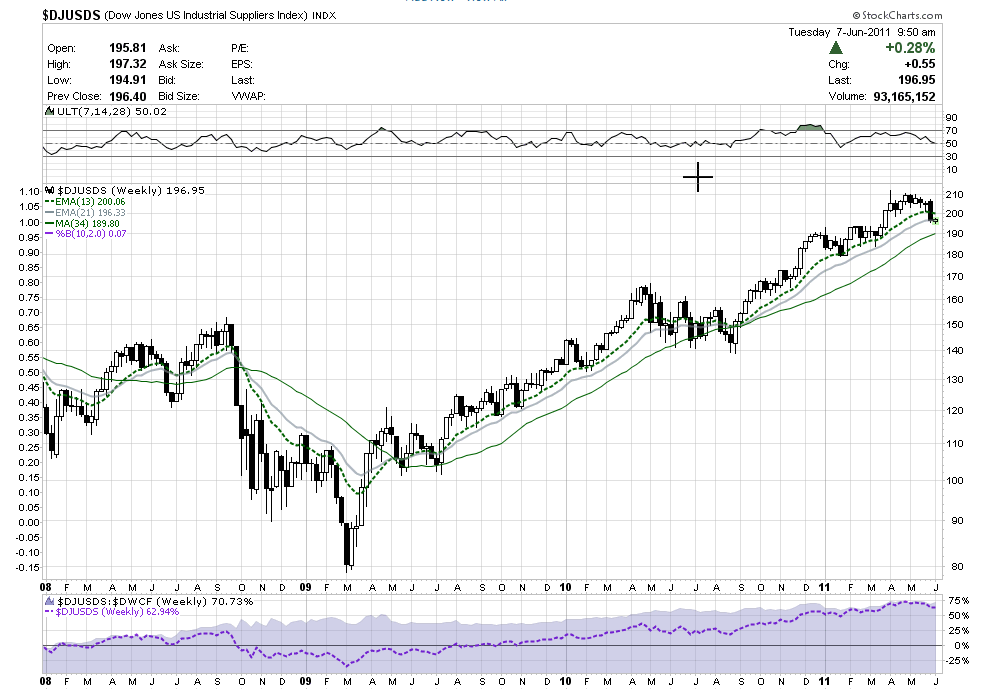
As you can see, this group has exceeded its pre-crash high. I am not providing separate charts for FAST or GWW as their charts are identical to this one. As you are looking at performance information, viewing this industry chart will help you see what others are concluding and how they are voting with their dollars.
This is Rusty. His only care about transparency is that you can see when his bottle is empty and fill it back up. He's about two weeks old now.

Subscribe to:
Posts (Atom)