There is a desert
I long to be walking,
a wide emptiness,
peace beyond any
understanding of it.
from Birdsong
Translated by Coleman Barks
Wednesday, December 06, 2006


Sunday, December 03, 2006
Santayana on Investing
To love decoration is to enjoy synthesis: in other words, it is to have hungry senses and unused powers of attention. This hunger, when it cannot well be fed by recollecting things past, relishes a profusion of things simultaneous. Nothing is so much respected by unintelligent people as elaboration and complexity. They are simply dazed and overawed at seeing at once so much more than they can master. To overwhelm the senses is, for them, the only way of filling the mind. It takes cultivation to appreciate in art, as in philosophy, the consummate value of what is simple and finite, because it has found its pure function and ultimate import in the world. What is just, what is delicately and silently adjusted to its special office, and thereby in truth to all ultimate issues, seems to the vulgar something obvious and poor.
----------------------------------------
I was struck by this paragraph taken from "Reason in Art", and I was reminded by the advice that many give about investing...most recently seeing Gartman's rules which strike at this very simplicity and elegance. (See the Big Picture and/or John Mauldin). For folks using TA, the admonitions to use a few indicators to have a balanced view and to provide more than one tecinical confirmation. So we should cultivate ourselves as investors to appreciate in our investment plans...."the consummate value of what is simple and finite, because it has found its pure function and ultimate import in the world."
ISM Numbers
 The ISM number is an important number. According to my "Secrets of Economic Indicators" (1)...."It is the first piece of news on the economy of of the gate every month and the most influential statistic released by the private sector."
Note that there are two of these surveys--one for the manufacturing sector and one for the service sector. According to Bauomohl, the manufacturing survey grabs the most attention.
Look at the table. You can see why readings below 50 are cause for concern. We should watch this data very closely.
Did you know? Federal Reserve Officials are briefed on the data before it is reported.
The Survey is sent out to 400 member companies around the country and represents 20 different industries. Corporate purchasing managers are asked if activity is rising, falling or unchanged in the following:
- New orders
- Production
- Employment
- Supplier deliveries (speed of delivery)
- Inventories
- Customers' inventories (they guess and their customer's inventories)
- Commodity prices
- Backlog of orders
- New export orders
- Imports
(1) Bernard Baumohl, Wharton School Publishing, 5th edition, copyright 2005,
Saturday, December 02, 2006
George Santayana....an odd, meandering post
If you were to look at my profile, you will see that one of my favorites books is the "Life of Reason" by George Santayana. You may not know who he is, and if you are interested, you can read about him here: http://en.wikipedia.org/wiki/George_Santayana. I'm confident you are familiar with the following aphorism: "Those who forget the lessons of history are doomed to repeat it"...bad paraphrase, but it's my "humming a few bars for you".
I stumbled up Santayana in a used book store in Lynchburg (The Little Givens Bookstore) which had a pretty extensive used book section. One of my favorite past times is going to used bookstores and wandering the stacks. I find that books jump out at you at times--a sign, of course, that you are ready for the topic, if you place any stock in "book karma".
When I picked up the book The Life of Reason, a frayed hardback, I could tell that it was a well-loved book. This particular book was a bit of a Reader's Digest version. As I opened the book and read the prose I was astounded about the incredible elegance of the use of language. It was like prose-poetry. Yet, I had never heard of this man. [Santayana was Spanish, and English was his second language. What I would give to have half the command of it as he. For those of you who didn't bother with with the Wikipedia link, he was a philosopher, taught at Harvard, and studied under William James).
So after purchasing the book and reading a bit and becoming even further struck by his extraordinarily deft and musical command of the written word, I asked a few people I knew if they were familiar with his work. I honestly couldn't understand why this man was not more well known. One of my book club members is one of the most erudite people I know. He's a theologian, clinical psychologist and business consultant. All bases covered there! I asked him about Santayana, and his face broke out into a grin. "How funny you should ask," he said. "I did my master's dissertation on him." As it turns out, Santayana was a student of Arthur Schopenhauer's works. Don gave me one of Santayana's works for Christmas--an exceedingly thoughtful gift that I will cherish.
You see, I'm one of those nerdy folks who has read AS's, "The World as Will and Representation". I also have (and have read) his "On the Fourfold Root of the Principle of Sufficient Reason." (I know this should be underlined, but there is no facile way to do this in this Blogger format). What's interesting about AS, is that he was one of the first Western philosopher's to study Eastern religion and incorporate it into his works. He was a curmudgeonly fellow, too. In fact, Ebeneezer Scrooge was likely patterned after AS! So it is indeed serendipitous that I also stumbled upon Santayana who was a disciple of sorts of AS's works. Also of interest, is that AS was such a ferocious note taker on the books that he read that the pencil would sometimes gouge the pages. (I have formed the habit of never reading unless I have pen and paper. I have a pen and paper fetish that I'll speak more about when I'm in a different mood.) Now understand, because I say that I have these incredible works and have read them, by no means suggests that I fully understand them. But I have this one wish that when I die, people will look at the books that I have and say...Wow! (Fluff over stuff, you know!)
But as I pick up GS's book to tell you about it, I'm reminded that it is time to revisit it. Great works by wondrous thinkers have deeper meanings than any of us can fully access on first reading. I remember reading John Adam's biography and his habit of reading Cicero's (?, oh pox on my bad memory) over and over. So tomorrow, I will settle in and read a chapter or two, and marvel again at such mastery over our language. And as I pick up GS, I'm reminded of Ernst Cassirer who wrote "Language and Myth", and who referenced GS's wonderful work "The Sense of Beauty".
And for those of you thinking what the heck does any of this have to do with investing...I leave you with E. O. Wilson. E. O. Wilson is an evolutionary socio-biologist. He wrote "Consilience" where is posits: "that the sciences, humanities, and arts have a common goal: to give a purpose to understanding the details, to lend to all inquirers "a conviction, far deeper than a mere working proposition, that the world is orderly and can be explained by a small number of natural laws." This is the essence of consilience." (From Wikipedia).
And as we think about how psychology, economics, base emotions (fear, greed), etc. politics, finance, mathematics, statistics, all conspire to move the world, then I think that affects investing! These are the great thinkers that introduced new concepts on integrating divergent disciplines into coherence.
And I'll leave you with my favorite GS quote and a suggestion.
Favorite Quote: "The definition of a zealot is when the efforts are redoubled when the aim is lost."
Suggestion: Pick up a book on something that you know little about but on which you'd like to learn more and read it.
Perhaps one of my NY's resolutions will be this. For the balance of my life, I will spend one year devoted to either one person's works or various works on particular subject and read all that I can. String theory, Italo Calvino, William Gass, chaos theory, flowers, training dogs,...whatever. Imagine the depth and richness that you will cultivate in your life.
On Hope (Major Axiom III)
Major Axiom III: When the ship starts to sink, don't pray. Jump
Minor Axiom IV: Accept small losses cheerfully as a fact of life. Expect to experience several while awaiting a large gain.
------------------------------------------
Obstacles: fear of regret, unwillingness to abandon part of an investment, and difficulty in admitting a mistake.
-----------------------------------
L comment: Studies in Behavioral Finance focus on the emotional issues noted in Obstacles. This is one axiom with which I have not quibbles.
On Greed (Zurich Axiom 2)
Major Axiom 2: Always take your profit too soon.
Minor Axiom III: Decide in advance what gain you want from a venture, and when you get it, get out.
Minor Axiom III: Decide in advance what gain you want from a venture, and when you get it, get out.
Friday, December 01, 2006
Diversification
I happen to think that diversification is important. I agree that over-diversification is dilutive. One strategy that I think makes terrific sense is where you own 2-3 leaders in 4-5 sectors (yeah, I know that gets you to 15 stocks or perhaps more!). As certain sectors outperform, you systematically move money into your lagging sectors (lagging sectors--not sick dog stocks that should be euthanized). As I was beginning my education (which I know will last a lifetime) on understanding investing, I naively thought that once I had mastered the understanding of cycles that all would be clear. Somehow I thought that the sector rotation signal would be like a Zen meditation bell ringing softly and clearly signaling it's time to switch. "Ting" --oh, it's time to move out of commodities and into financials. "Ting" oh it it's time to be in tech. "Ting" oh it's time to stuff everything in a mattress. Hah! Wrong again. The only "Ting" that I've come across is "Ting", Leisa you were a fool to think that it would clear at all. Okay, an initial fool in thinking it would be clear, but a wiser fool in understanding that the fuzziness is in the inflection points that that this sector rotational thing happens in fits and starts in that transition period.
My only certitude is that I do not know what is going to happen, and I'm confident that no one else does either. But like a wise Indian, I'll keep my ear to the ground, and I'll watch carefully for scatological evidence (no tasting though to determine if there are iron deficiencies in the beast that I'm tracking which is the market direction) and make the best decisions based on the empiricism before me. I think that reading quality publications and listening to respected voices (not pundits) and equipping yourself to discern probabilities will put you ahead. I don't wish to sound arrogant because I know (and admit) that I'm a complete dummy about much of this. Nevertheless, I did gain some singular confidence in questioning the moves in the bond market. I weighed the evidence, and while the bond market was betting on cuts as early as Spring of this year, I said that the other data did not support that based on my understanding. So the confidence that I'm talking about is individual investor confidence. And one gains confidence by stubbing his/her toe and scraping a knee or two.
My conclusion, then, is that if you maintain a presence in major sectors, appropriately weighted for your considered view on the economic cycle, then you will be exposed to the move when it happens, and you will shield your portfolio from undue sector risk, but you will expose yourself to the beneficial moves. If any wish to argue that making unduly weighted sector bets are smart rather than hazardous, I'd offer this years HMO and oil/oil service sector routs. One only has to see what happened to the HMO's in April when the buzz was that medical cost ratios would increase--an anathema for HMO's. The rout was swift and severe. Oh, it recovered, but these stocks (AET, WLP, CI, UNH) dropped 15 - 24%--in 2 days. You can keep your good stocks, just reduce your exposure when their sector is not shining.
George Dagnino (of Peter Dag) has great advice--"we move slowly". His model portfolio is comprised of leaders in each sector. As he sees sectors falling out of favor, he slowly reduces portfolio exposure--considered, measured moves. I believe that following this simple but powerful advice gives you appropriate diversification and ample stakes in your investment/econcomic thesis.

Flat Lining Sales
 I found this on FRED. It will be interesting to watch the plateau in retail/food services sales and see how far it extends.
Note the activity pre-2001
Thursday, November 30, 2006
On Risk (Zurich Axiom 1)
Major Axiom 1: Worry is not a sickness but a sign of health. If you are not worried, you are not risking enough.
Minor Axiom 1: Always play for meaningful stakes.
Minor Axiom 2: Resist the allure of diversification (I see your stunned look)
Three flaws regarding diversification:
As we work through these axioms, we'll see that they will violate much of what you've learned. Understand that my posting these is not an endorsement (and I'm not qualified to endorse anything but a check made payable to me) but rather a chance to explore an interesting view of risk/reward.
Minor Axiom 1: Always play for meaningful stakes.
Minor Axiom 2: Resist the allure of diversification (I see your stunned look)
Three flaws regarding diversification:
- It forces you to violate the precept of Minor Axiom I - that you should always play for meaningful stakes.
- By diversifying, you create a situation in which gains and losses are likely to cancel each other out.
- By diversifying, you become a juggler trying to keep too many balls in the air at once.
As we work through these axioms, we'll see that they will violate much of what you've learned. Understand that my posting these is not an endorsement (and I'm not qualified to endorse anything but a check made payable to me) but rather a chance to explore an interesting view of risk/reward.
Zurich Axioms
Max Gunther wrote "The Zurich Axioms" (published by Harriman House copyright 2004). His book is in 12 chapters. I thought that I would put up his 12 axioms in 12 posts (maximum utility) and some may be moved to discuss.
To provide a road map, I'll give an overview of the Chapters.
To provide a road map, I'll give an overview of the Chapters.
- On Risk
- On Greed
- On Hope
- On Forecasts
- On Patterns
- On Mobility
- On Intuition
- On Religion and the Occult
- On Optimism and Pessimism
- On Consensus
- On Stubborness
- On Planning
Resilient expecations
Let's see, we had a 8.5% drop in durable goods orders (that is a pretty telling economic indicator), the dollar is stubbing its toe and oil is increasing--and the markets along with it.
Jeffrey Saut stated on Monday, something that I very much believe. That is, the opportunity for investors is where there is a gap between perception and reality in the market. To be sure, it is also a place of great danger, because you can be right, but your timing can be so off, that being "right" eventually only means having your money spirited away currently.
First off, I'm happy to say that my MIND is doing terrifically well, up 11.37%, and that ERF is continuing to perform well, up 8.39%. Both are tied to oil, and oil has been steadily going up. Now, you think that would be bad for the market. I also own some KRY, a gold miner, and that has gone up 30% since my purchase. These successes soften my worthless puts on the DOW and S&P that will expire in DEC.
John Murphy stated recently that commodities peak AFTER the stocks peak, prior to bad things happening. Commodities are definitely on the rise. But this rise is NOT tied to resurging economic activity. Has the market peaked? I wouldn't hazard a guess, but we clearly can see that the market has had renewed vitality and commodities are now better performers with energy gaining almost 2% yesterday. I'm also mindful that in a slowing economy commodities move downward.
Yesterday we had a stronger than expected GDP number, but that also came after another noted investment house (1) recast 4th quarter GDP as zero. How I have made sense of the market that makes no sense is this: Concrete information has outweighed "forecast" information. Concrete information comes in the form of backward looking "confirmed" glorious news: wonderful corporate earnings and confirmed 3rd quarter GDP growth. Plus, we also have great liquidity and lots of folks willing to throw themselves on the rails to board the train that got away while they were buying their put tickets!
As people are imperfect synthesizers of information, they will fall victim to their biases/emotions. You do, I do, we all do. Accordingly, if you have a positive OR negative outlook, your lens will filter for all of the things that support your view, and you'll dismiss ideas contrary to your view. The positive bias has great corporate earnings, some sliver of positive news on home sales increasing (never-you-mind it's at deep discounts), GDP being greater than expected. These are concrete things that stave off uncertain future information like expected decline in corporate earnings or slowing GDP.
I would contend, then, that for those with a positive bias on the market, there is a disequilibrium in the amount of weighting they have placed on positive news v. negative news. Perception does not equal reality. Until that balance changes and a tipping point reached where the positive news gets eroded by negative news, we'll continue to have liquidity and performance anxiety fuel the market's surge. But after year end, performance anxiety takes a break and 4th quarter earnings will become reality (remember lots of folks warned). The earnings and forecasts will be the most telling, and if the numbers are bad there is no performance anxiety propping them up. BUT, for folks like me looking for dour numbers, if the numbers are good, that's a different fuel altogether.
And for any that want to say that the market is a perfect discounter, I would argue that the bond market was wrong about interest rates most of the last 12 months. Ultimately the market gets it right--and market corrections are nothing if not a supreme act of contrition for wallowing in perception rather than walking in reality.
(1) Deutsche Bank has also lowered their forecast:
In light of continued weakness in the economic data, we are cutting our fourth quarter real GDP growth forecast to zero from the +1.0% that we were originally predicting.
Sunday, November 26, 2006
Friday Trustee Sales

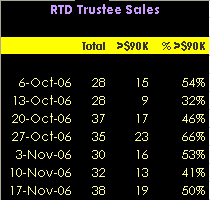
I wasn't expecting to see many of these. I was wrong. 9 were greater than $200K.
Friday, November 24, 2006
No One Knows
I'm a firm believer in fundamentals--in business, in personal life and in investing. Fundamentals are important because they are foundational; the structure on what everything else stands. When you have strong fundamentals and disciplines, you create a stronger, more accurate decision making environment. I will go to the earlier of my grave or the poorhouse believing that true investment fundamentals includes BOTH fundamental analysis and technical analysis.
While a facile command of fundamental and technical analysis is a laudable goal, that goal must exist within a very critical axiom. In fact every investor should recite as his/her daily investment mantra: "No one knows". I wish I had understood this simple, yet powerful, concept earlier on. It's not only applicable to investing but any topic you choose--including your health. As anyone who has faced difficult decisions regarding procedures/regimens knows, you're going to get divergent views. And when your health/life are on the line, those divergences are frightening. You only antidote to "no one knows" is knowledge and YOUR assessment of the risks involved in making decision x v. decision y.
In financial health decisions, one sees those divergences daily. On Friday, we had a whole new symptom to ponder: the falling dollar (You can read a professional's summary here. http://www.thestreet.com/_dm/markets/commodities/10324098.html.) Now I do not pretend to be qualified to explain to you all that it means; but I am qualified to tell you that you should have a rudimentary understanding of what that means. When asset classes have changing relative relationships with other asset classes, there's a bit of a yin yang dynamic unfolding that you should understand. What's bad for one is good for another (in terms of pricing). If the dollar is getting less valuable (relative to other currencies/asset classes) then something with intrinsic value, such as gold and oil, gains in value. Oil declines when the dollar is strong because it is priced in USD (less $'s to buy oil relative to other currencies.) and oil gains when the dollar declines (more $'s are needed because the dollars are valued less relative to other currencies).
So what does that really mean? For one, inflationary pressures will rise. Commodities will cost more for more USD's are required to buy a barrel of oil. There's another malefic result of a dollar going lower--higher interest rates. Why? Our bonds are USD denominated; therefore, if the dollar is going down relative to other currencies and asset classes, investors (and remember more than 50% of the holders of our bonds are foreigners) will require a greater return for those assets in the form of higher interest rates. Now just to mix it up and keep it interesting, you have some fundamental factors influencing oil: (1) OPEC's threatening to decrease supplies; and (2) increasing inventories.
But there's a beneficial result too....American made goods get cheaper and greater exports mean a reduced trade imbalance. Also, if you have ETF's understand the currency in which the share price is denominated. It will affect your returns. In general, Asian and European currency denominated ETF's will benefit from the dollar's falling. Those ETF's will gain in from the dollar's demise.
My point is not to give you any guidance but rather to coax you into developing an understanding of these dynamics and how they weave themselves into the tapestry of the investing climate. They are really important. I think that the best place to educate yourself on the business cycle and which asset classes do well or poorly is George Dagnino's site: https://peterdag.com/s_files/mLcn829S3eP2.pdf If you do nothing in your investment life do this.... Print out, read, and re-read that pdf. I would also urge you to look at his chart of the month. For fans of Bill Cara's site, you will see that George deploys stochastics to inform of the probabilities of moves in the market.
Remember, everyone has an opinion about what the stock market will do, where we are in the economic cycle, what the dollar, oil, gas, soy beans.....fill in the blank. There are several divergent opinions among great luminaries which means you need to tread carefully and understand YOUR risk environment. How? You must equip yourself to separate the wheat from the chafe. You can reduce your perplexions as a new investor through a basic command of economic cycles and of the asset classes that do better or worse at each stage of the cycle. When you do your head scratching, reach for the investor prayer beads and recite your mantra: "no one knows." No meaningful turn in the market or the economy is ever clear until you look in the rear view mirror. Until then, it's just blind mice trying to make sense of the elephant. Nevertheless, you'll be armed with knowledge to make informed decisions that are right for you.
Tuesday, November 21, 2006
Covering $hit with Snow--A tribute to my Armenian Grandmother.
My Armenian grandmother came to this country in 1920. She didn't know her real birthday. In spite of that, she claimed Jan 1, 1900 has her date of birth. Such a date! The first date of a new century! As I look at this market with my stupid, amateur gaze, I'm filled with incredulity. I'm reminded of phrase that my immigrant remembers-the-Armenian holocaust-but-we-thought-her-crazy grandmother uttered from time to time: "You cannot cover shit with snow". It's a wonderful aphorism is it not? Appropriate to this market.
So I write this blog post in honor of my simple, uneducated grandmother and the power of words and wisdom that do not require an education in our Western civilization sense, but rather that which is acquired from living life in the raw and on the edge. My grandmother--Alice was her name-- was sold to the Armenian church at the age of 12 (mother died in in child birth, stepmother wanted no part or husband's progeny) and placed, as a slave girl, with a Turkish couple in Constantinople until she reached majority age. Despite her simple roots, she harbored great wisdom garnered from years of living in the raw and on the edge of physical, emotional and monetary survival.
Many of us are so enamored with the educational and cultural trappings of ourselves and our class, that we forget the simple wisdoms of authentic people who struggle with the everyday of task of surviving. As Thanksgiving approaches, let us remember those simple wisdoms from authentic people and contemplate what small kindness we can extend to soften the edges in their lives.
Sunday, November 19, 2006
A favorite poem
I've spent most of my day in my office at home cleaning, filing, trashing. I moved my attention to the corkboard and found one of my favorite poems. This was in Aug 9 & 16, 2004 of the New Yorker.
The Kindness of the Blind
A poet is reading to the blind.
He did not suspect it was so hard.
His voice is breaking.
His hands are shaking.
He feels that here each sentence
is put to the test of the dark.
It will have to fend for itself,
without the lights or colors.
A perilous adventure
for the stars in his poems,
for the dawn, the rainbow, the clouds, neon lights, the moon,
for the fish until now silver under water,
and the hawk so silently high in the sky.
He is reading--for it is too late to stop--
of a boy in a jacket yellow in the green meadow,
of red rooftops easy to spot in the valley,
the restless numbers on the players' shirts,
and a nude stranger in the door cracked open.
He would like to passover--though it's not an option--
all those saints on the cathedral's ceiling,
that farewell wave from the train window,
the microscope lens, ray of light in the gem,
video screens, and mirrors, and the album with faces.
Yet great is the kindness of the blind,
great their compassion and generosity.
They listen, smile, and clap.
One of them even approaches
with a book held topsy-turvy
to ask for an invisible autograph.
-----Wislawa Szymborska
(translated, from the Polish, by Justyna Koskowska)
Gary K's 11/17/06 Recommendations
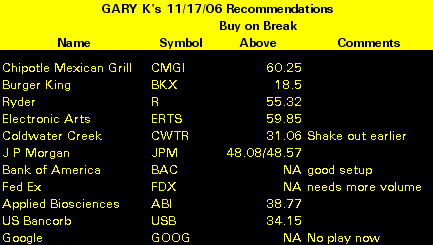 Have you visited Gary K? Gary K has one of the most informative, practicable shows. The link is the side panel.
His shown is downloadable. So you can listen at your convenience, and more importantly, you can skip through the Folicare ads.
Here are some of the stocks that Gary K mentioned in his Friday show.
I may do this from time to time. I offer this from the position of an information distiller.
Friday, November 17, 2006
Eulogy
It is with great sadness that I commit to eternal rest my BAC and AIG put that expired %^#$#!^ worthless today.
My thesis was that Fed rates would hold or even go up and that market would go down. Investment income would be hurt at AIG, but how was I to know that the hurricance season would be well a bust. Both BAC and AIG were experiencing rollover at the time of my purchase, but they did not roll. %#@#!%#% it.
Humorous Lesson: I should have gone out and bought some obscenely expensive wine and taken a bath in it and I would have had the same utility.
Real lesson: Never, ever, ever, buy a put or call option for an amount of money whose worthless expiration amount would make you cry. I didn't with either of these. If you are buying puts or calls, make sure that you understand your risks. I took a measured risk on both of these. I'm not crying. But the ouch factor is real.
Thursday, November 16, 2006
Rememberances
Nona's post on my home brought a funny memory I wanted to share.
I have two cool things in my home. Now, I write this telling you that I have a modest home--if any of this comes off as arrogance in anyway, it is unintentional. As Mark and I were eating dinner this evening, we talked about the gratitude that we have for everything that we have. Our modest needs are easily fulfilled. But I will tell you, that if we ran with a different crowd, I would feel that we were wanting for something. I'm glad that my social aspirations are modest. Okay...now onto the cool things....
Cool thing #1. I have this baroque mantel made of solid walnut. I found it at an antique dealer and it was covered with antique white, leaded paint. In a word...gaudy. I paid $350 for it in 1985--lots of money for me.
I brought it home--like a cat bringing its master a treat. Rather than gratitude, I suffered scorn..two-fold scorn. One of my former Peat Marwick colleague's husband, Doug, (a banker but former summer plumber's helper helping Mark with the rough-in) AND my husband laughed at me when I brought it home. My husband mocked, "You paid HOW much for THAT?" I can still hear Doug and Mark's cackling. Now you have to understand that nothing is more unpleasant for me than "paying too much" for something. I'm not sure where that gene came from, but it's the honest truth, and it embarrasses me profoundly and has caused many a sleepless night.
Anyway....the next day, my husband is bitchin'(excuse the profanity) to Buck, the cabinet man. You have to know Buck. He is a master craftsman, but a very quiet, deliberate man. In addition to making lovely cabinetry, he restores antique automobiles...pristinely.
Buck listens to Mark's lament of having a wife bringing home such crap at high prices. After the tirade, Buck quietly says to Mark..."Do you want to double your money now?" That statement stops Mark (and gives me a priceless "I told you so moment" that wives must always have in their quiver!)dead. Buck then benevolently offers to take the mantle in his service van to this place risque-ly called "The City Stripper" to have it vat stripped. It cost $100 to have this done. Yes, that is alot of money While there, they receive many offers to buy the mantle for about 6x what I paid for it. Vindication. We built our downstairs fireplace to accomodate this mantel. I also have a fireplace in our bedroom. A very plain, beautiful solid cherry mantel adorns that. We've never used it, but at the time, we felt like a fireplace in a master bedroom would be a good resale value.
When I received the mantle back it required much TLC. Stripping any type of wood raises the grain. Much sanding was needed. It has rope moulding, dental molding, hand carved flowers and carved posts. I did it all and put several tung oil applications in between each sanding. It's beautiful. Likely larcenous as well, as the owner of the place that I bought if from spent some time in jail for stealing things out of older homes. The City Stripper guessed its age as mid 1800's. With its age and all that tung oil, it will likely have spontaneous combustion and burn my home down.
Second neat thing. I have this bronze light fixture from the University of Richmond. Some bright soul sold these "surplus" fixtures for $25 each. They are about 4 feet from stem to stern with white semi-opaque glass. We (Tim/Mark) framed our stairway to handle it. It's monstrously beautiful. After they realized what they had done, they offered some terrific tax credit--I think it was a $3K tax credit. The fixtures cost them $7800 to replace. I think I got a good deal, don't you? The beauty of being poor as we were at the time is that the tax credit did not really mean too much! I now have an SIL who works at University of Richmond. Strange karma indeed.
Subscribe to:
Posts (Atom)