Cramer mentioned the Canadian Energy Trusts this p.m. His logic was similar to mine. ERF, the trust that I bought in my retirement account @ an average cost of $42.45 (I flipped some in my taxable account), was up immediately to $43, and it closed at $41.17. So I'm certain I'll be in the black again, but I must admit that I cringed when it was trading at $38. I had enough exposure in my portfolio that I did not buy more at this price. So, we'll see how this works out.
MIND had a nice increase today, closing up 4.4%. It's close to a small breakout. I have a very small position of 500 shares. I may add more if there's a decent breakout.
IVGN is still green but barely.
--------------------------------------
11.16.06 Update...certitude and the market are not compatible bedfellows. I think that if oil had not gone down $2 my comments would have stuck. But I'm egalitarian, and I would rather have cheaper oil than money to stave off starvation cum retirement.
Wednesday, November 15, 2006


Tuesday, November 14, 2006
Alternate Universes
Hmmm....I've had a couple of folks note that formatting appeared strange. When I view the blog I do not see these problems; however on the forwarded page that one of my blogger-friends sent over there is odd HTML stuff. I'm not sure how to handle, but I appreciate your patience and apologize for the odd look.
Sunday, November 12, 2006
On Recessions and Bear Markets...a Marty Zweig Perspective
In the early 90’s I was a Consulting CFO for an institution. As such, I served as staff for the Investment Committee of the Board.We were interviewing a number of firms, Martin Zweig’s fund being one of them.I didn’t meet Marty Zweig, but I remember that the presenters did a bang up job presenting.I believe that we must have chosen his firm, as I received an autographed (07/21/92) “Leisa-I appreciate your confidence, Marty” of his book "Winning on Wall Street (WOWS)". I did not read the book until this past year or so. There is some shame in that admission.But the point of this post is not to brag about the autograph (it is my only brush with investment celebrity, though Barron’s did print the one and only Letter to the Editor that I wrote to them. Yes, I do live an uneventful life which is why these little snippets have outsized proportions in my delicate psyche.) In WOWS, Zweig lays out 3 conditions for a bear market.
Two Perplexions come to play in my wanting to write about Zweig’s conditions. First perplexion is that people cannot agree as to whether or not we are in a bull or bear market; and second, people cannot agree as to whether or not we are/will be in a recession. I conclude, therefore, that much of this confusion is due to the perpetual need to read the economic tea leaves or lick one’s index finger and hold it up to find out if the ill winds are blowing us toward something malefic. It’s Ed Young’s Seven Blind Mice but we have to winnow out all of the confusion among the 100 (or so) blind mice that serve as market pundits.
I like Zweig's objective parameters. It provides some empiricism for us to evaluate the opinions of other market opinion makers. Zweig writes:
Zweig defines a bear market as follows: “a decline of at least 15% in each of the three important stock averages:the Dow Jones Industrials, the S&P 500 Index and the Zweig Unweighted Price Index (or the Value Line Indes, if you prefer).” I suppose that one could throw in the NASDQ to replace the ZUPI/VL index. I’m not sure if anyone has addressed this. Based on his definition, as there was not at least a 15% decline in all three indices in June/July, I’m not sure that we had a bear market within this description. See table below of May highs/June-July lows for DJI, NASD and S&P.None of the main averages achieved a decline of this magnitude.
Extreme deflation characterized by a PPI index drop of 10% on a 6 month average of annualized m-t-m changes.Take current year m-t-m inc/dec and average it with the last 5 months (sum the mtm change each month for the last six months and divide by 6).If that 6 month average is at least –10% then you have cleared this test; (I've not calculated this. I don't think we are there. I think that with the ISM falling, we will BEGIN to see where that calculation becomes meaningful).
Ultra high price/earnings ratios.He labels 10-14 aS normal P/E range. Upper teens and twenties is what he calls high; and (we are in this level now).
Inverted yield curve.Zweig used the Moody’s Aaa Corporate Bonds yield as the long term rate and 6 month commercial paper rates as the short term rate. (I've not calculated this). Addendum 11.13.06--Of course we all know that we have an inverted yield curve, and SFO did a wonderful story on that which you can find here. http://www.sfomag.com/articledetail.asp?ID=1946685477&MonthNameID=July&YearID=2 I've just not calculated it using MZ's method. So, some food for thought as we think about recessions and market corrections.
Two Perplexions come to play in my wanting to write about Zweig’s conditions. First perplexion is that people cannot agree as to whether or not we are in a bull or bear market; and second, people cannot agree as to whether or not we are/will be in a recession. I conclude, therefore, that much of this confusion is due to the perpetual need to read the economic tea leaves or lick one’s index finger and hold it up to find out if the ill winds are blowing us toward something malefic. It’s Ed Young’s Seven Blind Mice but we have to winnow out all of the confusion among the 100 (or so) blind mice that serve as market pundits.
I like Zweig's objective parameters. It provides some empiricism for us to evaluate the opinions of other market opinion makers. Zweig writes:
”The big money is made or lost in stocks during the most violent bull and bear markets. The bad news for those who crave action is that the market does not behave dynamically all that often. Even within the great bull market advances, there are periods of lull. I would estimate that stocks spend only about 20% of the time in the most active phases of the bull trend and only about 10% in the severe downward periods of major bear markets.Roughly 70% of the time stocks either meander in a neutral trading range or undergo minor rallies or declines within their various bull and bear cycles.During that 70% span—let’s call it the neutral area—your overall market strategy does not matter all that much…."
Zweig defines a bear market as follows: “a decline of at least 15% in each of the three important stock averages:the Dow Jones Industrials, the S&P 500 Index and the Zweig Unweighted Price Index (or the Value Line Indes, if you prefer).” I suppose that one could throw in the NASDQ to replace the ZUPI/VL index. I’m not sure if anyone has addressed this. Based on his definition, as there was not at least a 15% decline in all three indices in June/July, I’m not sure that we had a bear market within this description. See table below of May highs/June-July lows for DJI, NASD and S&P.None of the main averages achieved a decline of this magnitude.
Extreme deflation characterized by a PPI index drop of 10% on a 6 month average of annualized m-t-m changes.Take current year m-t-m inc/dec and average it with the last 5 months (sum the mtm change each month for the last six months and divide by 6).If that 6 month average is at least –10% then you have cleared this test; (I've not calculated this. I don't think we are there. I think that with the ISM falling, we will BEGIN to see where that calculation becomes meaningful).
Ultra high price/earnings ratios.He labels 10-14 aS normal P/E range. Upper teens and twenties is what he calls high; and (we are in this level now).
Inverted yield curve.Zweig used the Moody’s Aaa Corporate Bonds yield as the long term rate and 6 month commercial paper rates as the short term rate. (I've not calculated this). Addendum 11.13.06--Of course we all know that we have an inverted yield curve, and SFO did a wonderful story on that which you can find here. http://www.sfomag.com/articledetail.asp?ID=1946685477&MonthNameID=July&YearID=2 I've just not calculated it using MZ's method. So, some food for thought as we think about recessions and market corrections.
Saturday, November 11, 2006

A Brilliant Fall Day
Today is one of those truly glorious days. Clear and 79 degrees...no matter that it is November. Virginia has the most beautiful shoulder months. After my Medicare post, I decided that I should re-engage with some healthful habits. I took my dogs out for a walk. I later came back and snapped a couple of pictures. The odd angle on the leaf is because the wind was blowing it.
We live on 6.5 beautiful wooded acres. We bought this land back in 1984. I was 24 years old, my husband 29. We were so very poor, as I was just out of college in 05/82, and my husband had been out of work for a while due to the recession (commercial electrician). But we managed to buy this piece of land because there was owner financing--something that I'm eternally grateful for.
We literally designed and built our own home. Because the land was so perfect, we were faced with the dilemma of building a home that we could afford with sufficient quality that we would not say in 20 years, we were still living in a "starter home". The financial aspect was daunting; and the physical aspect was almost impossible at times. My husband and a 65 year old carpenter/mason built the house. Tim is dead now, but he was a master craftsman. Tim and Mark hand cut all of the rafters, framed the structure without the benefit of pneumatic equipment, and mixed mortar and laid brick. My husband nailed every plank of red oak flooring...we put it everywhere except the kitchen and bathrooms. I still remember one sweltering August evening where the air was so thick with humidity we were drenched. I laid out each piece so that my husband could nail it. I wiped up every drop of sweat that cascaded off his nose onto the boards. We truly had sweat equity. I painted everything--every piece of trim, every wall, stained the cedar on the back of the house and trimmed the exterior doors and windows. I do not paint anymore. I did a lifetime of painting then.
We did most things right. We did a few things wrong. Our drywall contractor was a hack. Our cabinet man pointed that out. We didn't know. Buck said that the finish coat would not be acceptable because they had not put enough mud behind the tape. We had to hire another drywall contractor. Before he could start, Mark's job was to take a garden sprayer and spray every !#@%^#@ seam and pull the tape off. It took him two days, and by the end of the second day, he could barely move his arms his shoulders were so sore.
It took us nine months. We planned meticulously. We had to make our own decisions on very damn thing. No one offered us 3 choices of this or that. We had the universe of possibilities that we had to winnow down to meet our budget and our mutual tastes. I remember laying awake at night with my heart pounding (I didn't realize at the time that these were anxiety attacks) thinking about the credit card debt that was amassing (I used that in between draws) and the $400 per month Amoco bill that I was having trouble meeting. My husband wasn't working, and I was making $20K per year. And we decided early on that we would manage our budget to a payment that I could make solely on my salary, given that commercial electrical work had suffered so badly during that time. Our mortgage principal was $65K, and we secured a 20 year mortgage. We conservatively figured that we had saved about $50K doing much of the work ourselves.
Today we live in a home that we probably could not afford to buy currently. So when we have a beautiful day such as today, that is clear and crisp, I'm frequently reminded of those sweltering August days where sweat and expletives flowed freely. And I'm reminded how important planning, courage, confidence and a measure hope are to building your life. Of even greater importance is finding people who will support your work. So many helped us along the way--the engineering/contracting firm that our banker made us hire to ensure that if Mark and I floundered someone would step in and finish the house. Tim and Buck who gave us quality craftsmanship. My banker who made the draw process flexible and stopped by from time to time to check on us. Our parents who worried over our over committed physical and financial resources.
As I build my financial house, I'm reminded of the process of building my physical home. I'm certainly wiser now than I was then, but in many ways I'm like that 24 year old--I'm going to charge ahead. I'm going to plan meticulously, be realistic in my expectations and work hard. I have lots of support, and I've found lots of resources. Perhaps 20 odd years from now, I'll be writing of this financial house building launch as I am writing now of my house building launch.



Friday, November 10, 2006
Wednesday, November 08, 2006
Election
Our Virginia senate race as stilled not been called. It looks like Webb is ahead by the narrowest of margins. Certainly there will be a recount.
I voted around 2 p.m. yesterday. I had to wait 5 minutes--unusual, and certainly less time than than the folks in Denver had to wait. Anyway, the election official said that it was 2x the turnout as last election.
I voted around 2 p.m. yesterday. I had to wait 5 minutes--unusual, and certainly less time than than the folks in Denver had to wait. Anyway, the election official said that it was 2x the turnout as last election.
Tuesday, November 07, 2006
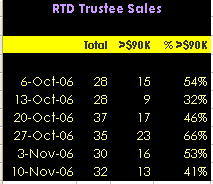
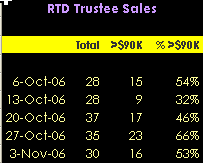
Trustee Sales Update

These listings were too compelling to ignore. The number of sales in the > than $300K range is noteworthy. Friends, these numbers are growing. NEVER have I seen this many large balances in one listing. NEVER. I'm not sure if I'm not sure if they will show up on Friday. I think that I'll start providing something like this in the future. In fact, I think that I'll send my other table to the editor of my paper and see if they post it in the letters to the editor. I'll see if I can find archival listings for same periods last year.
Today's Perplexion
The market has continued to astound. Tim Knight, perma bear extraordinaire, has almost capitulated, read his blog, Electile Dysfunction (http://tradertim.blogspot.com/). Rev Shark (Real Money, subscription required) calls the market "frothy. "
In my amateur view, there is a dissonance in the market that has to be resolved. That dissonance is the actual state of the US Economy and the global economy v. the perceived state of those economies. Part of the US economic dissonance (all call that ED) is the error rate in the jobs data. With the BLS making such an enormous error in the past--finding 800+K new jobs--it's hard to take the current information at its face value.
While I find conspiracy theories titillating (I'm an accountant, we get so few opportunities to be titillated), I don't necessarily subscribe to them. But one has to wonder IF the Fed were aware of the "real" employment numbers, would our rate hikes have been accelerated a bit. My answer to that hypothetical question would be yes.
When one is trying to find his/her way through the enormity of conflicting information, getting to basics helps (which includes throwing a few things out).
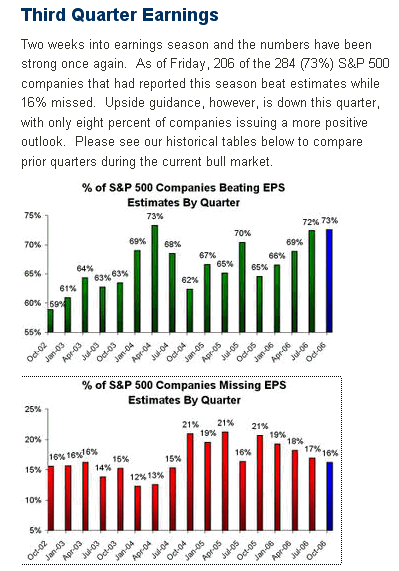
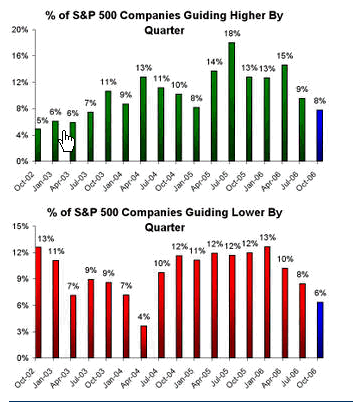
- While corporate profits have been phenomenal, the guidance has been lower for a majority of corporations. CAT and HON were notable. I'm surprised (okay, not really) how little air time has been given to this statistic This was pulled from Birinyi Associatiates and you can find it here http://tickersense.typepad.com/ticker_sense/2006/week44/index.html. To be fair, the % of companies guiding lower is declining; therefore, I would find this graph more compellingly ominous if the lower guidance were higher than the 6% guidance. There seems to be quite a few silent companies regarding future guidance...
- Gold is going up. Inflation worries? Demand fundamentals? (The same could be asked regarding oil, non-precious metals) Some mixture of both that confounds the average person? I'm betting on the latter.
- Election jitters....puhleeze....there's enough mischief and shame shared between the two parties that if they monetized it we'd have no national debt.
- Economic indicators? They are pointing to a slow down. Watch inventories. Increasing inventories mean decreasing prices and slowing production (margin squeeze). The ISM number is key. 50 is the magical number that is tell tale of a slowdown. We are only getting teased now.
- Housing? Greenspan says the worst is behind us. Is he even relevant now? I'm not really looking for an answer to that. It may be bottoming, but I see a long, flat bottom. The real key to who is ultimately right in the expected market direction will be the effect of housing slowdown on the economy. If it is benign, then that is fuel for the rising market fire. If it is malevolent, then you have the makings of a shock. I'm not sure if benign is the middle ground. I do think that we are still unfolding this data, and we'll have greater clarity in the next 90 days.
- Interest rates--I think that they will go up, or at least not come down for a while. So the inversion lasts a wee bit longer.
- Propensity of surprise indicator? High on each of these, so it throws out the whole thing! Just hang onto your seat and squeal with glee!
Friday, November 03, 2006
Pictures
I'm not great photographer, but I try. I went to Spain for 2 weeks on a wine tour. It was one of the most memorable things I have ever done. A splurge. No husband. No children. My goal was to master (okay learn) how to use my digital camera more facilely. I have an Olympus C-5060 (5.1 Megapixel).
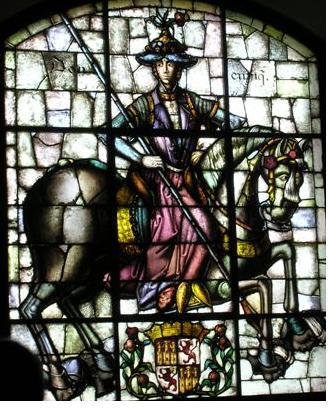
The fetching woman below is Queen Isabel. I snapped it in Spain (May 2005), in the place of her tomb. I'm forgetting the name of the place, but it was a monastery outside of Segovia. The place was fascinating. All of the kings/queens of Spain were buried here. It was one of the most wondrous places I have seen. Stately, somber. Green marble alcoves housed majestic black caskets with brass trims were in the lower chapel. In the upper levels were all of the lesser wives and children, cousins, etc. Beautiful crypts with alabaster carvings or plain carved facings. It's a place where the quiet envelopes you. A peaceful place.
The fetching woman below is Queen Isabel. I snapped it in Spain (May 2005), in the place of her tomb. I'm forgetting the name of the place, but it was a monastery outside of Segovia. The place was fascinating. All of the kings/queens of Spain were buried here. It was one of the most wondrous places I have seen. Stately, somber. Green marble alcoves housed majestic black caskets with brass trims were in the lower chapel. In the upper levels were all of the lesser wives and children, cousins, etc. Beautiful crypts with alabaster carvings or plain carved facings. It's a place where the quiet envelopes you. A peaceful place.

Some amateur technical talk....
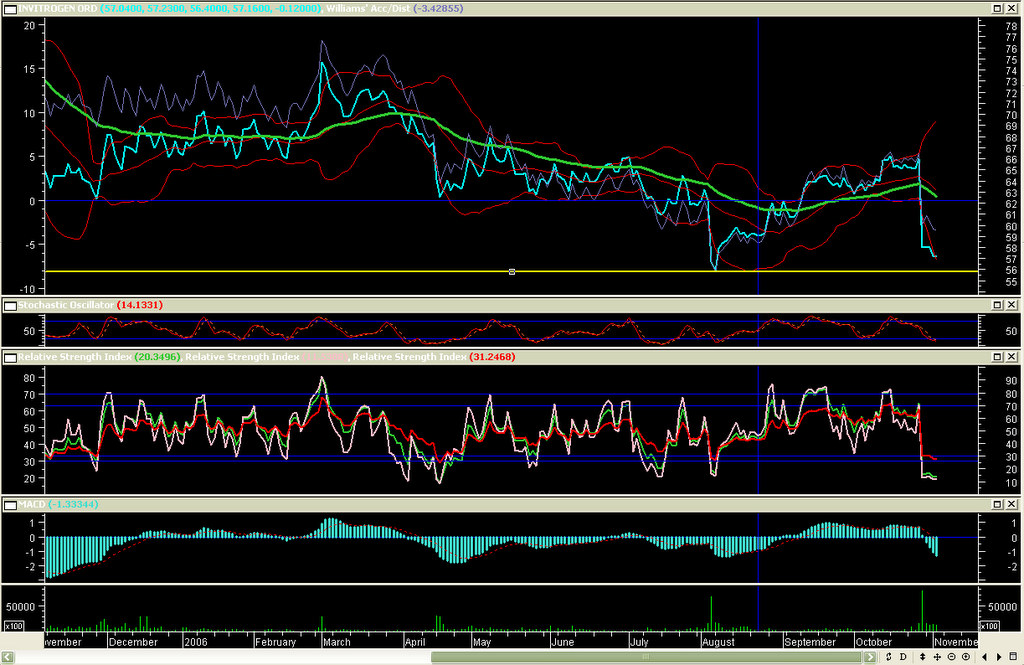
 gemma star, I post this because after your comment, I looked at TU. I must have reviewed this stock before, because I see I did a few line studies.
As my own belief is that fundamental and technical analysis are important to making investment decisions (though you have purists on either end who would vehemently disagree), I try to increase my technical skills. To do so, I have found it good practice to ambulance chase certain stocks on bad news and attempt to identify support. I don't commit capital unless I know something specific about the company. For IVGN, it was a company that I followed. If my IVGN breaches former support of $55.72, shown in the yellow line below, I'm outta there!
Canadian Energy Trusts, Redux
Here's something from Barron's that gives more color.... Also, if you are interested, check out Bill Cara here http://www.billcara.com/archives/2006/08/about_those_cdn.html
UP AND DOWN WALL STREET DAILY |
By RANDALL W. FORSYTH
The new tax treatment wouldn't take effect until 2011, however, and wouldn't even hit Canadian investors, explains Robert Willens, Lehman Brothers' tax expert. "For Canadians, it's irrelevant." Canadian investors can "impute" taxes paid by corporations, effectively getting around the double taxation of dividends, which the "primitive" U.S. tax system doesn't allow, he adds. As part of tax change, the Canadian corporate tax rate also will be lowered to 18.5%.
The only beneficiaries of the current royalty-trust structure are tax-exempt investors, such as retirement funds and endowments, and non-residents. "It's all about U.S. investors," Willens says of the proposed tax change, which he says will likely gain passage because it was proposed by the supposedly business-friendly Conservative government.
-------------------------------
So throw out my due process comment. But...it seems like the rest holds reasonably well.
Thursday, November 02, 2006
Canadian Energy Trusts. . .
take it on the chin. If I understand it correctly, existing trusts will be taxed in four years while any new trusts get the tax shaft next year. Now this sort of thing plays right into my bias of following the stampede and looking for the carnage, so long as there is some risk mitigation. My expectation is that something happening in 4 years is not a reason to give up the ghost now.
In looking over the trusts, I elected to buy some ERF. Here's a look at the chart (Click to enlarge):
 My average cost is $41.87 today. It closed at $42.29. They pay a .42 dividend on 11/08. Here's my thesis.:
Don Coxe (BMO Harris), who is no longer freely available, has been a huge proponent of geopolitically safe oil reserves. The Canadian oil plays fit that bill. I imagine though that any who have loaded the boat on these must be in pure agony now, for these oil trusts have declined 20+% over the news.
Now if my gourd is working correctly (and we are in the right season for gourds), the real risk is the price of oil, which I grant has been under much suspicion of late, and that's a discussion for another day. The price of oil affects earnings (near and far term) regardless of tax implications. And oil has been under pressure. But a 10% dividend rate is nothing to sniff at--and if in the US rates start to decline,--the search for yield will be relentless.
If there is such a thing as due process in Canada, there is a potential upside: the hew and cry may be so great that the politicians may come up with something more palatable for existing trusts while achieving their goal of abating the massive conversions to a trust.
In summary for ERF my investment thesis is
I found this article post post....I feel like my thinking is sound.
http://www.marketwatch.com/news/story/story.aspx?guid=%7BA46AED29-0D72-4965-82E9-E4F2CFD1FC57%7D
------------------------
An update on my other theses for IVGN and MIND. IVGN currently has an .82 (1.46%) per share gain over my entry point and MIND has a .04 (.4%) gain over my entry point. Pretty thin margins!
In looking over the trusts, I elected to buy some ERF. Here's a look at the chart (Click to enlarge):
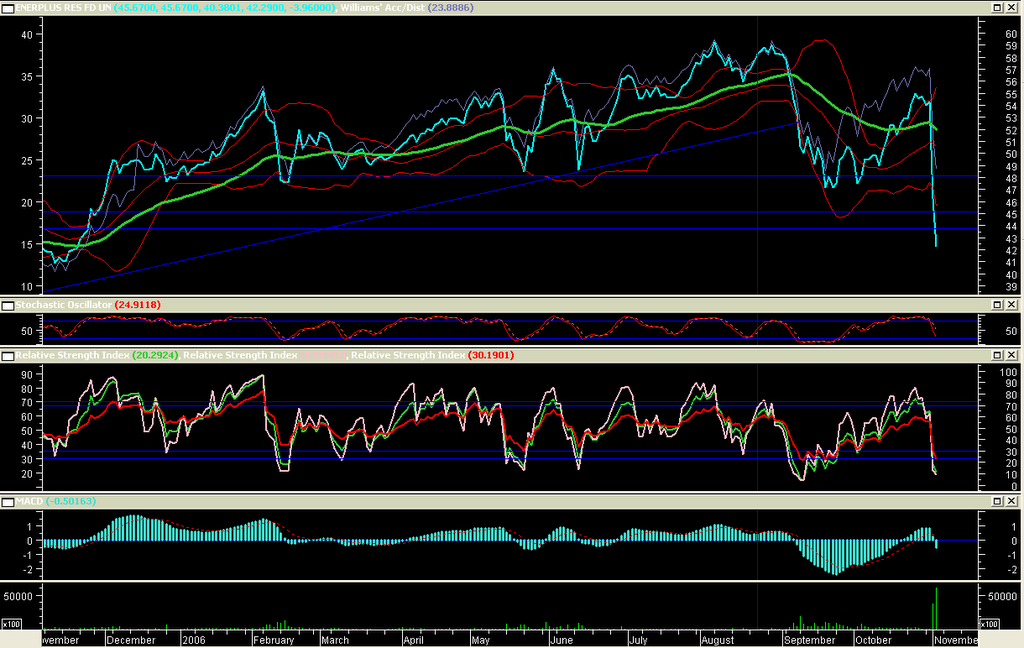 My average cost is $41.87 today. It closed at $42.29. They pay a .42 dividend on 11/08. Here's my thesis.:
Don Coxe (BMO Harris), who is no longer freely available, has been a huge proponent of geopolitically safe oil reserves. The Canadian oil plays fit that bill. I imagine though that any who have loaded the boat on these must be in pure agony now, for these oil trusts have declined 20+% over the news.
Now if my gourd is working correctly (and we are in the right season for gourds), the real risk is the price of oil, which I grant has been under much suspicion of late, and that's a discussion for another day. The price of oil affects earnings (near and far term) regardless of tax implications. And oil has been under pressure. But a 10% dividend rate is nothing to sniff at--and if in the US rates start to decline,--the search for yield will be relentless.
If there is such a thing as due process in Canada, there is a potential upside: the hew and cry may be so great that the politicians may come up with something more palatable for existing trusts while achieving their goal of abating the massive conversions to a trust.
In summary for ERF my investment thesis is
- + dividend of .42/share provides downside protection of same (though the shares may dip post 11/08)
- + greater clarity post exodus by clearer thinking may provide boost in share price
- - oil price decrease will deflate shares as income will be reduced
- +oil price increase will inflate shares..............
- - hew and cry may result in some repeal or softening...think about what that might do (but I don't know the predispositions of the Canadian government, but I think that some mitigation via due process could very well be likely--though complete conjecture, it is a possibility).
I found this article post post....I feel like my thinking is sound.
http://www.marketwatch.com/news/story/story.aspx?guid=%7BA46AED29-0D72-4965-82E9-E4F2CFD1FC57%7D
------------------------
An update on my other theses for IVGN and MIND. IVGN currently has an .82 (1.46%) per share gain over my entry point and MIND has a .04 (.4%) gain over my entry point. Pretty thin margins!
Tuesday, October 31, 2006
Did you know?
Here's a post that from Bill Cara's blog (it's mine, I just posted there first).
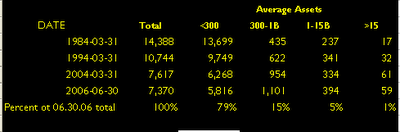
Through some genetic deficiency, I was perusing FRED's (Federal Reserve Bank of St. Louis) website a couple of days ago. I admit that I'm experiencing an unhealthy preoccupation with loan loss reserve trends. They have a wealth of schedules that report on such (in total, by region, by bank size).
Loan loss reserves are at historic low points (and they only show commercial and total losses, no consumer losses insofar as I can see). Anyway, I may just do something really geeky and start tracking these losses by bank size and region. If there is a credit problem as some have suggested, we should see it creeping in these numbers. It will be a bellweather of sorts. We'll see what develops.
One thing I found truly interesting is that from 1984 to 2004 the number of banks in the US fell by 53%. I understood about consolidation (indeed that was one of my investment thesis that paid off in the past), but I've not seen this number. I thought it intriguing. My friends and colleagues can always count on me to pull a "Did you know?" thing out of my pocket. I pulled this one out today. The person I shared it with was kind enough to pretend to find it interesting. Enterprising readers may want to use this in their arsenal should they be in cocktail conversation and find that their erudition is challenged. Keep this handy, it may serve as a needed deflection. Trust me, someone will be impressed that you know this...and surely your banker will be impressed.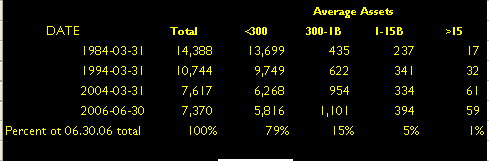
Subscribe to:
Posts (Atom)