Saturday, April 04, 2009

A Long Week

My work schedule has become brutal. I've been MIA in aspects of my life to include my blog.

On April 1, my son turned 18. I'm officially the mom of two adult children. We celebrated by going to Outback. I had two gift certificates. The four of us managed to eat enough to exactly use the the $75 gift card. I gave the waiter a $20 tip. The cards didn't cost anything.

I met my family there. I ordered a margarita. It was not any good. I needed a good drink more than I needed a good meal!

My schedule has taken me away from the daily market moves and news and the like. I still watch charts, but for a fractional amount of time. I'm pulling this chart up because it contains lines that I have not updated in a very long time. I think that being able to spot a topping pattern is one of the singular best things that one can learn in the market. This happens to be a rather beautiful one in its symmetry.

You know my fondness for Chinese stocks. Here's one that I have. It has been a attractive performer. They are a biodiesel producer.

AZC has been a phenomenal performer for me. It is at a point where it might fail. Not trusting the advance, I sold into successive rallies. I'm down to 1/3 position, and it is up 2.5x my purchase price. It house money that I do not want to burn down in a conflagration or renewed fears on the economy.

Sector ETF's: While the sector levered ETF's are an easy way to invest, I'm of the mind that finding decent chart patterns (if one is so inclined, as I am), is a better way to capture some quick moves. I'm still in UYM and UYG, but I did far better with my BAC flip than had I gone into UYM more deeply. Since I'm in chart mode, I'll present these.


That volume is pretty phenomenal is it not? I have a small position. You can see that AZC has powered beyond the ETF. AZC will have about 10% of the US copper reserves once its Rosemont facility is completed. They recently did a private placement with a mining investor @ 1.50 for some shares that included one share of common and one option to buy a share at $2.30. You can read about them here.

My security themed play is NSSC. This chart is not in a great mode in terms of volume. But, I bought some anyway in a couple of tranches.

Do you see that very long line in March? That should be a reminder to you that you do not place market orders for thinly traded stocks.


I'm still 93 %and 73% cash in my tow main accounts. Both accounts are at all time highs. I'm being methodical and selective--that I'm working 12 hours a day helps ensure that I don't jump in and do something stupid.

I think that the greatest gift from sidestepping a bear market is that psychologically, one doesn't feel the need to 'catch up'. And to provide one of my body blows, I present WH. The purple line is my buy point. I still believe that energy is important to the Chinese, and that this provider of tubular steel products will benefit from that drive. That they have cascaded downward along with the balance of the energy services complex is not a surprise given the belt tightening.


No dogs today......just work.

My red buds are blooming. I'm now in the second year of my forest pansie red bud blooming that is the grave marker for Lucy. One of my original blog readers MarkM suggested this red bud. It has done well in its location. My more mature redbud has a radius of pet corpses below it: Greta, Mylo and Chloe. I hope to not be doing any more digging for a while. I may find myself under one of those trees to in the distant future!

Sunday, March 29, 2009

Sunday P.M.

I'm back from a nice visit with an old friend who lives in Maryland. I combined a dog run from Richmond to Springfield. My friend lives in Rockville, so it was just a short drive from there.

We had a large group of dogs. The volunteer who coordinates this effort every single week shared the following video. It is of a dog, now grown, who was adopted out as a pup from the Kinston SPCA--the originating facility for my dog run. It's a reminder of how a loving home can offer an animal the opportunity to be a valued member.

Click here.

My friend, Carol, and I had a very long walk and managed to meet some really cool dogs. One woman had a large male American Bulldog on one hand and a diminutive and extraordinarily cute female French Bulldog. She was barking almost ferociously, but she was a total love bug. Here barking was 'talking'. The AB was a a very affectionate and extraordinarily handsome (and big) fellow who was eager to meet new friends.

It was nice to get away, but I'm very slammed. I've another busy week. This weekend was a nice recipe respite (gosh, it is terrible to get old!).

A reader asks about WH


I'm still holding. This chart is broken....and if it cannot hold above the green line, then another cliff dive is possible.

Monday, March 23, 2009

From Good to Great ---

http://www.stockmarketmentor.com/public/1737.cfm

Dan Fitzpatrick provides a number of free videos through his Stock Market Mentor service. Stock Market Mentor is a paid service, but like most folks, Dan provides entrees into the value of his service through these free videos. I do not subscribe to his paid service, but I eagerly await and enthusiastically watch his videos. I suggest that you do as well, and you can do so with your own adverbs.

What I like so much about DF's series, is that they are straightforward and to the point. And if you want to understand how to manage risk reward on a chart, then his videos will help you. Finding lower risk entry points that are closer to points that will tell you with anvil-on-the-head clarity that you are wrong, provides smaller price space and reduces your losses. If you buy when the space between right and wrong are wide, you'll have to pay up for being wrong.

It's such a simple concept, but very hard to do in practice if patience is not in your investor/trader psychological arsenal. Lack of patience in entering, leaving or staying in a trade can cost you money (to include selling before significant move--I do that frequently). The antidote for impatience is clarity and discipline. Find low risk entry points and clarify what will happen in the chart to prove you wrong. Walk away when the space is wide between being right and wrong, but keep a good watch list.

Your watch list is your reminder of things to look for when the the space between right and wrong narrows. I'm better about my lists, but I'm not great. I want to go from good to great.

Saturday, March 21, 2009

BAC


Here is a 7 year chart on BAC. I found the volume astounding. Most of the volume in this stock is at the current price bar. I don't own this anymore. I took my money and ran. I left money on the table--but that money only stayed on the table for one day.

I also sold one half of my AZC. It had doubled. I exercised discipline and sold. Of course, losing 'house money' is painful too.

I have a date with this little guy today, among others:

Thursday, March 19, 2009

Spring Forward, Fall Back

The simple saying to help the old folks (which now includes me that left her memory and other valuables in some other year) remember which way to set the clocks. It is also appropriate for market rallies--of any sort. It's just that in bear markets, the 'fall back' literally involves one falling out of their chair and cracking his/her head on the concrete floor.

Seems like the Fed's comments cause a barnstorming event. With the kindling being quite dry from a relentlessly downward march in equity prices, only a spark was needed to cause a conflagration of buying. I don't feel compelled to jump all in, and I've had a few seeded positions that are rewarding. I elected to sell my BAC as I had UYG exposure. I took my 62% gain, but had I hung on (famous last words), I would have enjoyed 50% more gain. But, I elected to invoke the discipline in this screwy market of taking substantial gains (particularly over a short period) when I have them.

Enough about me already....let's look at the industrial metals chart

Has it bottomed? I do not know, but we are seeing a recovery in metal prices. This is the chart that I watched and posted infrequently about when there was a mad rush to all of the metals. Those stocks were topping while the industrial metal prices were surreptitiously falling.

Financial stocks should be the first guys out of the block in another bullish phase with commodity prices recovering. We just need to know if the financials are a false tell. Opinions abound; I watch the charts.

Sunday, March 15, 2009

AIG: Wondering out loud

In the news again with bonus payouts. There is something almost laughable about the argument by any of these firms that required intercession from the government because they ran their businesses so badly claiming that the bonuses are a requirement to keep their so-called talent.

In AIG's case, they said that the bonuses were legally binding. A reasonable person has to wonder how the clause surrounding the measurement and payment of bonuses for performance is crafted which would allow performance that led to insolvency and financial chaos in world markets to be compensated with a bonus.

Lastly, one has to wonder that if these wunderkinds routinely negotiate employment contracts that allow for payment of bonuses under such circumstances (not to mention leading the company to experience 'such circumstances') how can the company be considered competent to extricate itself out of this mess?

Here's the English Setter girl, Belle, I transported yesterday:


Saturday, March 14, 2009

Stuff

I'm just back from doing a brief run from RIC to Fredericksburg. I took some pups up and came back with Belle, a beautiful English Setter on her way to her forever home. She reminded me so much of my Lucy! We were early to the meet stop (as they were early arriving in F'burg) so I took her for a walk in the rain. It is cold and miserable, but she was happy as cold be. She's has a long trip, so this break was welcome for her. Dogs don't mind the rain!

I've stimulated the economy a bit this week. Today I bought some wine (Oak Grove 2007 Viognier). It has price point of $7.99. I bought a case. It has a 89 pt rating from Wine Spectator. That's terrific value and quality intersect.

After Total Wine I went to Stein Mart. I needed a bit of sprucing up. I need to revive my Fit By Fifty initiative and spruce up that way. Here is is mid March, and I've done nothing since New Year's. Bad, bad, bad.

Last week, I went to Tuesday Morning and bought some prohibitively expensive sheets. But that are beautiful and sumptuous. I also bought a two coverlets. One made out of bamboo fiber which is very pretty. It's been several months since I have bought a thing. I'll be back in guerrilla economic mode. But it was nice to beautify my bedroom a bit...as well as myself.

I did buy some BAC at $3.73. I'm just going to forget about. I'll be like the Prince on Citigroup many, many years ago. I still have lots of cash, and I'm not in any hurry to get in fully.

Friday, March 13, 2009

Pics from our Snow

I was reflecting a bit yesterday morning on the violence of the weather as cold and warm air collides that marks the transition of winter to spring. The violence of the market is so similar.

We had a beautiful snow on March 1. I did manage to stop long enough and take some pictures. There is a lovely muffled quietness in the snow enveloped woods. Here are a few pics. The dogs are Ella and Macy. I would have snapped a picture of Daisey, but she was busy running all day long in the snow. She had ice on her little tufts of fur and did not stay still long enough to appear in any frames:


Thursday, March 12, 2009

Acapulco Cliff Divers

Well, it is one thing to see them in Acapulco, and it is quite another to see them in you portfolio. Here's my diver, who goes by the name of WH

I don't have a stop loss. Personally, on thinly traded stocks, you can get shaken out easily enough. I'm still long, but I'd be lying if I said that the 34% decline wasn't a wee bit painful.

The chart is also a useful example of how seeming support, once broken and aid a abet a rather sizable downfall. As support was rather easy to see, I'm confident that there were alot of stop losses sitting around it. Accordingly, once obvious support is broken it triggers a cascade of sell orders that result in the picture you see above.

A stop loss order does not help you in these instances. I have found that it's best to watch the chart and be willing to endure a hit if support is broken or sell and re-enter when the stock's action is more constructive.

Saturday, March 07, 2009

Defensive?

Here's a chart (click to make larger) of consumer staples. You'll recognize this chart as media sausage stuffing for recommending that you buy something 'defensive'. At a high of about $30. it is now trading at $19 and change for a 34% loss. So much for being defensive. It's like wandering into the streets loaded with jewelry at the annual Thug Convention Parade and Pillage. Rather than being beat up and left for dead unconscious on the sidewalk, you were defensive and copped a few moves that allowed you to just to crawl away after taking a beating and losing your jewelry. The better choice would have been simply to stay inside in the warmth, comfort and security of your home.

Sunday, March 01, 2009

Conventional Wisdom

I've written in this space about the danger of conventional wisdom with respect to the markets. Conventional wisdom works when things are conventional. Conventional wisdom is likely to get you killed if you are in unconventional times.

I like Martin Goldberg's blog. He has a post about Consumer Staples---the previously presumed to be 'safe harbor' for investors. His post is entitled: Throw away the cookbook.

Saturday, February 28, 2009

Checking In

The Peplexed Investor is now the absentee investor. The DOW totters on a precipice. Two months ago, I would have been watching every tick. Now, consumed ....a digression.

I almost wrote 'subsumed', and it occurred to me that I really did not know the meaning of that word. Naturally, I looked it up. Looking up words that I don't know is something of a habit. And in looking up subsumed, I found colligate. I found colligate in Wicktionary: To formally link or connect together logically.

I've had to do a good bit of colligating of late, so my rapturous contemplation of the Dow's limbo dance with 7,000 has been interrupted by things of a more mundane nature. It's the mundane, though, that matters, for the market is ultimately a reflection of the mundane.

Now that I'm working long hours again, the market seems like a very distant and foreign thing. But that I had the opportunity to become its intimate (seems like I should insert something about not getting screwed to badly), helps me look at passing data---interest rates, commodities, gold and other sector performance and have a reasonably clear sense of it all.

I often abbreviate Jose Ortega y Gasset's name a JOYG. Reading this lovely book, Meditations on Quixote has brought me much JOY.

He who wishes to teach us a truth should place us in a position to discover it ourselves. (p.67)

Monday, February 23, 2009

Rollbacks

It looks like the stock market is channeling the ebullient, sunny-faced Walmart cartoon figure and is rolling back prices with a vengeance. I see that we are back to 1997 levels in the DOW. So much for our perennial bottom callers who were so certain that THE bottom (v. A bottom) was in.

I secretly marvel at the hubris that it takes to make such statements with such certitude--largely in that I have some painfully embarrassing moments in my life where I've been most wrong where I was most certain. It is also one thing to be certain about your opinion of the market when it comes to your own money; however, to express these opinions so that other people's money will become entangled in your arrogantly held views on the market is another thing indeed.

Book club was at my home this past Saturday. It was nice to be with everyone. We discussed the book The Ascent of Money. I do recommend your treating yourself to this book that provides an interesting historical context for today's events. There really isn't anything new under the sun. And our market and credit machinations are just one of a long series of busts. The only question is of what magnitude and duration.

I'm embracing a new book: Meditations on Quixote by Jose Ortega y Gasset. I've mentioned it when I acquired it. The first 36 pages were introduction that I read. I'm 45 pages (9 of the author's) into this slender 165 volume. There is considerable here to grasp. I hope that I'm up to it!

"We should be on guard against rigidity, the traditional livery of hypocrisy."


I find JOyG's writing to be full of phrases, sentences and paragraphs that are quote-worthy--much like his fellow Spanish philosopher, George Santayana.

"Man reaches his full capacity when he acquires complete consciousness of his circumstances. Through them he communicates with the universe". (p.41)

"I am myself plus my circumstance, and if I do not save it, I cannot save myself." (p. 45)


I know that this book has come into my hands at an important juncture in my life and the circumstance of the world---the circumstance of MY life. I think that this man's thoughts will help me build some perspective that will tie in a number of things that have been flopping around in my brain. And as I read what he is writing and reflect on it in a wide-eyed response to it as if I had opened a little blue box with some glittering inside, I realize that there is something of a moral imperative for each of us to acquire complete consciousness of our circumstances. I've never thought about it that way before.

Perhaps it is the wrong approach to take as I slip back into interested reader mode--wrong in that it may bias my understanding by placing a filter between me and his writing. But our filters help us make sense of things. I'll be on guard to ensure that my filter does not subject me to the sin of rigidity that he warns against.

Saturday, February 21, 2009

Book Club Day

My book club comes to my home today. As usual, EPA cleanup duties abound. We are reading Niall Ferguson's, The Ascent of Money.

I thought I would print for them my Spring 2007 series of Hedge Funds and Systemic Risk. I ran across this paragraph, that I thought would bear repeating:

I wanted to provide a bit of a backdrop of hedge funds (HF's). You may not be a qualified investor and may never will be, so HF's funds may never be in your investment horizon. Nevertheless, they are in the same financial arena as you competing for returns. And the whole point of my writing about this is that if they screw up, it can cost you money.

Let's reflect a moment on the basic tenets of the paper.
· HF's have proliferated;
· They have a high attrition rates;
· Risk profiles (due to leverage and investment styles) are unavailable;
· Operations are not transparent; and
· Non-correlated dynamic strategies can correlate into phase locking during periods of market stress.

Welcome back Nice Guy.....the markets are writhing like a worm on a hot sidewalk. I stay mostly on the sidelines with just enough in the market to feel some pain/gain!

Wednesday, February 18, 2009

Another Fleecing Exposed

So the Stanford Financial Companies (to include the ubiquitous Stanford Research that appears in so many of the tickers has having issues a research report) is the very latest to have been exposed as financial charlatans.

No shortage of those. If we were in a more primitive society, they would be ground up as chum and fed to fishes who would then feed the hungry. Now that would be poetic justice. BRKR a holding was up yesterday in the carnage. WH, my Chinese tubular steel maker, did not fare well.

I sure wished I owned more gold! I was looking for a file and found my worksheet on the gold stocks that I did over the Thanksgiving holiday. I still have my CEF which I bought on 11/21/08. I try not to judge past decisions on current information as no one has the clarity of prescience, merely educated guesses PLUS miasmic probability distributions. Oh, those are just dressed up hunches and given the aire of respectability by making it look substantive.

Sort like our financial charlatans.

Saturday, February 14, 2009

Valentine's Day

Valentine's Day offers two opportunities: Opportunity 1 is to get out of the dog house. You can guess Opportunity 2 easily as it is the obverse: getting into the dog house. Hopefully my male readers have availed themselves of all means to embrace Opportunity 1.

Yes, I realize that saying that is a wee-bit on the gender biased side of the scales. There does seem to be more obligations for our men on this day than for women. But in men are the wooers still no matter how far women have come in trampling over some of the evolutionary roots of human courtship.

I had a dog run today. It ended up being a longer day than planned. When I arrived on the lot to get the Ford Freestyle, it was blocked in the back by a pickup truck and trailer. In front it was blocked by a trailer. I managed to pick up the trailer an move it out of the way to pull frontwards. To say that my body still has a vivid memory of that event is an understatement.

But, I accomplished my mission and had 8 puppies (in a large crate), 3 cat crates 3 lab girls sisters and a hound dog. The lab girls were NOT cat friendly, and I had to cover their crates, though they wanted to play tug of war with the sheet. Thankfully they settled down, and we had a quiet drive.

A New Leash on Life: A reader, RW, was most kind to suggest that I find a Chinese supplier. He provided a link. And.....it does look very promising. I'm doing some exploratories with different contacts to see if this looks like something to pursue. A dog's lead is very symbolic of their deep connection with us and us with them. I did a trial pitch to one of my former colleagues who was VP of Sales and Marketing. (I always want to abbreviate that to S&M, but it just never looks right, though I would say that there are likely many shared characteristics with the darker suggestion).

I showed him my leash, and he was amazed that I had made it. I'm not sure that it said so much for the leash as much as it may have said about his surprise at my skills to produce one. Anyway, it was good conversation over a martini!

I asked the bartender how business was. He said weekends were just as busy, but weekday traffic has lessened.

As I write this, my husband has come in (from making a dog 3-board dog fence extension) to tell me that he has not done too well. Apparently he has charged by daughter with procuring a box of chocolates. She, unilaterally, decided that spending $30 on a box of Godiva chocolates was more than I deserved. She did not bother to tell my husband this until it was too late.

Now, my husband's confession is a bit of paradoxical. Here is a man who has spent the better part of his day (and another day) to dig post holes and cut and nail boards to keep our dogs safely contained. This particular extension is to keep Chumbalina (a/k/a Macy and Fat Monkey) from terrorizing the mail person, the UPS man and any of my neighbor's other guests when they have to drive into HIS driveway. That Macy sees it as her duty to do this is unacceptable. As my husband and Tim are such good friends, a considerable amount of thought went into the gate latch.

We want an enclosure to keep our dogs from chasing vehicles that can hurt them. We do not want an enclosure to keep our friends from visiting. I find that value to be enormously more than a box of chocolates. For my own part, I'm grilling lamb chops. Simple dinner of grilled lamb chops, salad and baked potato and good bread. Accompanied by some Greg Norman Shiraz. I'm having a $120 (including tip) restaurant dinner for about $25. And there's not much effort involved. I normally have crab cakes with spicy avocado sauce, but that's more effort than the energy I have available.

I hope that you enjoyed your time with your special someone.

The market?.........ahh....love is more important than money. We'll save that conversation for another day.

Tuesday, February 10, 2009

Bonds v. Equities


Bloomberg provided this informative graphic (nice muted colors too) on equities v. bonds. You can click on the graph to be transported to the original post entitled: ‘Cult of Equity’ Is Under Attack, Citigroup Says: Chart of Day

For so long, we've been told that in all instances stocks outperform bonds, and it has been the rallying cry to invest in equities using bonds to soften some of the volatility in stocks. Are we a awakening, then, to a new day where bonds are now exciting rather than staid and boring? Will equities now languish as unattractive investments due to their 'last in line' status in uncertain times? The fullness of time will answer that.

------------------------------------------------

Ray Dalio is interviewed by Sandra Ward in Barron's.

Recession? No, It's a D-process, and It Will Be Long

By SANDRA WARD

Click on the title and you'll be transported. If you are not a subscriber to Barron's you can e-mail me (leisa-va@cox.net) and I'll be happy to e-mail you the link.

P. S. A reader offered this link to a PDF on Scribd.

Sunday, February 08, 2009

A New Leash on Life

The Perplexed Invetor has morphed into a second-rate, piece rate seamstress. Trust me, I'd starve if I had to make my living this way. But after the equipment failures on our dog rescues, I was determined to find a way to make some high quality leashes by buying the webbing and the clasps wholesale.

I do know how to sew, and I pulled out the trusty Bernina. My prototype did not go well. But in Henry Ford fashion, I managed to improve my productivity with each lead.

It is hard to find discount pet products. I knew last summer I had hit the jackpot at Big Lots, when they had a bunch of beautiful Aspen Pet leads for $1. I bought every one that they had, for I could not even buy the buckle for that. I parceled them out to my volunteer friends and to me. They are all gone but one. Ever since, I've been looking for a deal. There were none to be had.

Over the last few transports, we've had more tethered dogs. Big, strong dogs who pull. We've had 'D' rings break, choke chains break and the clip shank break. It's no fun handling a dog and have an equipment failure. So here I am with a goal : A New Leash on Life.

By spending a small amount of my time (about 10 minutes per lead), I can give a dog a new leason on life. S/he gets a high quality leash that helps him/her as well as supports the volunteer handling/caring for the dog. Leashes of this quality sell for about $12-15. I can save about 75% making them without a big investment of time ( Seems like the best I can do is make these leads for $3 a piece--or about 25% of retail price. ). I'm trying to work out a better deal from the supplier, so I gave him my inspirational story. We'll see what happens.

Wednesday, February 04, 2009

PRGO

This chart has been in my rifle scope. I believed that it was in distribution and had formed a top. I bought some FEB 25 puts at a whopping .25. It was a bit of a flyer, and I even bought some of the stock to pick up some uptick. I had fully funded puts that I just left. Oh, it was not very much mind you....a handful. But I sold them for $2 yesterday. I consider that a dividend. They traded as high as 2.90---but I was busy at work, and looked in after I saw they reported yesterday morning. Good historical numbers but reduced guidance. Huge gap down. I didn't overstay.

Here's an inverse chart for WH--my Chinese tubular steel maker (for oil services). They announced some good news and sold off a bit yesterday on about 1/2 volume of the day before. I remain long in a small position.

I remain very conservatively positioned.....I don't feel that the market has priced in all of the bad news----largely due to the rather serial nature of the bad news, meaning that it is keeps coming with no relief. It appears to me that the market is expecting some good news around the corner.

The healthcare sector has been enjoying a resurgence of interest. If you are looking for areas to find some action, you could look there. Here are a few names that I found with Stock Fetcher--13 day moving average moving above the 34 day moving average on in 2x increase volume in the 5 day v. 10 average volume:

Saturday, January 31, 2009

Another Busy Week

Just prior to leaving for my client yesterday I received an e-mail from the English Setter Rescue. A lovely girl was in the King William pound and today was the "Day". Times up, out or down. She had a foster, but the foster was up in DC and could not take her until Tuesday.

I found myself writing one of those 'use me as a last resort' e-mails. I was extraordinarily busy, and would have to leave early. I don't have a completely fenced in yard, and English Setters are go-go guys and gals. So all I could think about was all of the obstacles to my getting her--particularly when I had to do a rescue the next day (today). Stepping back away from the obstacles, though, I had to reason with myself, that I literally was the singular intervention in this dog's life on that day--and that felt like a duty. Not a burden, but simply a duty. I hit the send button.

My cell phone rang immediately. As it turned out, another volunteer who could not get her, could overnight her. All I had to do was drive. King William is not very far out. It was about a 40 minute drive. I picked up this BIG girl, who was very reticent, but very sweet (as are most ES's). Driving back into town, I was headed west. I was treated to the most beautiful and luminous of sunsets. It felt like a reward for doing good.

We will have a cold day today to do our work. I like doing these rescues in the cooler (if not cold) months. I don't get overheated, and the dogs do not get overheated. You can service the pups and their crates and stick them right in a vehicle without baking them.

The market has gone no where so it seems. I did get a call from a Merrill Lynch person who had been talking to my client about their investment options for the 401(K). He was going on and on about their experience. And then started talking about how they like corporate bonds and muni's. (I'm sure 2 years ago they liked the CDS's). Generally, he was talking about their 'success'. I had a 'moment' and said, "Well, after all you've done so well on your own account." I don't think that he fully understood my meaning.

Permit my being a little jaded in taking investment vehicle advice from someone who had to have a shotgun wedding.

Thursday, January 29, 2009

The Market?

I'm now on day 8 of my consulting project. So far nothing has blown up. I was able to process and get payroll out with nary a glitch. The nice thing about seeing and working with lots of systems, is that you realize that there are only so many different ways to get to the end result. The software interface either makes it an efficient or frustrating experience. And....I learned a long time ago that you do not mess with people's pay. So, I spent the better part of the weekend entering, checking and double checking payroll. It's an environment with producing employees so there is job costing involved for 80% of the employees.

But I've had to sit in an emptied seat and figure it all out for myself for every job that I've ever had (consulting and employee). While it's not a comfortable experience flying an airplane blind, I'm an intrepid pilot--though I would likely never land a plane so smoothly on the Hudson. The trouble is that these positions are pretty isolated and not one other person in the company knows how to do anything that seat does. They all just know what they get from the seat.

Being away from the market, I'm reminded as to what a foreign world the market's daily machinations are to working folk. The respite away from the dips, soars and wiggles has been very refreshing. I still look at charts, mind you, and I'll look at a few after I press the send button.

I had to have my car serviced. I stopped by to visit my salesman--he is a professional salesperson, and if you buy a car from him, he will take care of you. You will find NO auto salesperson more successful than he. My husband and I have bought every Ford car we've owned from him. He's been at the same dealership for years, except for a little tiff he had and left for a very brief interlude to work for a competitor. He said his volume is down 50% and his income is down 70% as they are offering employee discounts to customers to move product.

I heard Dennis Gartman on Gary K night before last. He believes, as does many others, that the market has already bottomed. I'm trying to be agnostic. I've enough long exposure to not feel like I'm missing out on any of the the good moves.

I've been watching the Utilities. I have some FEB XLU 30 calls. Lots of constructive action in several names.

Today I hunt for W-2's.

Sunday, January 25, 2009

Cecil County SPCA

I adopted Daisey from this organization, and I have given them support. I stopped sending any further donations as no one bothered to send me a thank you note. Recently, I was both surprised and disgusted to learn of the many allegations by former shelter workers and volunteers of animal abuse. One of our transport volunteers for my Saturday transport voiced some concerns. Apparently, many have been trying to get their voices heard to get someone to do something. I'll spare you the details. I had to stop reading the affidavit that was forwarded to me after about line 3. The alleged cruelty is unspeakable. Though someone had to speak it to fill out the affidavit. Worse, this person (and others) had to witness it. Worse still, the animals had to experience it.

Hopefully the tenor of the accusations is to the level that something will be done to remove the management of that facilty and return the facility to what it is supposed to be: a shelter.

Friday, January 23, 2009

The Nature of Risk Part Two

Justin Mamis's book, The Nature of Risk, is now on my 'must recommend' list for new investors. I'm not longer a new investor, but I sure learned plenty from it. There is a mosaic of points that he makes about time, price and information risk that is so cogently said, that I've not considered them together in such a way. Consider these points. . .

* At the bottom, there is maximum negative, and no positive, information, but the price risk is minimal. (p 36). . . The price risk--because selling is exhausted--has been taken out of the stock, even though we have total information risk.... At the moment of maximum information risk, the price risk is mininal.
* The more information that becomes available, the greater the price risk because the stock has already risen (p. 42). . . Thus at the point of maximum positive information we also have maximum price risk.
* Time risk is alwasy present for those who are over anxious to bottom-fish.What does eventually turn out to be the bottom eighth--in hindsight--is a high-risk place to buy a stock. (p. 34)

Overheard

I overheard a money manager stating the importance of staying invested so that investors can catch the first meteoric rise off the bottom.....paraphrased......"being in such lifts off the bottom are important to not underperform the benchmark indices."

As individual investors, we are not compared in any mandatory way to any benchmark indices. Any such comparison is done voluntarily--or perhaps under durress by a spouse who wonders about our competency--sometimes with good reason. Assuming a measure of competency which has schooled us into stepping aside lest we get flattened by an avalanche of selling activity, we have a heckuva lot outperformance goodwill accrued as we've sidestepped a wholesale 40%+ haircut on our portfolio. Why, then, should we feel compelled to step into the opaque and turbulent waters of a market uncertain as to if its next move is up or down?

Why are there few money managers willing to say such? Who's to know. But even forgetting about any of that, and I do not believe in benchmark performance against indices. Relative outperformance against an absolute loss of dollars is a hollow victory. John Hussman is astute in pointing out that the best way to compare the performance of one's money manager is over the course of an ENTIRE cycle. Makes sense to me.

Thursday, January 22, 2009

Vulnerable S&P

[This picture scroll illustrates a story of Minamoto Yoshitsune, a military commander at the end of the 12th century, and his follower, Benkei, who were expelled from Kyoto and arrived at Hiraizumi, Oshu Province. This story was very popular by being adapted to dramas and novels] Click pic to be transported to the Rare books of the National Diet Museum.

I've some client work that will keep me away from the markets for some weeks/months. I'm reminded that my skills are best deployed to help others.

The S&P is looking very vulnerable to my eye. It will either hold or break. It is likely not to dawdle long here.

Up or down? Toss a coin.

Tuesday, January 20, 2009

How Low Can They Go?

Sounds like it ought to be a new game show for financial stocks. Here's an ugly picture


Who is left to sell BAC? Or C?


Here's a chart of Industrial Metal Prices.

Have they stabilized a la Napier's suggestion for a bear market to end? I do not know. The $USD action and supply/demand are sort of a jumble. Best to observe as this violence plays out.

Monday, January 19, 2009

I Couldn't Help Myself

I no longer color my hair. Though I must say that it is a bit unsettling when folks say about one's streaks of gray that it looks "striking". It makes me think of Morticia. I'm not contemplating a divorce quite yet. So the agent of change in my life must be this blog.

I found this template and I like it alot. I have to rebuild links and what not. I hope you like the new style.

S&P 500: Then V. Now


In my continuing quest to bring you stuff that no reasonable person would look for on his/her own, I present to you the following table that shows the change in relative market cap among the sectors represented in the S&P 500. You can get this information for yourself here

While an immediate review of the percentages themselves may produce a yawn or two, if you look at the % change over 2008, the change is rather stark.. . .

  • Consumer Staples increase of 22.6%
  • Energy being weighted just higher than Financials
  • Financials DECREASING a whopping 34.6%
  • Healthcare increasing 19.3%
  • Utilities, while still less than 5%, increased 14.1%

I don't pretend to have any special knowledge of stuff, but given the weighting changes, it would seem to me that sector rotation would have lots to do with the behavior of the index when one is looking at comparisons. For example, how much further could financials fall RELATIVE to Consumer Staples? Meaning the new composition may affect onward rate of change relative to economic conditions. Accordingly, there might be some stability now in the index itself as so much of the 'hot money' was in Financials and Energy.

The S&P market cap has fallen 39.3% over the study period.

P. S. If I ever had ANY doubts about Mercury Retrograde, they were all resolved on our last dog transport: car troubles, traffic troubles, dog mix up troubles----not to mention the geese and the plane................

Sunday, January 18, 2009

The Nature of Risk


Google books on line has several out of print books that you can get. You know one of my favorites is Selden's Psychology of the Market. I think I'll go through that again today by the fire.

Anyway, this one came from Gold Bricks of Speculation byJohn Hill, Jr. of the Chicago Board of Trade. (1904). It is helpful to read these long forgotten words to remind ourselves that there is truly nothing new in the world, and people cheating other people is a timeless preoccupation of humankind.

Fraser Publishing has a number of these books for a reasonable price. I recently finished Justin Mamis's The Nature of Risk: Stock Market Survival and the Meaning of Life. It is a delightful book about the market and the rather twisted ways in which our psychology perceives risk. In reading the forward, he mentions Helene Meisler who write TA for Real Money. I wrote her a brief e-mail mentioning how much I enjoyed the book. She said that Mamis was the best mentors that a person could have. He is in his eighties now. How delightful it must be to have your mentor call you out as being a "helper along the way" to his/her own understanding.

As I move along in seeking to diminish the perplexedness out of my own investing, I've found that the less I think, the better I do. I say this, though, having spent a good bit of time in forging my own understanding of stock market stuff--and developing a bit of 'doing without thinking' which is rather firmly rooted in doing a lot of thinking, doing, falling down, getting up and getting kicked in the stomach, arse, and having my ears boxed by the market. It's called building competence.

I have to compare my investor education to the exquisite trade of a blacksmith. With only fire and brawn and a rhythmic pounding of his hammer, he takes unformed metal and makes it into wondrous things of both elegance and utility. I'm pushing for both elegance and utility in my own investor education. The fire is my own desire to understand this 'stuff' and the brawn is simply my dogged tenacity in reading and acquiring the tools to be successful and applying those tools in an environment of uncertainty (risk).

Mamis is a market technician's technician. He believes that the market has its own language and uses technical analysis to listen to what the market is saying. He reminds that the market is designed to fool the most people most of the time. I believe him.

He writes

The value of technical analysis in the stock market is to reduce risk. It is especially helpful in guiding you to believe what otherwise seems unacceptable. By extension, therefore, it is most helpful at identifying significant market turns, both for the market and for individual stocks. . . . Stock charts and the indicators are like doctors' advice: exercise, diet, reduce stress, and so on. They are a means of establishing imperfect but relatively objective ways to understand market risks and market choices. (p.13)


This book reads more like an engaging philosophical treatise that doesn't mention words such as phenomenology! Also, his writing is fluid and engaging, and the book is liberally interspersed with real nuggets of practicable wisdom. I'll likely read it a couple of more times. What is particularly helpful is his discussion about ultimately you have to make a decision to act (buy/sell/hold) within a context of having incomplete (in all of its manifestations) information.

Tuesday, January 13, 2009

Mercury Retrograde Strikes at Home

In classic Mercury retrograde fashion my computer was mightily felled over the last couple of days. I wrote to Cox customer service and they gave me the standard suggestions which I had done. But my broadband was crawling at 512kbs. All things that I rely on my computer for were screwed up. In that process, I wanted to share a few things with you.

  • Norton Utilities: I found and ran Stopzilla--one of those anti-spyware programs. It found Vundo and another virus that Norton was asleep at the wheel with! It has since found some other stuff.
  • Speedtest.net: Here's a great place to test your internet upload/download speed. My neighbor who has been in computer sales, repair etc recommended this site. This is where I was able to measure my pitiful performance. Check it out.
  • Online PC Repair: AFter I pulled off a bunch of stuff, these guys did a PC tuneup/repair that found bunches of other crap that both Stopzilla and Norton did not remove. For a flat fee, they fix this stuff. I got the Family Premium Membership which gives unlimited service for 1 year on up to 3 computers. The cost was $380. My daughter has a laptop, and just doing two tuneups/fixes pays for the service--then you can get whatever you need for another year afterwards. Sure beats unhooking and hauling. These guys worked on the computer (I couldn't use it for a good part of the day). Their service was terrific and more than exceeded my expectations. (I don't get any freebies for mentioning them).
So, if you've NOT given your pc any tender loving care (meaning removing the leper scabs of adware and other crap that has adhered to your computer), you might want to consider doing so in some fashion particularly if you rely on your computer.

Sunday, January 11, 2009

Mercury Retrogrades for 2009


Yes dear readers we are going to dip our toe into the waters of the fantastical other realms, in this case astrology! Whether or not you believe it or not, why not throw some salt over your shoulder and mark the dates below on your calendar for this year? These are the dates that Mercury goes into retrograde. These periods mark a time when stuff ruled by Mercury can go awry.


'SRx' is' retrograde'. 'SD' is 'station direct' where the planet moves from retrograde to forward motion. Here's a nice summary of the effects of a Mercury retrograde:

Mercury retrograde gives rise to personal misunderstandings; flawed, disrupted, or delayed communications, negotiations and trade; glitches and breakdowns with phones, computers, cars, buses, and trains. And all of these problems usually arise because some crucial piece of information, or component, has gone astray or awry.

Rob Tillet (Click here for link to this article)

Tillet also notes:

In general, Mercury rules thinking and perception, processing and disseminating information and all means of communication, commerce, education and transportation. By extension, Mercury rules people who work in these areas, especially people who work with their minds or their wits: writers and orators, commentators and critics, gossips and spin doctors, teachers, travelers, tricksters and thieves.
Because of the 'tricksters' and 'thieves' inclusion above, this retrograde fully embraces the market! Supposedly this is also a time when technical analysis, specifically supports, signals etc fail.

Saturday, January 10, 2009

Books and Candles


Because I am a reader, I'm an easy person to buy gifts for. Gift
certificates to Barnes and Noble or Amazon are generally in my
possession this time of year. Last evening I spent some time choosing
some
  • "Meditations on Quixote"; Jose Ortega y Gasset; Paperback
  • "Trading Without Gambling: Develop a Game Plan for Ultimate Trading Success (Wiley Trading)" Marcel Link; Hardcover
  • "The Ascent of Money: A Financial History of the World"; Niall Ferguson; Hardcover; $17.61
  • "When to Sell: Inside Strategies for Stock-Market Profits (Fraser Publishing Library)";Justin Mamis; Paperback
  • "The Nature of Risk (Fraser Publishing Library) (Contrary Opinion Library)" Justin Mamis; Paperback;
As I'm so suspicious of the market, I don't consider anything an
investment, but rather a trade. My current philosophy is to create
'dividends' through small exposures of capital to what appears to my
eye to be good chart set ups.

I hear on CNBC many money managers coming out with the 'paid-to-wait' theme by encouraging the investment in companies that pay a dividend. I remember when GM had a
.50 quarterly dividend. Had you hung on to that, you'd been paid to
watch your investment evaporate. Same can be said for the bank stocks.
Utilities, another dividen payer, have not faired too well either. The
siren like call for dividends can lead you on the rocks if you are not
careful. It is not a story that I buy, but it makes sense for some. But
the paid to wait is a stupid argument if the stock is under pressure. A
4% yield against a 10% + drop in price is not a trade off that I find
attractive.

I spent a goodly amount of time over the holidays
scouting out stocks. Last week, I had 18 positions (which is quite a
bit for me). Of those 18, 14 were green, 2 which were hedges were red
and 2 were red on their own. The reds were modest. Two stocks below,
I'm particularly proud of: BEST and CNTF--two of my Chinese take out
(meal, not buy out) stocks. I shared those with you when I bought them.

I
should add that BEST is VERY thinly traded. The nice thing about being
a nobody is that unlike BIG money, I can buy stuff like that. I've
shown in green where I bought these stocks. Id bought them because (a)
I liked the chart pattern (basing action, spike in volume); (b) I liked
the fundamentals. That two-fer made it less risky.

To say that the move has been remarkable is an understatement. I
judiciously sold into this rise for CNTF, and currently just have
"house money". Yeah that is another aphorism where you can still piss
money away if you don't have to! When you buy a stock for .89 per
share, and it makes a move such as the above, to NOT lock in partial
profits is just plain foolish. However, I have a long history of
selling way too early.

There is an aphorism that "No one ever went broke by taking profits."
Like most things in life, context matters. And in the context of
buying/selling stocks, if you have 5 losers that you lost 7-10% on, and
1 monster winner that you settled for a 20% profit (when it later went
on to be a 4 bagger), then you just squandered an opportunity to undo
alot of ill on stock picks of lesser genius. (Yes, I understand that it
is not genius but rather managing probabilities!).

One of my goals this year is to find a better way to manage
profits--finding that balance between selling too soon and holding on
too long. The space between those two polarities is where I want to
be. I rarely hold on too long. But I've lost mucho dinero
(opportunity costs) in bailing too soon. And opportunity cost is a
cost--it just doesn't show up on your portfolio statement, but your
mind calculates it in its "you're a dumb ass" bucket. It's the same
place that all of your memories that make you privately blush because
you couldn't believe that you were so stupid to do or say a certain
something that you went ahead and did or said despite knowing better.
It's definitely a place where you don't want your bucket to runneth
over, so limiting what you add to it is of some merit. Naturally
bailing on a stock too soon and not bailing soon enough are all
additive to this bucket.

Now having said all that, you immediately realize why the market and
your participation in it is like being in an insane asylum. Fear of
selling too late or selling too soon could render one paralyzed by self
doubt. You can immediately see, then, my choice of books above.
Knowing when to buy (which I do think that I've mastered pretty well)
and knowing when to sell (I wouldn't be talking about the DA bucket if
I were any good on this!) is the second part of the equation. And of
course, both of those things reside in the context developing a game
plan.

The Ascent of Money is a book club selection. We are resurrecting our
book club, and that will be our next selection. I'll be hosting book
club. I've plenty of time to think of what to fix. Jose Ortega y
Gasset is an old favorite of mine. You'll remember that I found a
couple of his books at the used bookstore in Sylva on our trip to
secure Ella. Meditations on Quixote was his first book. And as I write this, I'm going to put a reading of Don Quioxote on my list of
things to read this year.

And speaking of resurrection....I've pulled out my Candlestick Charting Explained. by Gregory L. Morris. This is after having re-read completely through Martin Pring's Technical Analysis Explained as well as John Murphy's TA book earlier. While I generally use candlestick charts--I cannot say that I've any real focused study on them. So as part of my managing my positions better, I'll be sharpening my chart reading skills on candlesticiks.

Friday, January 09, 2009

Buy and Hold

I'll go to my grave convinced that the buy and hold is a scheme by the financial services industry to dupe (lull) hapless investors into a sense of false security. Ultimately, passive money managers have no real interest in YOU, but a very keen interest in YOUR MONEY. I know that I'm painting with a wide brush here, which is unfair and all of that.

However, when I meet with my friends, and they lament about the market and their lost wealth, it makes me sad. I come from a working class family. My mother and father had to work for everything that they had. My husband and I have had to work for everything that we have. There's no systematic wealth transfer on my or my husband's side of the family. No grandparents able to fund college educations. Many of my friends, even though they are professionals, come from the same working stock.

These losses, then, hurt. I had dinner last evening with a couple of friends. And they were kind enough to ask me about what I thought the market would do. They trust my opinion because I've been right. Unfortunately, as I was the only person in their sphere (I certainly wasn't the only one expressing concerns) , talking about this stuff, I'm sure that they thought I was a bit of a crack pot.

I'm also careful to clarify that just because my opinion was correct on one large matter, I could get other matters totally wrong. But they asked me, "Do you think that the market is done going down, and do you think that it will come back?" I assured them that nobody knew the answer to that question. My opinion, no better than any other's, was that the market was showing improvement, but I believed that it would go down again and that it would be long recovery. I talked about the similarities with Japan. Japan is a useful example of hope gone terribly awry--for more than 20 years.

While many want to pooh-pooh Japan, it is the second largest economy of the world. And when folks point to the Great Depression and the massive bull market that sprang from that ash heap, it was a time when we actually produced something that others wanted. Surely some other wellspring of economic prosperity may spring from the scorched earth. Outside of the government's stimulus plan, I'm not sure that I see it clearly. There's a shadowy glimmer of energy efficiency--and with Russia and Iran sabre rattling and chest beating, quite a bit of money and energy may get behind improving our reliance on petroleum.

It is Armageddon week on The History Channel. So long as your funds can hold out until 2012 when the world is likely to come to an end through the bible coders, the end of the Mayan calendar, the Cardinal Climax and all other confluence of signs: natural, supernatural, supranatural and paranoid.

While my friends felt depressed about the economy and the market, I did state that I thought that the US would weather it better than most places. But I ended that portion of the conversation with the counsel: You do NOT have to expose your assets to the stock market when it is at its riskiest. The retort, "How do you know when to sell?"

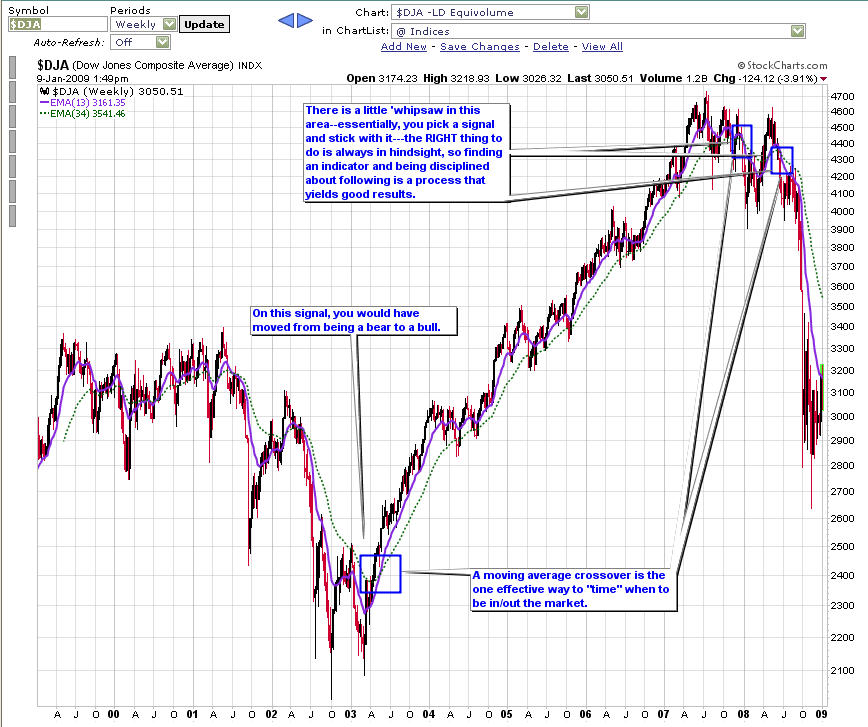
First, I admit that I spend a great deal of time studying the market and improving my investor skills. Second, most folks have neither the time nor the inclination to do that sort of thing. Accordingly, how does one meld the first and second point together? My advice to someone who wants to protect their capital but have appropriate exposure to new uptrends would simply be this: On a month basis, look a total market indicator that has a short term and long term moving average. Buy when the s-t average crosses from below to over the l-t average. Sell when the s-t average crosses from above to over the l-t average. One could use the 50/200 combination. I've been using the 13/34 in my charts.

Without inviting a debate on which is better (my analysis was merely to get the s-t v. l-t relationships together to share with my friend), I created this chart.


Admittedly the period prior to 2002 had much chopping around!But I am making a quick example here rather than providing a be-all methodology to smooth out the rough patches. My point specifically was to demonstrated for my friend was that while you cannot time the market perfectly, you can certainly make entries and exits that expose your portfolio to the gains and protect your capital from the great swooshes down.

Why have your money with a passive money manager who collects a fee and only puts you in in passive investments? Where's the value if in a down market you are going to lose right along with indexes? Personally, I don't see any value to that and in fact, it seems to me to be pretty darned expensive.

Wednesday, January 07, 2009

Learning from the Great Ones

Wang Jin

I had a couple of books arrive yesterday. One of them is a regrettable choice: Learning Learning from Data: Concepts, Theory, and Methods from Data: Concepts, Theory, and Methods, Cherkassky, Mulier. The idea of the book is for people who must understand the principles and methods for learning dependencies from data. If I get through this book, I might as well read Krugman's series. It is a dense volume.

The other book was a slim and easily read volume, Lessons from the Great Traders, John Boik. He has a website and a tab for "Monster Stocks, the name of his most recent book. There's some names posted that you might find interesting.

It is always refreshing to read about successful investors. It was affirming to read that each of the investors that Boik profiles (Darvas, Livermore, Baruch, O'Neil) each went through a learning process that involved skinned up knees and kick or two in the stomach and ass. Nevertheless, they learned from their mistakes and ultimately prevailed.

As Boik notes, there is nothing easy about making money in the stock market. There is certainly the perception that choosing winning stocks is easy--and that is ultimately the allure. I think that Stan Weinstein said it best: That the market's objective is to take the money out of the pockets of many and put it in the pockets of a few. There's also a perception that when you buy a stock in a raging bull market, your performance is directly linked to your genius. It's not easy and everyone looks like a genius in a bull market.

You may also find some well done articles at Market Masters. Lots of good stuff at that website. I go back and re-read the profiles, again for knowledge and inspiration. I particularly like the article on Richard Donchian (maybe because of his Armenian heritage!). But there are some timeless investment/trading rules here that you may wish to print out and post handy to your workspace.

As I think about my own bumpy process as an investor, I realize that my embrace of these books was through shared experience: I made all the mistakes that they made. Accordingly, reading about these very successful investors doing the same assuaged a bit of the shame and embarrassment of having committed those same errors.

Overconfidence, not knowing what you do not know, lack of discipline all conspire against one's investment success.

Sunday, January 04, 2009

Napier's, Anatomy of the Bear: Lessons from Wall Street's Four Great Bottoms

I was researching Tobin's q-factor, which led me to Russell Napier's excellent book. I wanted to capture a few salient points (there are many) in Russell Napier's, Anatomy of The Bear. You can also listen to Jim Puplava's interview with Napier here. ( Jim has many terrific guests on. Great interviews you can listen to while you are cleaning your desk off and paying bills.) Napier says it best:

By watching the financial bears, we can observe the point at which a number of potential factors come together to signal the market can only get better. Those factors include low valuations, improved earnings, improving liquidity, falling bond yields, and changes in how the market is perceived by those who play it. (p. 3)


Napier chose four bear markets (month equates to the bottom):
  • August 1921
  • July 1932
  • June 1949
  • August 1982
His choice was based on a singular criteria of the q-ratio, or the ratio of the stock price to the replacement value in assets, falling at or below 30%. It's worth noting that the article that grabbed my interest happened to be one that stated that the market had to fall another 50% for THIS bear market to equate to those. So the jury is still out as to whether or not that is the case. However, I wonder how that factor would equate to the Japanese stock market?

His book is essentially a field guide to the 'signs' of a bear market's bottoming process. Accordingly, if you have an interest in reading about the confluence of 'stuff' surrounding bear markets, I'd recommend your reading this book and plowing through it. While I enjoyed the book, but there are places where the writing could have been clearer and the data presented a bit more clearly. Nevertheless, there is much factual data that will give an investor some armament against the foolishness spouted by pundits.

Napier notes some key items to look for--I highlighted the first two because they were evident at each of the bear markets he studies--he particularly notes copper prices as the commodity to watch:

    • improving demand at lower prices for selected goods, particularly autos
    • commodity price stabilization
    • improving economci news being ignored by the market
    • rising volumes on a strong stock market
    • falling volumes on a weak stock market
    • a rising short interest
    • a final fall in equity prices on low volumes
    • reductions in Fed controlled interest rates
    • A rally in the government bond market
    • a rally in the corporate bond market
    • positive signals from the Dow Theory
    p.74


    Russell smartly reminds us that all bear markets are different. I'm also going to state that what we are undergoing is a trans-generational move which effectively emasculates any's posturing of "In my 30 years in the market". I'm hearing much of that, and I'm going to say emphatically that in a trans-generations move, 30 years is an inside of that and therefore irrelevant. That's not to say that the market may just go the way that those pundits suggest--UP. BUT, my point is that 30 years v. a trans-generational move (should we be having one)doesn't quite cut the mustard.

    What I found most helpful was Napier's discussion of the interplay of government bond prices, corporate bond prices and the equity markets. While he did not provide a table, I will do so for you.


    Now, let's take a look as to when government bond prices bottom.


    Based on MY reading of the data table (Is that not a monstrous head and shoulders that can NEVER go below the neckline!), it appears to me that interest rates bottomed here: 2007-08-09 5.41. Accordingly, I'm going to call that date, the bottom in government bond prices (I've no idea if I'm using the right data). However, there is some credibility to that date as it was just a week before the FIRST systemic risk crisis in the money markets. I'm going to use the Dow Jones Composite Average rather than the DJIA. It's worth noting that the market TOPPED about 1 month ahead of the government bond market bottoming. Please click on these images to prevent blindness.

    To be true to Napier's use of the Dow Industrials, I provide that chart here:

    (I am lazily not bothering with corporate bonds.)

    Am I concluding that this is indeed the bottom? Truly, I do not know, but the exercise seemed a fair to conduct. Looking at the weekly volume patterns in both charts certainly lends some credence that we had a high volume sell off in Sept culminating in November of 2008. I'd also hazard a guess that given the great hedge fund unwind, we are UNLIKELY to see a re-visitation of these volume levels. However, we should expect to see some improvement over the weekly volumes. It does NOT appear to me that we've had a low volume sell off.

    I've flagged a number of interesting things in Napier's book which I'll share here in no particularly order. IN addition to chronicling what was happening in the monetary and interest markets, Napier chronicled WSJ commentary in the 2-3 months on either shoulder of the bear market bottom. My point in sharing a few of these things with you is that what his researched uncovered is at odds with some of the conventional wisdom. I'm including my summary of his points and the page number on which the thought is expressed. Any direct quotations of text will be within quotation marks. My own thoughts/questions will be in brackets.

    • Extreme undervaluation in the market: I partly produced by a final downdraft in prices. The second contributor is the failure of stock prices to keep up with economic and earnings growth. (p 37) [I do not see that we have the second contributor yet. It's also worth noting that there can be large gaps (2 decades in 1899-1921) of GDP growth without a commensurate increase in the earnings of companies--Napier notes a 130% increase in earnings v a 738% increase in GDP in 1881-1921 period. ]
    • Napier calls into question the aphorism "buy when the news is bad". "The Wall Street Journal in the summer of 1921 was teeming with news and well-informed opinion that the economic contraction and with it the bear market in stocks was ending." (p.44). Specifically he opines that ". . . waiting for an absence of good news before buying stocks would not have been wise."
    • Price stability is at the core of factors signaling the end of a bear market. Napier specifically notes that "the most accurate forecasts of the end of the bear market came from those who focused on the change in the trend in prices." He also notes specifically auto sales (demand response to lower prices) and copper prices. [I'll add that my focusing on the decline in the industrial metal prices helped me conclude that the good times were over. Industrial metal prices are starting to now recover. I watch Stock charts $GYX, which currently shows some recover. How long it will last will unfold in the fullness of time).
    • A final bottom is generally made on low volume (in contrast to the popular adage). (p 68). [This observation lines up well with Selden's comment that the market generally rises from a period of dullness--market tops are violent; market bottoms are dull. Could we then be seeing JUST a year long workout of a top with more to follow? 'More to follow' would certainly fit with some of the direr predictions (e.g. L. Yamada's 400-600 S&P).
    • In 1932, the Fed started a wholesale purchase of treasuries (as they are doing now) and that scared foreign investors thinking that the dollar would be devalued against other currencies, thus they wanted to liquidate their dollar reserves. [I believe that the moves of other currencies against the USD is one of the most important things for us to watch. We are not a producer nation any more--we are a service based economy. The countries that produce stuff (everyone BUT the US) will want their currencies cheap relative to ours. So perhaps we will not see a dumping of Treasuries as many fortell.]
    • Napier notes that the move from overvaluation to undervaluation can take well over a decade--and that the 1932 bear market was the exception, not the rule. (p. 116)
    • Napier notes " There is often ample good and improving economic news at the bottom of the market. This all suggest the risk to investors at these extreme times may not be as great as often assumed. An investor need not buy equities based on his forecast that the economy will start to improve in six-to-bnine months. At the great bear market bottoms there is likely to be growing evidence the economy is already on the mend." (p. 264)
None of the above is meant to be a comprehensive review of the book, but rather some points of interest to get your noggin thinking. I think that this book would be an important part of your investor education, and I hope that you will consider buying it.


Thursday, January 01, 2009

DJ Sector Performance


The above table is the DJ Sector overview for the last 5 years. I've included the last month and the last week to show the relationship of the last week performance to the last month. Not sure if it means all of that much, but I wanted to view it.

Happy New Year

May we live the New Year with a heart filled with gratitude and love. Not an easy thing to do but certainly worthwhile pursuing.

I see my last post was December 23. I really did not have much to say! Whatever the market lacked in zip for most of the holiday week it made up for yesterday.

We had a handful of people over for dinner last evening. A smaller scale than I've done in the past both in guests and fare. Past NY's dinners have been a bit overtaxing on both my energy and my pocketbook. I didn't want to spend $400-500 entertaining (as I had already done another grand scale dinner earlier in the year); however, I still wanted to do something nice. Rather than an expensive piece of beef, I fixed duck leg quarters. I served them with caramelized onions and spinach and butternut squash ravioli with shallots/bacon/cream. Our dessert was a simple, but delicious lemon tart. I had nice wine. We had crab stuffed eggs and smoked salmon.

The dinner came together well, and there was no compromise on the 'wow' factor. The smaller scale allowed me to enjoy my guests. I've been guilty of very elaborate meals in the past, that frankly left me exhausted. Graham Kerr remarked in one of his books that one should never have more than eight for dinner. I've had 10 and 12 in the past, and it really is too much. You wouldn't think that two people make all that much of a difference, but when you think about pan and serving sizes (desserts, entrees, wine), not to mention the seating, it really does. One hates to chop the guest list, but I did this year.

I'll spend a little time over the next few days reflecting on this past year. Because I've had my resolutions close at hand (by my computer), I was pretty successful in keeping most of them. A few were just on the radar and did not get within firing range. Oh well. I'm most happy with my fitness goals being reached, though I've fallen off the wagon in these last few weeks. I'll do my resolutions on a "mind map" format again. I really found that helpful.

I've also kept Miyamot Musahi's Nine rules close by. Here are my favorites: I also have Musashi's 9 things even closer...my favorites. . . .
  • Learn to see everything accurately;
  • Become aware of what is not obvious;
  • Be careful even in small matters;
  • Do not do anything useless.

With respect to the market: I did better than most hedge fund and money managers. My retirement accounts are higher yesterday than they were at the beginning of the year. I could have managed a few positions MUCH better and been significantly higher--the biggest fish that got away were my DIA SEP 125 puts AND my DUG $35 calls. I've a tear in my eye thinking of all the money that I left on the table--5 figures in both. Oh well.

I started out the year with the Lucky 13 that was given as a stragegy


You would have lost 29% of your investment. I guess that was better than the 34% that the S&P was down, but still..... I know that we will continue to hear about the worst being over; the stock market recovers before the economy; etc..... As I've come to learn, sometimes the hard way, the market is an odd mix fact and fantasy, with the fantasy being largely attributed to the emotions and lore (such as the Lucky 13, Dogs of the Dow, Best Buying Days, etc) surrounding the market.

The simple fact is this: If you lose 30% of your capital, you will have to make 43% on your entire investment to become whole again before any accretion. There's alot of compounding that nobody talks about much in avoiding losses. If the amount of time spent yapping about "long term horizon" were spent on preserving capital, individual investors would be much better off--they wouldn't need a long term horizon to make up for substantial losses suffered. Unfortunately, investors are admonished that market timing doesn't work.

Let's just call it something else: asset allocation. That's what the other money managers call it, right? "WE are not market timers; we are asset allocators." Asset allocation is all about managing risk and reward. Managing risk and reward is also relevant to particular positions. Where I've MISSED substantial gains is by not properly evaluating the risk/reward on some very favorable positions. In the same breath, but certainly not meant to minimize the mistake, I've also avoided most of the risks that exposed others to outsize losses. My goal this year is to do a better job of managing risk reward.